

building @muni_bio AI ∩ bio | in vitro to in silico, always an experimenter
SF
Joined August 2024
- Tweets183
- Following572
- Followers649
- Likes5.3K




Pinned Tweet
Binding is nice, but it’s getting boring. If you’re not thinking about biological function, you’re ngmi.
At our last @muni_bio hackathon co-hosted with @onepot_ai, we set one ambitious goal: neutralize the latest threat of Ebola using small molecules.
The wet lab data is in, and we’re excited to announce that teams were successful, including our agent that repurposed... an anti-itch gel?
muni.bio/research/hits-from-…

Kat retweeted

coolest email i have gotten since starting at @OpenRouter:
"the compute you sponsored helped identify hits against Bundibugyo ebolavirus in our assays"
you check out what @katyenko and her team were able to accomplish here: nitter.cf/katyenko/status/211622…

Binding is nice, but it’s getting boring. If you’re not thinking about biological function, you’re ngmi.
At our last @muni_bio hackathon co-hosted with @onepot_ai, we set one ambitious goal: neutralize the latest threat of Ebola using small molecules.
The wet lab data is in, and we’re excited to announce that teams were successful, including our agent that repurposed... an anti-itch gel?
muni.bio/research/hits-from-…
Kat retweeted

Great to see teams using the Boltz API at the Ebolathon successfully designing novel molecules! 140 molecules tested, 11 selective hits in Ebola pseudovirus assays. Exciting to see hackathon ideas turn into experimental results! 🧪 muni.bio/research/hits-from-…

Kat retweeted

The factorioization of biology is happening.
Expect faster/cheaper experimental validation and more novel drugs developed at a fraction of todays cost.
My sense is that many people inside the drug development industry are further behind in understanding what's becoming possible than those on the outside looking in. Which leads to an interesting arbitrage, bound purely by ambition.
Teams that embrace agentic workflows will soon look like an entirely different species of biotech, one that the old guard will struggle to comprehend.
Some will interpret this negatively as the removal of human creativity from biological research, my view is opposite. I think this gives people with deep biological insight far more leverage. Freeing them from the tedious, repetitive work that consumes most of their context.
Exciting times.
Binding is nice, but it’s getting boring. If you’re not thinking about biological function, you’re ngmi.
At our last @muni_bio hackathon co-hosted with @onepot_ai, we set one ambitious goal: neutralize the latest threat of Ebola using small molecules.
The wet lab data is in, and we’re excited to announce that teams were successful, including our agent that repurposed... an anti-itch gel?
muni.bio/research/hits-from-…
Kat retweeted

In July, @muni_bio and @onepot_ai co-hosted Ebolathon to find small molecules that could block Bundibugyo ebolavirus from entering cells without harming the cells themselves.
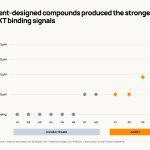
Teams designed 140 molecules in just one Saturday in San Francisco. All were synthesized in 11 lab days, followed by 22 lab days of testing. The results are in: 26 of the 140 molecules were preliminary hits—an 18.6% hit rate.
In part, powered by Modal.
Binding is nice, but it’s getting boring. If you’re not thinking about biological function, you’re ngmi.
At our last @muni_bio hackathon co-hosted with @onepot_ai, we set one ambitious goal: neutralize the latest threat of Ebola using small molecules.
The wet lab data is in, and we’re excited to announce that teams were successful, including our agent that repurposed... an anti-itch gel?
muni.bio/research/hits-from-…
The next drug discovery team will be a few scientists, a team of agents, and a network of CROs. This is the world we’re building with muni (muni.bio/dispatch).
As models more accurately predict binders, the question becomes, “does this binder actually do what we want?”
Cost and speed of function, ADME, PK and tox assays will set the pace of discovery. We’re betting that early and iterative work will go to CROs that are fast, rigorous, and transparent, and ready to work with agents. A solo drug hunter should be able to run a program without building an entire lab. h/t @Prof_Oak_ for leading the charge.

1
10
299
A huge thank you to @PostHog for hosting us, and to @RowanSci, @boltz_bio, @modal, @OpenRouter, and @anyscalecompute for the computational resources and support throughout. Also, @derekalia, @daniil_boiko, @andrei_tyrin, & @CorinWagen for making this happen.
And to everyone who spent their Saturday designing molecules with us. Getting to share the lab results is the best part :)
Mission complete: nitter.cf/katyenko/status/206763…
EBOLATHON - the ultimate rapid-response challenge against viral threats.
8 hours to generate and submit compounds to test against Bundibugyo Ebola strain with wet-lab validation.
Join us in SF on July 18th: luma.com/2rbgfn69
Hosted by @muni_bio & @onepot_ai
10
271


expect more of this

In January 2025 my mom’s lung cancer spread to her brain. The drug with the best chance of helping her was approved in China but not here.
A doctor told me, almost as an aside, that if she were Chinese she could buy it at a pharmacy.
So I flew to Shanghai and came home with 26 boxes in my luggage. That was 19 months ago. My mom is still here, still working, and in her words has had an amazing three years.
The drug was approved in China in 2023. The FDA approved it in July 2025. It still is not for sale here. I know of at least 30 Americans who have made the same trip.
I have been scared to tell this story because I worried it could cost my mom access to the medicine keeping her alive. But the problem matters more than my silence. These drugs need to be developed and available here, and that means FDA reform.
Art Allen at KFF Health News told our story this week. It also ran in The Washington Post.
kffhealthnews.org/health-ind…

4
423
Kat retweeted

Force fields and folding models finally merging, nice


Kat retweeted

We're launching 30B-scale virtual screening at Rowan today in partnership with @onepot_ai.
By combining Rowan's high-throughput computational infrastructure with onepot's autonomous lab, we can go from target to experimental data in weeks, not months.

Kat retweeted

Excited to introduce @ReactorfieldAI Cohort 1:
@merge - brain-computer interfaces with no implants, $250M seed led by OpenAI and Bain
@episteme - a new R&D institution, cofounded by Louis Andre and Sam Altman
@RetroBio_ - unicorn longevity startup, adding 10 healthy years to human life. In phase 1 trials
@NorthwellHealth - NY's largest healthcare system, with Chief Biotech Officer @itchdoctor
@StrandTx - programmable mRNA medicines out of MIT, lead cancer drug already in patients
@MayoClinic - turning leading clinical science into new ventures represented by @vera_mucaj
@xiliotx - publicly traded biotech making cancer therapies to activate inside tumors
@marathonfusion - producing the world's most valuable isotopes from compact fusion reactors
@KopraBio - viruses that turn cancer cells into factories for their own destruction
@radifymetals - hydrogen-plasma reactors that turn rare-earth oxides directly into metal
@FoundationManf - rapid domestic CNC machining for frontier hardware
@MassMagnetics - US-made high-performance magnets from recycled rare earths
@algabiosciences - turning cattle methane into calories, peer-reviewed cuts of up to 63%
@lumehealth - building a wearable that measures cortisol continuously from sweat
@liu_liu_lemon - smart materials for med tech and robotics, @Harvard PhD, Fulbright Fellow


AI transformed coding, science is next
@ReactorfieldAI makes scientists and deep tech startups AI-native
Built by me and @berkbuilds to accelerate science with frontier AI
Kat retweeted

ʙɪɴᴅᴄʀᴀꜰᴛ2 is out, and we're not waiting for the paper. The full code drops today, free for academic and industry use.
We're releasing it early so you can start designing right now, and bring its full power to the current Adaptyv competition.
github.com/PacesaLab/BindCra…
Kat retweeted

Also the technology to even measure most of it at a reasonable scale doesn't exist yet.

Kat retweeted

Every experiment should inform the next. @katyenko and @derekalia are building @muni_bio: a platform for agents to design hundreds of drug candidates, run wet-lab validation, and use that knowledge for future discoveries.
Kat and Derek are joining Reactorfield to show our scientists how to connect autoresearch with real-world experiments.


