

co-founder & president @LatchBio, intelligence infrastructure for biology
San Francisco, CA
Joined January 2020
- Tweets356
- Following569
- Followers710
- Likes3.7K







Kyle Giffin retweeted

Our Antibody Discovery Benchmark asked whether agents could make the decisions that produce a promising candidate. Now we’re following what happens on the way to its first human dose.
We introduce TxBench–Antibody Development, a verifiable benchmark of 60 evaluations across seven stages of therapeutic antibody development.
Choosing a molecule opens another set of scientific questions. Can it be manufactured and stored reliably? Did a process change alter its properties? How should animal exposure, immune responses and safety findings inform the decision to enter humans?
Some concrete examples:
- A manufacturing change may affect the drug’s quality even when its sequence stays the same.
- Low antibody exposure in an animal may reflect a dosing artifact rather than rapid clearance.
- Choosing a first human dose requires reconciling pharmacology and safety evidence across experimental systems.
Agents received records from real development programs, drawn from public patents, regulatory reviews, published studies and trial records. Each evaluation asks for a decision and its quantitative justification, graded against a fixed answer key.
Across 34 model–harness configurations, Grok 4.7 with Grok Build led at 39.4%, followed by Opus 5 with Claude Code at 37.2% and Sonnet 5.5 with Pi at 36.7%. Averaged across configurations, toxicology and first-dose decisions each passed only about 13% of the time.
We also connected five stages into one development program, asking agents to carry four candidate antibodies through successive decisions while building on their earlier answers. Only Opus 5.5 completed the full sequence, in one of five runs.
Development makes the dependencies between scientific decisions explicit. An interpretation of an animal study can change which candidate advances and the dose proposed for humans. We’re extending our benchmarks along that path, toward the increasingly consequential decisions required to turn a promising molecule into a medicine.
Manuscript: latch.bio/txbench-ab-dev
Leaderboard: benchmarks.bio/txbench-abdev
Blog: blog.latch.bio/p/txbenchanti…

Kyle Giffin retweeted
Stoked to be SemiAnalysis’s exclusive biology partner for GDPx. Very early days for AI in biology.
Recommend digging into the trajectories: gdpx.semianalysis.com/domain…
Read more about our contributions: gdpx.semianalysis.com/domain…
Exceptional folks working on this project @arjunomics @maxkan @AndrewMegalaa


Kyle Giffin retweeted

Incredibly excited that Latch was part of this (awesome work from @arjunomics ). Incredibly exciting too to see how biology has become one of the most talked about applications of LLMs.
While it's clear that LLMs are improving very quickly, work like GDPx makes it clear that their knowledge and practice of it are very spiky. Not only that, but as LLM capabilities in biology improve we still need better tools and benchmarks for safe deployment. Some of the tasks included in GDPx originated from biosecurity work at Latch.
Latch is hiring extremely aggressively across science, engineering, and ops roles. If you're interested in being part of more initiatives like this one, check out jobs.ashbyhq.com/LatchBio
Kyle Giffin retweeted
In science, model capabilities have no obvious ceiling. Economic utility can keep increasing as impact jumps from improvements in constituent steps of research programs to outcomes legible to consumers: cures and enhancements.
Single evaluations might take months, millions of dollars and large teams of the world’s best talent. Benchmarking is one of the few durable components of the AI x science ecosystem, requiring compounding technical knowledge and human creativity.
As these markets are being built with unknown growth potential, it’s important to use your imagination.
Kyle Giffin retweeted

Our multi-omics exercise paper is out in Cell!
We all know exercise is good for us. But what actually happens at the molecular level when we exercise regularly?
In this study, we set out to understand this by analyzing bulk RNA-seq data from 22 mouse tissues after 8 weeks of voluntary exercise. We also generated single-nucleus RNA-seq, single-nucleus genome-wide DNA methylation, proteomics, and metabolomics data to investigate tissue-, sex-, and time-of-day-dependent responses.
Some interesting findings:
1. We observed widespread molecular changes across multiple organs, with responses varying by tissue, sex, and time of day.
2. By profiling ~36,000 single-nucleus methylomes alongside ~268,000 single-nucleus transcriptomes, we identified cell-type-specific DNA methylation changes associated with muscle adaptation that bulk measurements cannot resolve.
3. We found that males and females respond differently to exercise, with distinct transcriptional and DNA methylation signatures.
4. We identified a 51-gene signature that distinguishes exercise-trained from sedentary states across independent datasets, including human and rodent studies.
5. We identified 180 differentially expressed transcription factors and 4,633 predicted target genes, revealing cell-type-specific regulatory networks associated with muscle adaptation to exercise.
Beyond these findings, we've made the datasets available as a resource for the research community to explore the molecular mechanisms of exercise.
It was a fantastic collaborative effort across multiple labs and disciplines. Thanks to everyone involved in making this work possible!
Paper: doi.org/10.1016/j.cell.2026.…
#MultiOmics #Exercise #Epigenetics #SingleCell

Kyle Giffin retweeted

Lux family co @LatchBio launched OncologyBench...
AI x Cancer...

We introduce OncologyBench, a verifiable benchmark of 25 multistep oncology evaluations that tests the ability of multi-agent systems to produce clinically relevant decisions in cancer.
25 evaluations, built on 92 component tasks, span six stages of an oncology journey:
(1) Translational and basic research
(2) Risk and detection
(3) Diagnosis and tumor characterization
(4) Treatment
(5) Response and resistance
(6) Outcome
Evaluations draw on published datasets, case studies, public databases, and patient data graciously donated to Latch for the express purpose of benchmarking.
Clinical and translational decisions in oncology are rarely made by one person working from one dataset. They are built on several analyses, each carried out by a specialist on a given data type, whose reports are then weighed by someone who does not typically repeat the underlying work.
OncologyBench is built to benchmark agents working in that setting. Agents received experimental data and worked without internet access. The strongest of the 31 model-harness combinations we tested were Claude Opus 5, Opus 5.5 and Sonnet 5.5, passing 29 to 40% of attempts, followed by Kimi K3 at 24%.
We found that the models with the strong interpretation and analysis skills still showed weakness in reasoning. Two-thirds of the attempts that got every analysis right still failed the final decision. In a separate experiment we found decision and answer quality varied depending on the persona of the question asker.
An example evaluation:
A 76-year-old woman has undergone resection of stage II mucinous cecal cancer. The evaluation asks whether she should receive adjuvant chemotherapy.
Five specialist agents analyze her tumor mutations, pharmacogenomics, gene expression, T-cell infiltration and clinical record. A decision agent receives their reports without access to the underlying data.
The tumor is MSI-high, which predicts no benefit from 5-FU monotherapy. CDX2 loss and low T-cell infiltration do not establish that chemotherapy would improve her outcome. DPYD*2A is detected in 6 of 58 tumor-sequencing reads, but these data neither confirm nor exclude an inherited variant associated with severe 5-FU toxicity. BRAF V600E and MLH1 silencing support a sporadic origin.
The expected recommendation is observation, with missing pathology requested and germline DPYD testing before any future 5-FU.
---
Incredible work from researchers + former biotech founders at Latch. Gratitude to the patients that donated their data. More to come.
Kyle Giffin retweeted
We introduce MetagenomicsBench, a benchmark for testing whether AI agents can analyze microbial communities and make scientific decisions from experimental data.
100 evaluations span five domains:
(1) community structure
(2) host-microbiome associations
(3) microbial function
(4) longitudinal dynamics
(5) microbiome interventions
Tasks draw on published datasets from human, animal, and environmental microbiomes.
Metagenomic analysis requires interpreting microbial abundance alongside functional potential, host biology, and experimental design. Sequencing depth, taxonomic resolution, and confounding all affect observed results.
Some concrete examples:
- A higher abundance of antibiotic-resistance genes may reflect a change in community composition rather than a greater burden of acquired resistance.
- A decline in one annotated butyrate pathway may not imply a loss of overall butyrate-synthesis capacity.
- An association between bacterial abundance and reduced host-cell proliferation may reflect tissue context rather than a direct microbial effect.
Agents received experimental data and worked without internet access. Across 34 model–harness configurations, Claude Sonnet 5.5 achieved the highest mean pass rate at 60.0% with both Claude Code and Pi, followed by Claude Opus 5 with Pi at 54.0%. GPT-6 Astra with OpenAI Codex was the highest-scoring non-Anthropic configuration at 49.7%.
Performance also varied by scientific question. Host-microbiome associations were generally harder for the Opus and GPT families, while longitudinal dynamics and microbial function had higher pass rates across model families.
Across judged failures, 47.1% involved unverified assumptions about task interpretation, thresholds, or metadata. Agents often produced plausible analyses while making choices that changed correct end biological conclusions.
Manuscript: latch.bio/metagenomicsbench
GH: github.com/latchbio/metageno…
Blog: blog.latch.bio/p/metagenomic…

Kyle Giffin retweeted

Hiring a *Design Engineer* to help build products for AI × Biology.
Our mission is to advance humanity’s ability to engineer biology. We approach this by understanding and improving AI’s application to biology use cases such as therapeutics and biosecurity. We are a group of engineers, scientists, designers (me), and operations specialists driven by improving capabilities and interpretability. Some of our work is showcased on benchmarks.bio.
You will design and build interfaces for complex workflows across model benchmarking, AI agents, and biological research. Your work will span product design, frontend engineering, data visualization, and developer and user experience, alongside our website and marketing presence. You’ll take ideas from early exploration through polished implementation, working closely with engineers and scientists to make powerful tools intuitive and useful.
Hosting six talks in San Diego next weds on research in bio & chemistry. The Whaling Bar, 6-9pm.
1. @SuralR (CEO, Serafin Labs): using computer vision on metastatic cancer organoids to inform drug design
2. @yuqirose (Professor, UCSD Engineering): guiding generative models with molecular dynamics & chemistry to design compounds with desired properties
3. @h_manoj (Bioinformatics, Exact Sciences): generating epigenetic data across blood & skeletal muscle to derive predictive biomarkers
4. @EmilyManoogian (Clinical Researcher, Salk Institute): AI integration of wearables, glucose monitors, and metabolic tests to model circadian disruption
5. @chazbot2 (Ward Lab, Scripps Research): learnings from wiring agents into the entire ops & research flows of a structural biology lab
6. @bryanbriney (Professor of Immunology, Scripps Research): TBD
Food & drink covered. Link below.

Kyle Giffin retweeted
We introduce an Antibody Discovery Benchmark, a benchmark for testing whether AI agents can make scientific decisions across the stages of therapeutic antibody discovery.
100 evaluations span ten areas from concrete drug programs: from target and modality selection through assay design, binder discovery, binding characterization, cellular pharmacology, antibody engineering, and preclinical candidate de-risking.
Therapeutic antibody discovery is a multiparameter, context-dependent process. Affinity must be considered alongside specificity, stability, solubility, expression, and biological activity.
Every measurement must be interpreted in the context of the experimental system that produced it. Display enrichment can reflect amplification bias rather than binding. Strong binding to purified antigen may not translate to recognition in its native cell-surface context. Apparent affinity can arise from avidity, while changes in valency or molecular geometry can alter function without changing the underlying binding domains.
Across 20 model–harness configurations, even the strongest systems passed only about half of all attempts. Opus 5 with Claude Code led at 53%, with models from Google and xAI following closely. GPT-5.6 Sol with PI reached only 33.8%. Performance also varied substantially by competency: Opus was strongest on target opportunity and cellular pharmacology, Gemini on epitope, escape, and structural mechanism, and GPT-5.6 Sol on sequence, enrichment, and next-cycle engineering decisions.
Manuscript: latch.bio/txbench-ab
Leaderboard: benchmarks.bio/txbench-ab
Sample evaluations and trajectories: github.com/latchbio/txbench-…

Kyle Giffin retweeted

The past ~3 months at LatchBio have been a whirlwind, but excited to share a bit about what we have been working on.
We introduce an Antibody Discovery Benchmark, a benchmark for testing whether AI agents can make scientific decisions across the stages of therapeutic antibody discovery.
100 evaluations span ten areas from concrete drug programs: from target and modality selection through assay design, binder discovery, binding characterization, cellular pharmacology, antibody engineering, and preclinical candidate de-risking.
Therapeutic antibody discovery is a multiparameter, context-dependent process. Affinity must be considered alongside specificity, stability, solubility, expression, and biological activity.
Every measurement must be interpreted in the context of the experimental system that produced it. Display enrichment can reflect amplification bias rather than binding. Strong binding to purified antigen may not translate to recognition in its native cell-surface context. Apparent affinity can arise from avidity, while changes in valency or molecular geometry can alter function without changing the underlying binding domains.
Across 20 model–harness configurations, even the strongest systems passed only about half of all attempts. Opus 5 with Claude Code led at 53%, with models from Google and xAI following closely. GPT-5.6 Sol with PI reached only 33.8%. Performance also varied substantially by competency: Opus was strongest on target opportunity and cellular pharmacology, Gemini on epitope, escape, and structural mechanism, and GPT-5.6 Sol on sequence, enrichment, and next-cycle engineering decisions.
Manuscript: latch.bio/txbench-ab
Leaderboard: benchmarks.bio/txbench-ab
Sample evaluations and trajectories: github.com/latchbio/txbench-…
Kyle Giffin retweeted

@LatchBio's new AI antibody discovery benchmark.
benchmarks.bio/txbench-ab
Opus and Gemini do well. OpenAI models do poorly in general, which is very surprising.

We introduce an Antibody Discovery Benchmark, a benchmark for testing whether AI agents can make scientific decisions across the stages of therapeutic antibody discovery.
100 evaluations span ten areas from concrete drug programs: from target and modality selection through assay design, binder discovery, binding characterization, cellular pharmacology, antibody engineering, and preclinical candidate de-risking.
Therapeutic antibody discovery is a multiparameter, context-dependent process. Affinity must be considered alongside specificity, stability, solubility, expression, and biological activity.
Every measurement must be interpreted in the context of the experimental system that produced it. Display enrichment can reflect amplification bias rather than binding. Strong binding to purified antigen may not translate to recognition in its native cell-surface context. Apparent affinity can arise from avidity, while changes in valency or molecular geometry can alter function without changing the underlying binding domains.
Across 20 model–harness configurations, even the strongest systems passed only about half of all attempts. Opus 5 with Claude Code led at 53%, with models from Google and xAI following closely. GPT-5.6 Sol with PI reached only 33.8%. Performance also varied substantially by competency: Opus was strongest on target opportunity and cellular pharmacology, Gemini on epitope, escape, and structural mechanism, and GPT-5.6 Sol on sequence, enrichment, and next-cycle engineering decisions.
Manuscript: latch.bio/txbench-ab
Leaderboard: benchmarks.bio/txbench-ab
Sample evaluations and trajectories: github.com/latchbio/txbench-…

Kyle Giffin retweeted
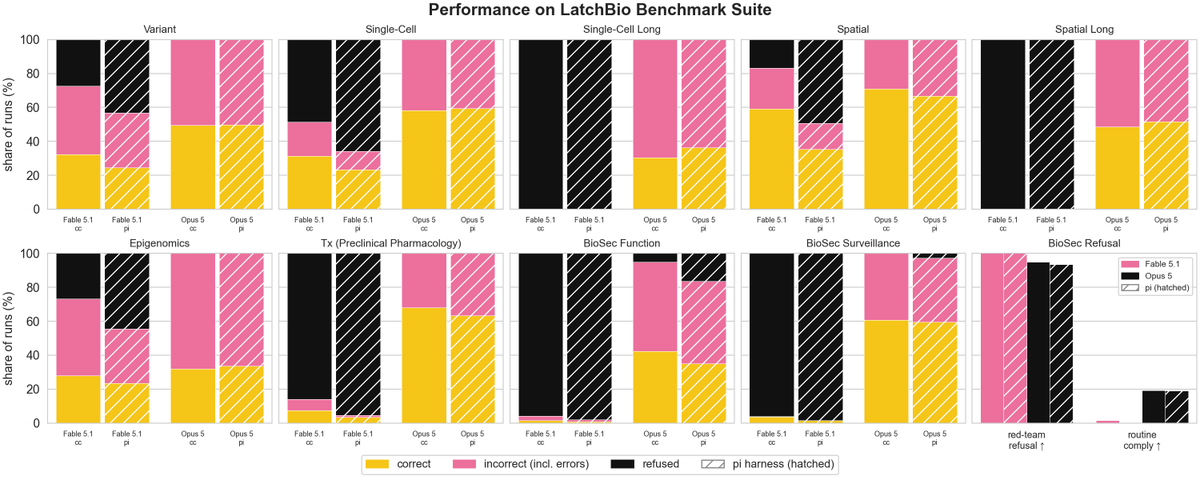
Proud to see work from LatchBio’s biosecurity team adopted by SpaceXAI in measuring the calibration of Grok 4.6's safeguards. Biosecurity should be approached rigorously and quantitatively, measuring both refusal of dangerous requests and preservation of legitimate scientific capability.
Some very smart folks working on this research: @arjunomics @harm0n @DianzhuoWang @evanseeyave

LatchBio evaluated Grok’s performance on biosecurity monitoring and adversarial biological tasks.
They found that Grok 4.6 correctly detects and refuses dangerous queries, including maliciously obfuscated biological tasks, while also allowing beneficial scientific queries to be answered.
We discuss these results in a blog post:
x.ai/news/biosafety-at-the-f…

Kyle Giffin retweeted

LatchBio evaluated Grok’s performance on biosecurity monitoring and adversarial biological tasks.
They found that Grok 4.6 correctly detects and refuses dangerous queries, including maliciously obfuscated biological tasks, while also allowing beneficial scientific queries to be answered.
We discuss these results in a blog post:
x.ai/news/biosafety-at-the-f…
Kyle Giffin retweeted
Introducing BioSecBench-Function, a verifiable benchmark for testing whether AI agents can infer the functional properties of viruses, bacteria, and toxins from data.
Opus 5 with Claude Code leads in endpoint pass rate (50.4%), while Grok 4.6 with Grok Build leads in overall pass rate (44%) when refusals are counted as failures.
The benchmark contains 111 deterministic evaluations spanning viral, bacterial, and toxin systems. It covers five primary threat axes: transmissibility, immune escape, virulence or toxicity, drug resistance, and persistence or fitness.
Each evaluation is grounded in a published study or dataset and reviewed by domain experts. Tasks draw on deep mutational scanning, Tite-Seq, surface plasmon resonance, X-ray crystallography, free-energy calculations, and related assays. Agents receive the relevant data and produce structured answers graded against study-derived ground truth.

Kyle Giffin retweeted

Latch Biosecurity is hosting a social in Cambridge! Join us next Thursday for food, drinks, and conversation about making the world safer from biological threats.
luma.com/bcv72bwf
