

Sr Director of Research at @Scale_AI | agents research, RL environments, professional domain agents, AI for science | ex-Meta | ex-Google | Erdős number 3
California, USA
Joined September 2013
- Tweets219
- Following783
- Followers710
- Likes279





Pinned Tweet
Even if AI agents and superintelligence surpass us in mathematics, software engineering, and most other professional domains, I don’t think we’re anywhere close to running out of purpose.
Our work may change dramatically. But at least two human pursuits seem timeless to me.
1. The pursuit of a longer, healthier life.
Every culture has its stories about the search for immortality. In China, more than 2,000 years ago, Qin Shi Huang (秦始皇), the First Emperor, enlisted alchemists to find him an elixir of life. He sent Xu Fu (徐福) and thousands of young men and women across the sea in search of the legendary islands of the immortals. Compiled around the same era, the Huangdi Neijing (黄帝内经), or The Yellow Emperor’s Inner Classic, described 120 years as the natural limit of a human life. Even today, we have barely crossed that threshold: only one person has ever been verified to have lived past 120.
The aspiration is ancient and universal. What’s new is that AI may finally give us real tools to pursue it: tools to understand aging, cure disease, and extend the healthy years we get to spend learning, creating, and being with the people we love.
2. The pursuit of a worthy goal that may outlast us.
Curing cancer. Making humanity a multi-planetary species. Understanding the universe. Goals like these can carry us through different careers and stages of life, even when their fulfillment lies beyond our lifetimes. Their value doesn’t depend on our being there to witness their completion or on doing every part of the work ourselves.
If AI helps us reach them sooner, that’s a reason to expand our ambitions, not shrink them. We can take on projects that once seemed out of reach. Longer, healthier lives might even let us complete endeavors we once expected to pass on to future generations.
Human purpose doesn’t require us to be the most capable intelligence in the room. Discovery, exploration, relationships, and the futures we choose to build can still matter deeply to us.
(Yes, I wanted to schedule this message to go live 10 years from now, with no way to retract or delete it.)
nitter.cf/liuying04/status/21167…

Feature request for X: "Locked Predictions."
Make a prediction today, schedule it to be revealed months or years later.
Every prediction gets a publicly verifiable timestamp, and locked permanently—no editing, deleting, or canceling, to prevent hindsight bias and cherry picking.
Especially valuable for AI forecasts, economic predictions, and scientific hypotheses.
Make predictions accountable, not just memorable.
@elonmusk
1
11
906
Congrats to the @thinkymachines team on the release of Inkling 2 Small! Strong results for a smaller model, and another example of SWE-bench Pro V2 helping benchmark the next generation of smaller, more capable models.
- SWE-Bench Pro Paper: arxiv.org/pdf/2610.24206
- @ScaleAILabs Blog: labs.scale.com/blog/swe-benc…

Introducing Inkling 2 Small. Scoring 31 on the AA Intelligence Index, it's a big jump over its predecessor.
Inkling 2 Small is available for fine-tuning and inference on Tinker today, with full weight release planned soon.
thinkingmachines.ai/news/ink…

- SWE-Bench Pro Paper: https:/arxiv.org/pdf/2610.24206
- @ScaleAILabs Blog: labs.scale.com/blog/swe-benc…

256
Impressive work from @RicursiveAI. 79.1% on SWE-bench Pro v2 Hard with a 65B open-weight model.
Exciting to see increasingly capable models being tested against challenging, real-world software engineering tasks.
SWE-Bench Pro Paper: https:/arxiv.org/pdf/2610.24206
@ScaleAILabs Blog: labs.scale.com/blog/swe-benc…


Strong work from the @cognition team. As coding models become faster and more efficient, rigorous evals become even more important for understanding real-world capabilities.
Great to see more teams using SWE-bench Pro V2 to measure progress on challenging, real-world software engineering tasks: 89.9% on SWE Bench Pro v2 Hard
SWE-Bench Pro V2 Paper: https:/arxiv.org/pdf/2610.24206
@ScaleAILabs Blog: labs.scale.com/blog/swe-benc…


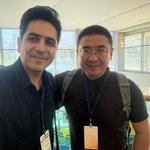
It was a great pleasure to host an old friend from grad school, Professor Yehua Wei (@wei_orms) of Duke University’s Fuqua School of Business, at @scale_AI’s SF office.
Back in school, we often discussed the foundations of research problems and what made them worth pursuing. We also played basketball together on Fridays.
It had been a dozen years since we last saw each other. When the @INFORMS 2026 conference brought him practically next door, I couldn’t pass up the chance to reconnect and welcome him to our beautiful SF office.
Our conversation ranged from advances in belief propagation and distributed algorithms to supply chain and combinatorial optimization, before turning to a practical problem in AI deployment: reducing costs while preserving quality through contextual LLM cascading (arxiv.org/pdf/2606.07392).
Bringing rigorous mathematical modeling to the practical challenges of building and deploying AI agents. There’s a lot for our fields to learn from each other.

Interesting! Do LLMs speak their special languages? Are there deeper understanding of the relationships between raw weights and capabilities?

We asked GPT-6 Astra to edit Qwen3.5-0.8B weights to improve math.
It directly changed only 0.016% of weights, fixing 0.8B's reasoning loops & improving math up to 6x and even instruction following 3x, without gradients or training.
We call this Weight-Space Programming: frontier LLMs can now natively read/write neural network weights! 🧵
Blog: rikiyat.github.io/blog/weigh…

Readers added context they thought people might want to know
LLM was given weights explicitly as text in prompt and used code/forward passes (per authors' logs) to ablate Qwen looping direction, a known thinking-mode issue per model card. Primarily fixed repetition in that mode, not general 'natively' improving weights/math.
rikiyat.github.io/blog/weight-sp…
github.com/RikiyaT/lm_und…
huggingface.co/Qwen/Qwen3.5-0…
huggingface.co/RikiyaT/Qwen3.…
2
4
333
Feature request for X: "Locked Predictions."
Make a prediction today, schedule it to be revealed months or years later.
Every prediction gets a publicly verifiable timestamp, and locked permanently—no editing, deleting, or canceling, to prevent hindsight bias and cherry picking.
Especially valuable for AI forecasts, economic predictions, and scientific hypotheses.
Make predictions accountable, not just memorable.
@elonmusk
SWE-Bench Pro V2 has joined the Specialized Intelligence Index.
@ScaleAILabs built SWE-Bench Pro v2 around challenging tasks from applications, business services, and developer tools. Our private commercial cases also help assess performance on codebases that aren’t publicly available.
By joining the SII, we’re helping teams compare models against the demands of maintaining and extending software. These results give engineering teams a stronger basis for deciding which models to test on their own repositories.
This quoted post is unavailable.
Join Scale AI’s ML Research Internship for a summer of impactful, fun, and rewarding research. Many of our interns complete high-quality research over the summer and go on to join Scale full-time.
A few examples from our awesome 2026 summer interns.
- Spine-Branch Coordination for Multi-agent Computer Use — Mian Zhang (@Guuuuuuuu)
nitter.cf/_Guuuuuuuu_/status/209…
- Evidence-First Agentic Verification — Reza (Rey) Sanayei (@r_sanayei)
nitter.cf/r_sanayei/status/21125…

From the beginning, Scale was built by people who love solving hard problems. That same ambition is driving what we build next.
Our ML Research Internship Program is accepting applications in SF and NYC. Work on frontier AI research alongside @ScaleAILabs researchers, publish your work, and help build the next generation of AI.
Apply now. scale.com/careers/university

Frontier labs are citing @scale_AI’s SWE-Bench Pro V2 in their model releases.
Cleaner, harder to game, and a much sharper measure of coding progress.
SWE-Bench Pro Paper: arxiv.org/pdf/2610.24206
Blog: labs.scale.com/blog/swe-benc…

Today, we release our first model, Flint-40B-A2B, a fast local coding model built with our automated research system. huggingface.co/RecursiveSI/f…
1. Strong performance. 54.9% on Terminal-Bench 2.1, 89.7% on SWE-bench Pro v2, and 74.2% on SWE-bench Verified.
2. It is trained from scratch (tokenizer->Pretrain->Midtrain->SFT->RL).
3. Fast in your local laptop. Up to 2x faster than comparable models: 125+ tokens/sec on a MacBook Pro, 150+ on RTX Spark.
4. We build the complete model training pipeline in 4 month!

Huge thanks to Wen Sang @sang_wen , co-founder & COO of @genspark_ai , for inviting me to visit the Genspark office in Palo Alto.
Wen is a serial entrepreneur, and the signal was clear as far back as our school days, when he was already doing venture club activities. The last time I visited one of his companies, it was Smarking, which he had just founded and which later went on to a successful exit. Great to see him building again.
He gave me an in-person demo of Genspark’s newest products (super cool designs) and left me with new insights on how to leverage enterprise agents and truly co-work with them day to day. And some research ideas on multi-agent orchestration and coordination too :)

Solving the virtual clock problem in AgentEnv
Anyone who has worked on search engines knows that getting time right across the system during training, relative to query time, as in “what was the weather yesterday?”, is critical yet easy to overlook. Reproducible RL environments face the same challenge. In AgentEnv, we explored several approaches before landing on a clean solution for the virtual clock.
The core tension: inject the clock too low in the stack and it interferes with certificate validation and other system functions; inject it too high and you pay a large overhead while still missing invocations.

Three agents and eight servers ask what time it is, all at once, and every one gets the same answer.
At @ScaleAILabs, we built this virtual clock into our open-source AgentEnv Framework so RL environments stay reproducible. Here's why it matters and how it works 🧵
1
7
615
Controversial take: well-specified, self-contained science problems, whether in quantum field theory, condensed-matter physics, quantum chemistry, or structural biology, if they can be described and verified digitally, will essentially all become turbo-charged math “word problems.” And they’ll fall to the same frontier models that are now cracking open problems in math.
But that is far, far from “solving” science. That requires layered evaluation, shared environment state across agents and experiments, and autonomous physical labs to close the loop with the real world. I gave a talk on this recently at lifelongagent.github.io/ — write-ups to follow.
TheoPhysEval:
"a suite of 50 unpublished research-level theoretical physics problems with verifiable answers."
"GPT-6-Astra harnessed in Codex, obtains the final answers with a near-perfect accuracy of 98% at an average cost under USD 3 per problem."
arxiv.org/abs/2610.16733
3
12
677

Fascinating event! Excited to help bring live, streaming benchmarks and arenas to life for agents tackling extremely long-horizon tasks—with shared resources, coordination, and competition adding new challenges.
Fantastic work by our partners @bake_ai_hq (main organizer), @huggingface, @NotreDame, @UW, and @Stanford!
In the ongoing Stage 2, each model resumes from its own Nemotron checkpoint, incorporating feedback from its arena battles.
Watch live October 10–13 at rsiarena.live and join the checkpoint evaluation!


Grok 4.7 ran out of API credit and was cut off 41 hours early. Nearly 70% of its GPU budget was still unused.
And somehow, the model it trained still made the top two!! @SpaceXSI
Stage 1 of RSIArena is over. Thank you, our collaborators @huggingface @scale_AI @NotreDame @UW and @Stanford, we did awesome! 🧡
Stage 2 training is now LIVE—and this time, the models have human feedback to work with.
Round 1 was a six-day competition: 10 models (AI researchers), the same @NVIDIAAI Nemotron base model, and 1,000 GPU-hours each to build something better.
They chose their data, wrote training code, ran experiments, and submitted their models.
At @COLM_conf and online, people then cast 1,685 votes in blind comparisons. @OpenAI GPT-6 Astra model finished first; the models trained by grok 4.7 and @Zai_org GLM-5.3 rounded out the top three.
Now those judgments go back into the experiment.
In Stage 2, each model resumes from its own Nemotron checkpoint with feedback from its model’s arena battles, another 500 GPU-hours, and $150 in API credit. Across both rounds, that’s a total budget of 1,500 GPU-hours and $450 in API credit per model.
The agents decide how to interpret the feedback, which experiments to run, and what to change in training. Their next models will show whether those decisions actually helped.
Stage 2 runs October 10–13. Watch the training live: 👇

12
714
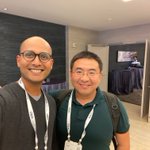
Such a pleasure to run into Prof. Theja Tulabandhula (@TTulabandhula) of the University of Illinois Chicago just as I was heading home on the last day of @COLM_conf!
We were next-door office neighbors in grad school and used to chat and joke together a lot. A dozen years later, we still recognized each other immediately, even if we both look a little different now. 😄
Alongside his role as a tenured professor at UIC, Theja has built an impressive industry career, including founding his own companies.
And of course, an old-friend reunion at an AI conference calls for the obligatory photo!

20
637
Ilya @ilyasut saw this three years before most of us.
Raw intelligence, much like physical strength, may no longer be the defining driver of human productivity.
What will endure? Empathy, kindness, curiosity, and the simple ability to find joy in life.
Attending @COLM_conf to learn, talk, and make new friends feels like it :)

13
573
I am honored to join the fantastic lineup of speakers at the Lifelong Agents Workshop at COLM 2026! I'll be giving a talk titled "From AI4Sci Headlines to Autonomous Scientific Discovery."
Using AI to tackle scientific problems has been a passion of mine since my PhD days, so this one is close to my heart. Two points I'll be making:
1. Science is the lifelong-agent problem in its hardest form.
2. The bottleneck for science agents isn't intelligence — it's the environments and verifiers we can build around them.
Hope to see many of you there!
Time: 1pm, Oct 9, Friday
Location: Hilton San Francisco Union Square
Workshop: lnkd.in/gNkjyNj5
RSVP: luma.com/h6vm3nqc

This Friday (Oct 9) at #COLM2026, we're hosting the 2nd Workshop on Lifelong Agents: a full day on how to build agents that keep learning after deployment while staying reliable and aligned.
Speakers:
• Sergey Levine (UC Berkeley)
• Graham Neubig (CMU / OpenHands)
• Yu Su (NeoCognition / Ohio State)
• Fred Sala (Snorkel AI / UW–Madison)
• Philippe Laban (Microsoft Research)
• Shi Dong (RadixArk)
• Ying Liu (Scale AI)
📍 Continental Ballroom 6, Hilton San Francisco Union Square
🗓 Fri, Oct 9 · 8:30 AM – 5:00 PM PT
💻 Virtual option available
RSVP: luma.com/h6vm3nqc
Schedule: lifelongagent.github.io/
Thanks to my co-organizers, our reviewers and authors, and to Salesforce AI Research, Snorkel AI, and Tencent for helping cover registration for student authors!
If you're at COLM and working on agents, come say hi!
#AIAgents #ContinualLearning
1
17
896
My posts here are usually all work and research, but this guide is exactly what I needed! I make the long commute to SF just for work, so the city feels so close yet still a mystery. Time to bring the family for a day trip (that is not for SF Zoo). Thanks, @_jasonwei !

Visiting SF for COLM and curious what SF is all about?
The bad news: COLM is in the dodgiest neighborhood and if you hang around there, you’ll hate SF just like I used to.
The good news: your twitter buddy Jason Wei wrote a guide on experiencing SF like a local: jasonwei.net/blog/the-best-t…

5
806