
Assistant Professor at @scilifelab and @Stockholm_Uni. Intrigued by what makes life work at the molecular level.
Stockholm, Sweden
Joined February 2018
- Tweets134
- Following292
- Followers360
- Likes103




Emil Marklund retweeted

The model of gene expression taught in school is highly misleading!
Transcription factors are proteins that bind to DNA and then help repress, or activate, the expression of genes. Cells have hundreds of different types of transcription factors, each tuned to regulate different genes based on short snippets of DNA located near those genes.
The basic model, taught in school, says that these transcription factor proteins float around the cell and, when they bump into a DNA sequence, either latch onto it strongly (CORRECT SITE!) or fall off quickly (WRONG SITE) and keep searching. All the other DNA in a cell is basically abstracted away as unimportant or irrelevant; mere background noise.
But again, this model is naive! And a new paper, published in Cell, beautifully shows how the sequences SURROUNDING a transcription factor's binding site also matter a great deal.
This won't be surprising to many biologists, as "cracks" in the standard two-state model began emerging decades(?) ago. Biologists have tagged transcription factors with fluorescent tags and then watched them move around living cells. And they have noticed that when transcription factors land in a "wrong" location in the genome, they skip or hop to a nearby location and repeat this until finally connecting with the "correct" sequence. So in other words, there are actually three states that a transcription factor can exist in: free-floating, "searching", or "bound."
(More technically, transcription factors first do a 3D search, then latch onto DNA and do a 1D search to find the correct location.)
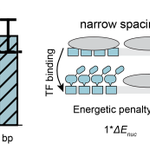
For this new paper, though, scientists exhaustively quantified *how* the sequences flanking a transcription factor binding site influence the search of the protein.
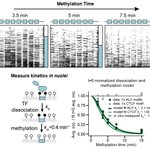
They did a huge in vitro experiment, wherein they placed a specific transcription factor with a known binding site, called KLF1, in a huge library of 11,812 different DNA sequences. These sequences had mutated "core" binding sites and variations in the flanking sequences. They also prepared negative controls. Then, these researchers measured the binding kinetics of KLF1 with each sequence to understand which bases in the flanking sites impact the 1D search.
What they found is that KLF1 has a basically flat disocciation rate from its core sequence, but that the PROBABILITY that it finds this sequence depends a lot on the surrounding context. Even mutations located dozens of bases away from the core site matter a lot, either pushing KLF1 to "hop" faster to find the site, or "trapping" KLF1 and slowing down its search. These flanking sequences can cause up to a 40-fold variation in the affinity of a transcription factor for its target site!
This is just one small part of the paper, though, so I encourage anyone interested to read the whole thing. It is challenging throughout.


Emil Marklund retweeted

Congrats to @juliaschaepe and @marklundem on the recent publication of their work linking the binding behaviors of TFs in vitro and in vivo! Out in Cell now: cell.com/cell/fulltext/S0092…

Emil Marklund retweeted

Ever wondered how transient transcription factor DNA binding can robustly activate transcription? In this new preprint, we find support for one of the possible mechanisms: transcription factors exchange. A 🧵 1/9. biorxiv.org/content/10.1101/…

Emil Marklund retweeted

High-throughput biochemistry in RNA sequence space: predicting structure and function go.nature.com/3GAzwPW #Review by @marklundem, @Yuxi_Ke & @WJGreenleaf @Stanford
Emil Marklund retweeted

My review went live today. I argue that transcription factors find their binding sites using both protein-protein interactions and DNA binding interactions. It's halfway between a review and a perspective. academic.oup.com/genetics/ad…
Emil Marklund retweeted

Excited to share our review in @MolecularCell!
Exploring molecular biology in sequence space: The road to next-generation single-molecule biophysics authors.elsevier.com/c/1f3Vc…

Emil Marklund retweeted
Our paper describing NEAT-seq, a method to simultaneously measure transcription factor protein abundance, ATAC-seq, and RNA-seq in single cells, is now out at Nature Methods! Congrats to Amy and Ben! nature.com/articles/s41592-0…

Emil Marklund retweeted

Our ribosome tracking study is out today in @NatCommun!
nature.com/articles/s41467-0…
Among other findings, we present results suggesting significant re-initiation on poly-cistronic mRNAs in E. coli by 70S, not 30S. All data and code are available at @SciLifeLab_DC.
Emil Marklund retweeted

Some scientific illustrations become memes*, some turn into cultural icons.
It requires a combination of originality, aesthetic, simplicity and scientific accuracy.
Here are some of them 🧵
1/n
*memes in the original sense: units of cultural inheritance that replicate and evolve

ALT DNA double helix

ALT Waddington's landscape

ALT Vitruvian man

ALT Ebola virus
Emil Marklund retweeted
Our work in collaboration with the @zamore_lab profiling sequence determinants of TtAgo binding and cleavage across diverse guide and target sequences is out in Molecular Cell! Congrats to all coauthors! authors.elsevier.com/c/1elT5…
Emil Marklund retweeted

How do DNA binding proteins find true targets in the genome w/o getting stuck at sequences that look similar? A new study @ScienceMagazine by @marklundem @johan_elf_ @SebastianDeindl + al in @scilifelab @uppsalauni provide new + surprising insights bit.ly/S_abg7427

Emil Marklund retweeted

Happy to share our results, where we present a method how to determine the fast ASTs and identify an individual species in a mixed bacterial cultures biorxiv.org/content/10.1101/…



Emil Marklund retweeted

Sequence specificity in DNA binding is determined by association rather than dissociation biorxiv.org/cgi/content/shor… #biorxiv_biophys
Emil Marklund retweeted

#StoptheExecution & #freeahmadreza! @Amnesty is calling on Iran’s authorities @khamenei_ir to immediately stop any plans to execute Swedish-Iranian academic #AhmadrezaDjalali. On 24 Nov, he was transferred to solitary confinement and informed that his execution is imminent.
Emil Marklund retweeted

Excited to share our work on "DNA surface exploration and operator bypassing during target search" with @johan_elf_ @GlobischLab.
nature.com/articles/s41586-0…