
Postdoc immunologist with @EJohnWherry at Penn, studying immune responses to SARS-CoV-2, viral infections, Long COVID, and beyond
Joined October 2016
- Tweets408
- Following662
- Followers1.1K
- Likes3.3K



Pinned Tweet
Our study on virus-specific T cell activation in Long COVID (LC) is up on bioRxiv! We identify a subset of people with LC with persistently elevated activation of CD8 T cells targeting spike and/or EBV lytic antigens, consistent with viral persistence.
biorxiv.org/content/10.64898…

Mark Painter retweeted

How does our history of influenza infections shape the ability of CD8+ T cells to recognize new viral variants? Our new paper in @CellReports examines these questions using influenza-specific CD8+ T cells! 🧵⬇️ (1/12)
cell.com/cell-reports/fullte…

Mark Painter retweeted

In new study, we show that SARS-CoV-2 has evolved decreased inherent antigenicity in humans, as quantified by a ~3-fold decrease in the number of naïve human B cells that can bind the spike RBD.
doi.org/10.64898/2026.10.15.…
Mark Painter retweeted

#LongCOVID: T Cells May Reveal the Virus That Routine Tests Miss!
➡️ A new study profiling virus-specific T cells in hundreds of people found that a subset of LongCOVID patients had persistently activated CD8⁺ T cells targeting SARS-CoV-2 spike and/or Epstein–Barr virus (EBV).
➡️ Spike-specific T cells showed signs of chronic stimulation, exhaustion and reduced function when challenged with their target antigen. 1/

Mark Painter retweeted

Our new work using virus-specific T cells as biosensors in Long COVID. These data point to viral persistence detected by T cells and some level of T cell exhaustion. Excellent work by @markmpainter biorxiv.org/content/10.64898…
Mark Painter retweeted

Breaking: PolyBio-Supported Preprint Finds Persistently Activated Virus-Specific T cells in a Subset of People with Long COVID
👉🏻Virus-specific immune cells show signs of ongoing stimulation and impaired function in a subset of people with Long COVID, offering a potential way to guide targeted clinical trials
1/

Virus-specific T cells could also be used as a readout of intervention efficacy through changes in activation or exhaustion. Moreover, existing therapies could be used to modulate activated T cell responses in multiple ways as a potential therapy for LC.
In summary, we describe a subset of people with LC with evidence of chronic antigen-driven T cell activation. This provides key mechanistic insights and identifies a biomarker for stratifying patients, assessing response to treatment, and guiding the development of new therapies.
I want to thank everyone who worked on this study, especially David Reeg and @EJohnWherry, and all the study participants who made this possible, especially the LC patient community. Check out the paper for everything that didn't fit in this thread! biorxiv.org/content/10.64898…
CD8 T cells specific for EBV lytic antigens were also activated in LC, largely in the same participants who had elevated spike-specific CD8 T cell activation. These data nonetheless support an association between EBV activity and the development of LC.
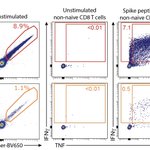
Spike-specific CD8 T cells from the subset of people with LC with persistent activation and evidence of exhaustion (e.g. expression of TOX and 2B4) produced fewer cytokines and were less proliferative compared to recovered controls, indicating some degree of T cell exhaustion.

First, not all people with LC show evidence of persistent T cell activation. This is consistent with a model in which multiple mechanisms contribute to LC, and SARS-CoV-2 persistence drives disease in only a fraction of patients.
Taken together, our data are consistent with chronic stimulation of spike-specific CD8 T cells by a persistent reservoir of SARS-CoV-2 in a subset of people with LC. These findings have several implications for ongoing efforts to develop successful therapies for LC.
In contrast to Flu-specific CD8 T cells, which had similar gene expression profiles in recovered controls and people with LC, spike-specific CD8 T cells from people with LC resembled spike-specific cells from acute SARS-CoV-2 infection samples.


T cell exhaustion is a distinct differentiation fate driven by chronic antigen stimulation. We observed strong enrichment for T cell exhaustion gene sets in spike-specific CD8 T cells from the activated subset of people with LC, consistent with persistent TCR-driven activation.

Spike-specific CD8 T cells from these people with LC shared gene expression profiles with spike-specific cells from acute SARS-CoV-2 infection, including enrichment of gene expression modules associated with recent TCR stimulation but not bystander activation.

At the clonal level, a large majority of spike-specific CD8 T cell clones from these people with LC (selected from the subset with high activation) were enriched in activated gene expression clusters compared to clones from recovered controls.

To test whether the spike-specific CD8 T cells from people with LC who maintained elevated activation truly showed evidence of persistent antigen stimulation, we did a deep dive using scRNA and TCR sequencing with barcoded peptide/HLA tetramers to track virus-specific T cells.

Spike-specific CD8 T cell activation was maintained over time, with distinct groups of LC patients maintaining consistently low or consistently high activation in longitudinal samples.

