

COO @ Well Copy | Scaling brands to 8 figures+ on Email & SMS. Generated $100M+ in revenue for clients.
Detroit, MI
Joined October 2023
- Tweets2.5K
- Following921
- Followers1.3K
- Likes5.3K






Pinned Tweet
3 years ago, I was working a 9-5 bored out of my mind jumping from side hustle to side hustle without direction.
Then I found a random job posting from a guy named Max Sturtevant looking for an account manager at his email marketing agency.
I had some experience, but mostly what I had was a fire under my ass and a goal to learn and roll with any punches to be the best I possibly could be. So I applied & sent over the worst loom intro video anyone’s probably ever seen.
After about 5-6 months of learning the ropes, I moved into the Director of Operations role simply because stuff needed to get done and I kept being the one to make shit happen.
Fast forward to today:
Our agency has grown from a team of 10 people to 75+. We manage email and SMS for 7-9 figure e-commerce brands… Overseeing fulfillment, operations, and client services across the entire company.
None of this was planned. But as we grew, I kept learning and figuring shit out on the go.
What I've learned is there's no manual for scaling a company 10x. You just have to build the plane while it's flying and never any one thing get you down. If you let stress or noise or overwhelm get to you, you’re never going to be able to perform at your best.
So, if you're building an agency or running an ecom brand, let's connect. I'll be dropping the sauce of what I'm learning along the way as we scale Well Copy to 8 figures and beyond.
Let's get it.

Curious how other agency owners/operators are leveraging AI agents right now
We're a 100+ person team and looking to roll out way more AI systems & workflows particularly around internal workflows, ops, and repetitive/low leverage work
Love to connect with people doing some cool shit around this
Looking to network w people who's down to chat
Learned so much from this guy it’s not even funny.
Any good partnership, business or life, comes down to rolling with the punches aimed for you, keeping each other cool & collected, and letting the other do what they do best.
Pleasure to do it. Blessed to have met this guy early on
Hell of a ride so far. Big things ahead.

I have a business wife and his name is @mikewellcopy (my COO).
- He deals with alllllll the shit without telling me so I can focus on growing the biz.
- He manages all of our hiring, firing, processes, people movement, etc
- He keeps the team accountable on our values every day
- He works harder and longer than me
- He only brings things to me when I'm 100% necessary
- He tells me when to chill the fuck out and calm down
I would say that I’m actually the wife and he’s the husband.
Wouldn't be where we are without him. If you don't have a Michael, go find one.

1
36
861
Anyone know a badass ecom developer type w experience in telehealth?
Someone who can pull metrics from custom built sites (non shopify) and pass events along to platforms like braze, customers.io, etc
Hmu if that's you or you know someone interested in speaking
1
4
722
Most agencies skip solid SOPs & Training systems for the same reason...
"We'll document it later."
But later never comes. And that's why growth gets messy.
Here's what happens when you don't have SOPs:
Every new hire reinvents the wheel or comes in with their pre taught bad habits.
They're learning from memory instead of a set guide, which means quality depends entirely on the individual.
Your best people become bottlenecks. Instead of doing high-level work, they're answering the same questions over and over because nothing is documented or taught effectively and nobody knows the correct way to do things properly
Then, mistakes repeat and compound. Without a set process, the standards deviate by person. The same errors show up repeatedly with no clear answer.
Scaling feels impossible becuase each new hire is a major lift to get up to speed. You can't hand off what only exists in your head.
SOPs and training systems aren't glamorous.
Nobody posts about them. But they're the foundation everything else is built on and what each new hire sees when they walk in the door.
Document the process. Run it a thousand times. Update when it changes.
That's how quality talent becomes scalable
8
371
At a point, being the hardest worker in the room stops being an asset and becomes the thing holding everything back.
What got you from 0 to 5 isn’t what’s going to propel you from 5 to 10
Here's what that looked like for us:
Turnaround times were lagging. Not because the team was slow, but because everything sat in my queue waiting for approval.
New ideas weren't getting off the ground because I was too deep doing opposed to letting the team own different projects and take the lead
The team was growing, but more people just meant more questions because we were solving problems instead of teaching people to solve them for the future.
Doing everything yourself feels productive. It rarely is.
Similar to a hamster wheel…. You run faster but get nowhere
The most valuable thing you can do for your business is identify what only you can do, your highest leverage activities, and build your team up to handle the rest
For the longest time I thought that was laziness.
However, that’s leverage and what any team needs to grow sustainably.
2
278
Micromanaging feels like thoroughness. It's not.
It's a trust problem dressed up as a quality problem.
When you're in every detail, on every decision, reviewing every piece of work, you're not leading a team. You're just doing the job yourself with extra steps or inadvertently becoming the bottleneck you sought to eliminate
Real management looks different.
It's being clear upfront so you don't have to correct constantly. It’s setting an outcome, and building your team up so that they have all the tools to get it done without your involvement
The goal isn't to be everywhere.
The goal is to build a team that runs well without you in every conversation.
When you get that right, you stop being the bottleneck.
And that's when things actually start to scale.
5
216
The fastest way to create new problems is hiring out of necessity.
You're growing fast, the team is stretched thin, and you convince yourself that a warm body is better than nobody.
So you rush someone through the door because the pain of being short-staffed feels worse than the risk of a bad hire.
We hired an account manager once and let him go within two weeks.
It wasn’t easy and it sucked, but at the end of the day have to take an honest look at things and when you know it’s not going to work out, it’s in your and their best interest to pull that plug early.
That's what hiring out of necessity looks like.
You know it's wrong almost immediately but you pulled the trigger anyway because you needed someone yesterday.
The hard truth about scaling an agency fast is that being short-staffed is uncomfortable but survivable. A bad hire is expensive, disruptive, and sets the whole team back.
We'd rather delay an onboarding by weeks than rush a hire.
That's where fast-growing companies crumble.
7
245
I stopped saying "you" to our team and everything changed.
When someone drops the ball, the instinct is "you didn't do this" or "you need to fix that."
The problem is people hear "you" and their brain immediately switches to defense mode, which isn’t in their best interest, or in the team’s best interest. It's an accusatory phrase.
Without fail, it’s always "we." in these instances whether we’re giving feedback, correcting an issue, etc.
"We need to tighten up response times on this account."
"We can't let a client sit for three hours without a reply."
It's the same message delivered without an accusation.
It sounds small but it completely changes how people receive feedback. They stay open instead of shutting down.
They actually want to fix the problem instead of just surviving the conversation.
It also enforces our core values, that we either win or lose together, as a team.
1
6
217
If your team is burning out, it's not a motivation problem.
Early on, we made the mistake of putting newer team members on our bigger, more demanding accounts.
There was a mismatch. New hires are still learning the ropes. They need one or two accounts to sink their teeth into before they fully get the rhythm, not five.
This is why managing people is a skill in itself.
Part of that skill is knowing exactly where someone is in their development and matching them to the right account at the right time.
Give someone too much too soon and they'll burn out.
As they prove themselves, their capacity grows. Then you give them more.
That's why burnout isn't a mindset issue.
It's a systems issue.
The number 1 trait we hire for is dawg mentality.
Someone who sees what needs to be done and doesn't wait to be asked.
Who goes the extra mile because they hold themselves to a high standard, not because they were asked to do so.
I started here as an account manager.
Didn't have the most experience.
Wasn't the most qualified person in the room.
But I showed up every day and just figured shit out.
That's how I went from a junior account manager to overseeing our entire operation.
Dawg mentality isn't something you can fully teach.
You either have it or you don't.
Not that some of it can’t be learned, but it’s a mindset that you can sense early on with people.
Even though Well Copy has 100+ clients, I’ve still to this day joined every kickoff call myself.
To an extent, this is on me for not letting this responsibility go sooner.
Ideally I'd love to remove myself from them completely...
But there's often curveballs that clients can throw that it’s simply impossible to train people on every situation.
Something about contract terms, a piece of the sales call that hadn't been passed along, a conversation we had 3 weeks ago that a new team member wasn't on, etc.
And the truth is, I do trust our team.
However, the kickoff call is where we make that first impression.
If we get stuck in one of these instances and stumble on it slightly, it jeopardizes some trust right from the jump, which could make us look unprepared.
These moments are why I'm still there.
I’ve wrestled with this one a lot, and I likely overthink it.
All the ones I have missed for one reason or another have all gone smoothly. But, that concern remains there.
Eventually there will be a day where I’ll have to let go, and I know they’ll have the confidence to take those curveballs in any shape they come.
But until then, I'd rather be the safety net than let a client walk away from their first call feeling uncertain.
6
193
We have an "always early, never late" policy at Well Copy.
If a client expects work on Friday, the team has it done by Wednesday.
There's always something that slips through the cracks.
A typo in the copy. Something in Klaviyo that's just not firing right.
That buffer period can be the difference between catching the mistake yourself and the client catching it for you… It's also an important safety net.
And when you deliver 2 days early, now you're the hero.
That's the importance of properly setting expectations with your team and clients.
One missed deadline costs more trust than ten early deliveries can earn back.
6
189
Every week we have a competition to see who made the best email.
Recent winner: A Netflix-inspired layout for a THC beverage company.
Why did this win?
Creativity — lifts from popular streaming platforms while incorporating multiple CTAs built for conversion.
The "Play" button next to the first CTA is a nice touch.
Nostalgia — classic movies as nostalgia bait. Gives their audience a reason to crack a can while watching their favorite films.
Simplicity — very little copy, large buttons, and completely skimmable.
Creativity + Nostalgia + Simple yet killer design is what made this email stand out.
What do you think?

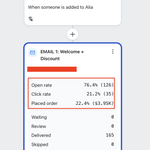
Welcome flow rebuild for a client:
76.4% Open rate
21.2% Click rate
22.4% Placed order rate
These are the results our team delivers on a daily basis.

4
155
Well Copy has grown from 50 clients → 120 clients in the last year. That’s 2.5x growth.
Operationally, that means more hiring, more check ins, and more oversight.
We have over 80 team members at this point, and it’s simply impossible for to oversee every single person and hold everybody accountable.
If you try to do that you’ll surely get overwhelmed
But one of the biggest lessons has been getting the systems in place to make sure it runs smoothly.
Each client gets assigned a pod.
A pod has a copywriter, designer, and Klaviyo tech.
Each pod has an account manager running the day to day
Every account manager reports to a senior account manager.
The senior account managers bring all the high level updates to me and we talk them through
At the end of the day, if there’s something on the client side that’s really going wrong, then I step in and take over.
But growing the business requires stepping back and trusting the team to do what we brought them on to do.
Here’s why your Klaviyo revenue is lying to you.
We see this all the time with subscription brands. Here’s what happens:
A subscriber opens one of your campaign emails. They read it, but don't buy anything. The next day, their subscription rebills automatically.
Klaviyo attributes that rebill to your campaign.
Now your Placed Order dashboard says that email drove $200K in revenue when it actually drove half to a quarter of that.
The subscriber was going to get charged regardless of whether they opened your email or not…. It just happened to get attributed to email
This is why so many subscription brands think their campaigns are crushing it when the numbers are completely inflated.
Worse, you might be over-emailing your subscribers thinking it's driving revenue, when all you're really doing is annoying them and increasing churn.
Here's how to fix it:
Create a custom metric in Klaviyo called "Placed Order w/o Subscription Rebills"
Set it up like this:
– Metric name: Placed Order
– Metric value property: Revenue
– Property: Source Name
– Relationship: does not equal
– Value: subscription_contract_checkout_one
This filters out all subscription rebills and only counts actual purchases: one-time orders and first-time subscription orders.
Now you can see what your campaigns/flows are actually generating.
Use this metric as your core reporting metric and you'll finally have accurate data to make decisions from.
You might find out some campaigns you thought were winners are actually doing nothing.

We don't want to be just another agency you hire.
We want to be fully integrated into your team.
And the way we do that is through communication.
Our clients hear from us every single day.
Not just monthly check-ins or quarterly reports (we do those too), but actual daily presence in their Slack channels.
Sharing a campaign result the moment it comes in, flagging something in the data before the client even notices, sending over a competitor's email that caught our eye because we thought it was worth testing for their brand.
That kind of communication isn't on a task list. The random ones. It happens because our team is genuinely thinking about these brands throughout the day.
When your agency feels like an extension of your internal team, you stop thinking about whether to keep them. They're just part of how the business runs.
That doesn't happen through great strategy. It happens through great communication, consistently, over months.
Most agencies sell you on the strategy deck.
We'd rather show you what it feels like to have a team that actually gives a shit about your brand every single day.

7
199
Handling operations for an agency is really just customer service at a high fucking level.
Most people think ops is systems, processes, project management. That stuff matters but it's not the core of the job.
The core of the job is making sure every single client feels taken care of.
What that actually looks like day to day:
→ Managing team energy so it doesn't bleed into client interactions
→ Making sure no client channel goes dark
→ Catching problems before clients ever feel them
→ Stepping in personally when something goes sideways
But ops isn't just client-facing either. It's making sure the team has what they need to deliver great service.
If your team is stressed, burned out, or disorganized, the client is going to feel it eventually. Additionally, nobody does their best work in these states either.
Taking care of your people & having a badass team is how you take care of your clients.
People think scaling an agency is about putting better systems in place to outsource as much as possible.
But as you scale, your service needs to scale with it.
You can always close more clients, but the reputation that each client leaves behind is what really matters.
4
142
The first pop-up you test will be your worst one.
Our client had been running a Free Gift offer on their popup for years.
Their welcome email was converting at 3.3%.
They didn't know what was possible because they never tested anything else.
When our team took over, we ran a structured test with four different offer variations against each other to see what their audience actually responded to.
For context, this is a $300 AOV brand. Here's what we tested:
→ 10% OFF
→ $25 OFF
→ Mystery Discount ($25)
→ Free Gift (their original offer)
The results weren't even close.
$25 OFF → 10.7% placed order rate
10% OFF → 8.6% placed order rate
Mystery Discount → 7.6% placed order rate
Free Gift → 3.3% placed order rate
By switching from Free Gift to $25 OFF, our team more than tripled their welcome flow conversion rate. Same prospects entering the flow, just buying 3x more frequently.
This is exactly why we test everything instead of assuming what's already running is good enough. This brand left years of revenue on the table because nobody thought to challenge the original offer.
When we broke down the gross profit the switch was a no-brainer and now their entire funnel converts significantly better.

Every week at Well Copy, we run 300-400 A/B tests across the board.
We test everything from email send times to button sizes to email formats.
For this client, we tested morning sends against afternoon sends.
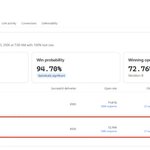
Both had nearly identical open rates. Around 72%.
But 1:00 PM drove 5x more revenue.
Same opens. Drastically different results.
When people open matters just as much as whether they open.
A 7:00 AM open might be someone skimming emails before work.
A 1:00 PM open might be someone on lunch with time to actually buy.
Test your send times based on conversions, not opens. Also, never make assumptions.
When in doubt, test it out.

6
166