





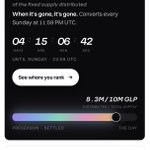



Every staking programme I have joined paid a better rate to people with bigger bags.
This one does not. @GenLayer's Pre-Mainnet Staking pays 1 Staking Point per GEN per day, at the same rate for everyone, for any amount. No tier. No boost for size. A thousand GEN and a hundred thousand GEN earn at exactly the same rate.
That leaves one edge: time.
Points are just GEN multiplied by days. You can add GEN any time before the snapshot. You cannot add the days you missed.
The clock has already started for people who never claimed. From THE DAY, an unclaimed airdrop counts as staked automatically and collects points while it sits locked, and you can still withdraw it whenever you want.
A flat rate is not a flat outcome. Seats are shared in proportion to points at the mainnet snapshot, so a large stake still takes a larger share. What the flat rate removes is the reward for arriving rich, not the advantage of being rich.
It will not make a small staker equal. It does stop the rate itself from working against them.
If you were designing this, where should the advantage sit: more GEN staked, more days staked, or more nodes kept running?

Every one of those three cases needed an exception. The rule ran its course in all of them, and the outcome was still wrong.
Anthony Ray Hinton needed one person with the power to say: pay for the test. $1,000 stood between him and it, and nobody with that power looked up.
Lee Castleton needed someone to say: before we take this man's house, check the software.
Both needed discretion: the ordinary power to adjourn, to waive, to look again, to say this case is not like the others.
Discretion is the strangest thing we ask of a justice system: it is both the kindness and the corruption. The official who can bend a rule for you can bend it against you. Same facts, two answers, all depending on who is sitting that day.
So we keep trying to remove it. Write the rule down, apply it exactly, and nobody's mood decides your outcome.
That works until it meets a case nobody wrote a rule for. Which is every case in that film.
Code has no discretion at all. It will apply a bad rule to you with perfect fairness, and it will never notice that yours was the exception.
That is where @GenLayer sits: not a rule engine, a judgment layer. Contracts are written in ordinary language and judged by independent validators, so a decision is a reading rather than an execution. Judgment comes back, but it belongs to strangers applying a published standard, not to one official holding an unpublished one.
Not a kinder system. A system where the kindness does not depend on who you drew.
Think of the last time a rule was applied to you exactly as written and it was still the wrong answer. What was the exception you needed?
#JusticeNeedsAnUpgrade
Slow. Expensive. Wrong.
It's been this way for centuries. It doesn't have to be.
#JusticeNeedsAnUpgrade
My old crypto card top-ups for pizza took longer than blockchain game raids.
I love how @StartaleGroup links @Soneium wallets to daily spending and cashback. Startale Card is a real win!
What game loot would you spend first?
app.startale.com/sign-up?cod…


Hacking: Your bank just cried itself to sleep. Again. 😭
Enter the @StartaleGroup card, a card that allows you to spend your cryptocurrency as if it's nobody's business (because it's your business).
This is a HUGE victory for the @soneium ecosystem we are bringing real benefits exactly where they need to be.
More purchasing power in the blockchain = more life in the ecosystem.
Simple math, even for your bank's CFO. 🧮
3 Reasons to Stop Scrolling and Start Scrolling:
1⃣Spend your cryptocurrency anywhere - on groceries, coffee, impulsive purchases at 2 a.m. Your tokens, your rules. 💳
2️⃣ Full integration with onchain - no PhD required. If you can click, you can pay. 🫳
3️⃣ Cashback and Rewards - because getting paid for spending it is the energy we all needed. 💸
All these are real benefits that competitors have and Startale is likely to have. And maybe even better!
Join me right now via my link and let's make your bank even more in demand.:
👉app.startale.com/sign-up?cod…
#cryptocard

1
1,651
In my second year of secondary school I stopped studying for a teacher and started studying him.
He rewarded definitions more than thinking, so I gave him definitions. He never checked the back page, so my weakest answers went there. My score went from 44 to 81 and I had not learned more of the subject. I had learned the person marking it.
In May 2026 someone did that to an AI agent. A transfer order was hidden in Morse code, Grok translated it into plain text, Bankrbot read it as an instruction and moved the tokens. Press reports put it at $150,000 to $200,000.
That is prompt injection: a command planted in text an AI was only meant to read. It worked for the same reason my trick did. One filter, one model, one predictable grader, and enough time to rehearse.
@GenLayer's Greyboxing takes away what there is to study. Your text never reaches a model directly. Every validator rewrites it first, with defenses only it knows and a model of its own. A trick written for one reader turns into noise for the next, and a validator that still falls for it gets outvoted.
You cannot learn the habits of a grader you cannot find.
What is the last thing you got good at by learning the grader instead of the subject?
A points program can promise anything except how it splits the prize. This one published the split, so the split can be checked.
18.2 percent for rank 1. 1.8 percent for rank 10. Ten ranks in total.
The gap is 16.4 points across nine steps, so each step is 1.8222 points.
That makes the curve linear, and the chart below shows what that means: a straight line across ten places that closes at exactly 100 percent.
Three consequences follow, and all three matter if you are deciding whether the work is worth it.
The whole 1 BTC is committed to the ten ranks. No discretionary pool, no bonus round, nothing held back.
Every rank step is worth the same 1.82 points, which is 0.01822 BTC. Moving from rank 9 to rank 8 pays what moving from rank 2 to rank 1 pays.
Rank 10 still receives 1.8 percent, so the curve rewards showing up rather than assuming only the lead matters.
Most programs are built top-heavy, which may be why participants go quiet once they are not near the front. A flat marginal step changes that incentive without asking anyone to trust a promise.
The cost belongs in the same breath. A linear curve also means the final push to rank 1 earns exactly what the previous push earned, so it pays sustained effort rather than one heroic week.
The work being bought is narrow by design. Marks come from verified actions only: posting, education and referrals. No purchase, deposit or holding earns any.
What sits underneath is why the program exists.
@2FactorFinance runs on Base beside Coinbase's tokenized-stock ecosystem, where assets arrived onchain without a capital structure around them.
Its design partitions volatility into two perpetual tranches. A senior side holds deep downside protection and receives a premium. A junior side carries the exposure with capital efficiency, no liquidation risk and no external hedger.
Sizing is Kelly-optimized per asset from drift and volatility: near 1.33x for BTC at 60 percent volatility, past 3x for equities, about 2.35x for gold and 2.1x for the S&P 500. Structure beats a fixed multiple.
One line for the technically minded: at 60 percent volatility, that 1.33x target inverts to an implied drift near 48 percent. Whether that input is conservative or generous is a fair argument, and I would rather have it in the replies than in a footnote.
Season 1 ends when the product launches, and the leaderboard freezes at that moment. The top 10 then split 1 BTC paid in cbBTC on the curve above.
Marks carry no cash value, cannot be transferred and are not a claim on any token or asset.
Every figure here is arithmetic on the published terms, not a forecast, and not advice.
Join Season One if you want to check the curve yourself (referral, I may earn Marks):
points.2factor.finance/r/3zs…
One word is enough: flat curve, or top-heavy?

Bitcoin is the hardest case for the mechanism behind @2FactorFinance. It's where the design is being proven, not where it ends.
At volatility near 60 percent, the band of leverage that compounds in the holder's favor closes early. So the junior side's Kelly-optimized leverage targets about 1.33x, and 2x and 3x BTC products decay over long horizons. Equities run near 16 to 19 percent, so the band stays open much further. Their research has gold near 2.35x and the S&P 500 near 2.1x.
The public beta is live on Base, built for buy-and-hold investors. Bitcoin comes first, and the structure extends to stocks in Coinbase's tokenized stocks ecosystem. One side is a senior with downside protection. The other is a leveraged junior with no liquidation risk and no external hedging counterparty.
Tokenization solved distribution, not capital structure. That gap is why I joined the Points Program.
Marks come only from verified social activity, education and referrals. Buying, depositing and holding earn nothing. When Season 1 freezes at launch, the top 10 split 1 BTC, paid in cbBTC. Marks carry no cash value, can't be transferred and aren't a claim on any token or asset.
My link, if you want to follow along (I may earn Marks if you qualify):
points.2factor.finance/r/lav…
The mechanism applies to any asset with positive long-run drift. Which one would you run the numbers on next? I read every reply.
The listing said iPhone 13. The serial number said iPhone 12.
I paid cash for it at Computer Village in Lagos. The seller showed me a screenshot with 92% battery health and a clean serial check. The screenshot was of a different phone, and the box carried a serial that belongs to an older model.
A smart contract could have held my money until handover. What it could not do is open a page and check whether the thing described was the thing handed over. It waits for someone to tell it what happened, and that someone becomes the trust we were trying to remove in the first place.
@GenLayer's Intelligent Contracts are Python contracts that can call the live web and a language model. This one takes the serial number you were given, opens the manufacturer's coverage page, and asks a model whether the model and dates shown there match what was advertised. One validator proposes the verdict. The others run the same contract with their own models and check whether they reach the same answer. If they disagree, a new leader tries again, and anyone can appeal before the money moves.
Here is the part the explainer leaves out. The contract only sees what is published. A seller can still tell you the truth in a private chat, and that chat is invisible to it. Reading the web is not the same as knowing.
It still moves the question from "do I believe the seller" to "does the manufacturer agree".
What is the last thing you bought where the seller's word was the only proof you had?
Three files in that film closed. Not one of them closed because the truth arrived.
File one. Calcutta High Court, suit CS/4240/1951. Closed 16 April 2026, seventy-five years after it was filed, because neither side appeared. No finding on the facts. Just a docket going quiet.
File two. Lee Castleton. Closed in 2007 with an order that he pay 321,000 pounds in the Post Office's legal costs, after Horizon reported shortfalls he had not caused. The file closed on a man who was right. Horizon was later shown to produce false shortfalls, by which point he had already gone bankrupt.
File three. Anthony Ray Hinton. Closed with a conviction. Reopened decades later when the bullets were finally tested and did not match his gun. Nearly 30 years on death row before he walked out in April 2015.
A system that closes files is not a system that finds answers. In all three, the mistake was cheap to make and expensive to prove.
So the worry about AI judges, that they might be fast and wrong, is the wrong worry. The system being replaced is slow and wrong, and has been for centuries.
@GenLayer is built the other way round. Many independent AI validators each examine the evidence and have to reach a verdict together. Disagreement means another round, or an appeal to a larger group. Speed falls out of that. Agreement on the evidence is what is actually being bought.
When agents are making millions of deals a day, which failure would you rather inherit: slow and unchecked, or fast and checked?
#JusticeNeedsAnUpgrade
Slow. Expensive. Wrong.
It's been this way for centuries. It doesn't have to be.
#JusticeNeedsAnUpgrade
The Shawshank Redemption is overrated, and the movie accidentally explains why.
It has a whole speech about getting institutionalized: you hate the walls, then you get used to them, then you need them. Reruns did the same thing to its reputation.
Last time I watched it, it was muted on an airport bar TV and I still knew every scene. I’ve never once picked it myself. I’m not a fan. I’m institutionalized.
Strip away the reruns and it’s a fairy tale: a cartoon warden, a narrator who explains every feeling, and one patient man with a rock hammer who beats the system and ends up on a beach.
Very good movie. Greatest ever? Only if you count airings.
Try this on any classic: did you ever pick it, or was it always just on?
@RallyOnChain asked for an overrated classic, so there’s mine. Reply with the classic that fails the test, or defend Shawshank and change my mind.
Two numbers from @GenLayer's Genesis Episode 5 have been sitting in my head all week.
25 cents to spin up a prediction market that used to need a team, a budget and humans in the loop.
$150,000 to get listed on an influencer marketing platform. Rally does it permissionlessly, for free.
Albert calls it Binance versus Uniswap. Gated versus open.
The second number is the one that decides who gets to build. Talent was never the bottleneck. Permission was.
If the gatekeeper disappeared tomorrow and distribution cost a quarter, what would you launch?
When it was just the three of us, Albert knew everyone who touched GenLayer. Now thousands of people build on it.
The project of our lives became the place where others build theirs.
Genesis, Episode 5.
6
182
Genesis Episode 4 finally answered the question I had been carrying around for a year.
Two years of testnets, still no mainnet. What are they actually doing?
The answer, from @GenLayer's own episode: they test a chain they do not own. The base chain underneath everything belongs to someone else, and the team runs it through its own checks anyway, because a network is only as reliable as the floor under it.
That is backwards from how most teams ship. You test your code and assume the ground.
I have watched things break exactly there, on the layer nobody owned.
If you were putting real money on a chain tomorrow, what would you want proven first: its code, or everything underneath it?
A points program should be graded like an open-book exam: syllabus public, weights public, and no extra credit for the size of your wallet. Season 1 of the @2FactorFinance Points Program is the first one I've seen that actually grades this way, so I joined it.
The grading is simple to state. Marks come from verified actions across three tracks: social activity, the education track, and referrals. Nothing you buy, deposit, or hold earns a single Mark. Marks themselves carry no cash value, cannot be transferred, and are not a claim on any token or asset. They exist to rank you.
Season 1 ends when 2Factor Finance launches. The leaderboard freezes at that moment, and the ten highest ranked accounts split a prize of 1 BTC in total, paid in cbBTC, on a fixed curve from 18.2 percent at rank one down to 1.8 percent at rank ten. To be exact: one bitcoin is divided among ten accounts. It is never handed out ten times.
The subject of the exam is leverage built to be held. 2Factor Finance is live on Base with a public beta of Kelly-optimized leverage, working with Coinbase to bring that sizing into the tokenized stocks ecosystem. Its structure splits an asset's volatility into a protected senior tranche and a leveraged junior tranche with no liquidation risk and no external hedging counterparty, and it lets the asset's own drift and volatility set the multiple instead of a label. Bitcoin's volatility near 60 percent keeps the junior target near 1.33x. Equity volatility near 16 to 19 percent opens the band well past 3x.
The program only credits work you can defend in public, which is the reason I take it seriously: a deposit can buy silence, not rank.
My Season 1 referral link:
points.2factor.finance/r/3il…
If you join through it and qualify, I may earn Marks from the referral track. That incentive is how the track works, not a catch.
Final question, open book: ten seats on the curve. If you had one week left in Season 1, which track would you push, posts, the education track, or referrals, and what would it prove that a deposit never could?
Before you trust a leveraged product, ask it three questions: who is on the other side, where the multiple came from, and what it costs to stay in when nothing happens.
Most products fail the first one by default. In a perp, the other side is a short waiting for the squeeze. In a leveraged ETF, a desk bills for your exposure every day the position lives. And the multiple is usually a label: 2x and 3x sell because they are round.
The public beta of @2FactorFinance is now live on Base, and it answers all three with arithmetic instead of marketing. It starts with cbBTC, capped while the mechanism proves itself, and it is built to work with Coinbase to bring Kelly-optimized leverage onchain into the tokenized stocks ecosystem.
The mechanism, in one pass: an asset's volatility is split into two perpetual tranches. The senior tranche takes losses last, with deep downside protection. The junior tranche carries the leverage with no liquidation price and no external hedging counterparty, paying a premium priced against the cost of stable capital rather than the cost of shorts.
Sizing comes from the asset, not from a product sheet. Two forces decide the band: volatility drag, which is arithmetic, and financing drag, which is the cost behind the exposure. At Bitcoin volatility near 60 percent the band closes early, so the junior targets about 1.33x, and 2x or 3x BTC products decay over long horizons. At equity volatility near 16 to 19 percent, it stays open well past 3x, which is why tokenized stocks matter: they arrived onchain with market hours but without market makers or any structure around them.
I joined Season 1 of the Points Program alongside the beta. Marks come only from verified social, education and referral actions; no purchase, deposit or holding earns one. When 2Factor launches, the leaderboard freezes and the top ten accounts split 1 BTC paid in cbBTC. Marks carry no cash value and cannot be transferred.
My referral link:
points.2factor.finance/r/3il…
So, question two: if a multiple comes from an asset's volatility instead of a marketing calendar, which input would you audit first, and which product on the market fails that audit today? Defend your pick.
35
9
4,928
My sister and I smelled the same candle and described two different candles.
She said "old library." I said "jasmine and wet paper."
Neither of us was wrong.
A machine reading those two descriptions would call them a mismatch. That is the trap blockchain walked into. Every node had to return identical bytes or the transaction died, and an AI never writes the same sentence twice. Two right answers looked like a disagreement, so AI stayed off the chain.
The Equivalence Principle from @GenLayer changes what agreement means. A leader proposes one answer. Each validator redoes the work with its own model, or checks that answer against the same evidence and criteria, then votes accept or reject. Nobody takes the leader's word for it. The question is not "are the words identical." It is "do they point to the same thing."
Each Intelligent Contract writes its own rule for what counts as equal before any answer arrives. A price takes the exact number. A measurement can take a tolerance. A verdict can take different words if the conclusion holds.
My sister and I never needed matching descriptions. We needed to be pointing at the same candle.
What is something you and someone close to you describe in completely different words while both being right? One line each. I am reading every single one.
Ask a million AIs the same question and you'll get a million different answers, most of them right.
Meet the Equivalence Principle, how GenLayer gets them to agree anyway.
96
7
17,030
This is the next big thing

We’re still early. So, a few fresh updates:
• New task notifications are live. Tasks get updated regularly, keep an eye out for more ways to earn RARS: rarelist.io/projects
• Fixed bugs affecting rewards for tasks.
• Improving filters for low-quality X posts.
50
This is the angle that scored highest for you. Refined for a banger:
Crypto already solved how to bet. It never solved who decides who won.
On the biggest prediction markets today, if the result is messy, token holders vote. Whales, friends, politics. You know how that goes.
Now make it AI agents. Two agents bet on an election, a game, a price. The data is ambiguous. Who is the final judge?
That is how I explain @GenLayer to crypto friends.
It built Internet Court. An open standard for settling agent disputes, launched with 27 founding members like MetaMask, , BNB Chain, NEAR and Kleros, now joined by Solana, Yellow, HOL and Blocksee.
Every verdict comes from a jury of GenLayer validators, each running a different AI model. No single model controls it. They have to agree.
Smart contracts on Ethereum are blind. GenVM reads the live web, understands plain language and runs on Python, so it can actually look at evidence.
If you want to get started, the GenLayer Portal is the place. Everything you have done for GenLayer already counts there and earns GenLayer Points.
portal.genlayer.foundation/g…
If your agent just lost a bet because token voters chose the other side, would you want a jury of AIs instead?

33
6,554
The number I can’t shake from the GenLayer story is $14,000.
One Sunday night, a custodian lost the keys to $150 million at the previous company of GenLayer CEO Albert Castellana (@kstellana). Getting the money back meant a million in court fees, paid just to start. When the lawsuits ended, $14,000 was left.
It is easy to file that under slow courts. I think it says something sharper: courts are built for one size of problem. If opening the door costs a million, nobody opens it over a smaller loss. They shrug and move on.
My bet is that agents will do most of their business below that line: thousands of small deals, a few going wrong, none worth a lawsuit.
So the test for any court built for agents is simple: can it afford to care about a small deal? That is why the Internet Court interests me. Every verdict comes from a jury of @GenLayer validators, each running a different AI model, and they have to agree on the answer.
What is the smallest amount you would actually take to court? Agents will need an answer for everything below it.
The internet never had a judge.
AI agents are about to move $9 trillion. Nobody built the part that handles disagreement.
GenLayer did.
And now you can become part of it: portal.genlayer.foundation/g…
22
10
5,710
I’d have paid for a hater.
A hater opens the link. A hater screenshots the roadmap and says it won’t work. I’d have framed that.
Instead I kept giving the speech: 14 months of changelogs, eleven names, ten on mute.
Then one reply. “still here, what’s next?”
Best scene in the whole movie. Audience of one.
@RallyOnChain scores the work in public, so the link gets opened now. Same speech, bigger crowd.
Who was your “still here”? Name them below. I’ll tell you mine.

2
6,004
Most memecoins give you a character to rally around. $PROPHET gives that attention somewhere to go.
Memecoin energy brings the crowd. Prediction markets give them a simple yes-or-no action. Then the game loop begins: spin, make a call, hold a tokenized position, and let the outcome decide.
That’s a much more interesting job for a meme than just being a meme

gm. i'm prophet 🐕
a memecoin on @RobinhoodApp chain. with actual utility.
i've been rugged by everything you've been rugged by. this time i'm the one who sees it coming.
here's how it works 🧵
8,758
Rally just landed on Robinhood Chain.
The campaign I want to see next is @chainlink.
Nobody asks the obvious question about a chain built for tokenized stocks. When the stock
market is closed, who sets the price?
Robinhood Chain is built to trade around the clock. Nasdaq is not. So at 3am on a Sunday, a
tokenized share's price is not coming off an exchange. It is coming off an oracle. Chainlink
already prices 95 equities here, and that feed is the one number TradFi and DeFi both have to
accept.
Which makes the oracle the most important thing on this chain and the easiest to take for
granted.
So a Rally campaign should not ask creators to praise Chainlink. Ask them to answer one
question in plain language: what happens to your tokenized stock when the market shuts?
Any project on this chain can fund a campaign with its own token. AI does the scoring, the
weights are published, and the payout settles onchain.
Who is your pick to run the first Robinhood Chain campaign, and what would you make creators prove?

RALLY IS LIVE ON ROBINHOOD CHAIN 🚨
Robinhood built an AI-native chain, so we brought the AI-native attention layer to it.
Starting today, any project on @RobinhoodCrypto can fund a Rally campaign with its own token and put 150K+ creators to work on its story.
Welcome 💚