








Nfticallyman 🐻⛓️ retweeted

Rema has built a career filled with "First African/Afrobeats Artist" milestones. 🦇 🏆
•First artist to top the Middle Eastern & North Africa (MENA) chart
•First Afrobeats song to reach #1 on US Radio song
•First African Artist to appear on the cover of Rolling Stone Magazine
•First African-led track to surpass 1 Billion Spotify streams “Calm Down”
•First African Artist to perform at the Ballon D’or
•First African Artist to be featured on TIME100 Next list of rising global stars
•First African album in history to surpass 3 billion streams on Spotify


Nfticallyman 🐻⛓️ retweeted
Every staking programme I have joined paid a better rate to people with bigger bags.
This one does not. @GenLayer's Pre-Mainnet Staking pays 1 Staking Point per GEN per day, at the same rate for everyone, for any amount. No tier. No boost for size. A thousand GEN and a hundred thousand GEN earn at exactly the same rate.
That leaves one edge: time.
Points are just GEN multiplied by days. You can add GEN any time before the snapshot. You cannot add the days you missed.
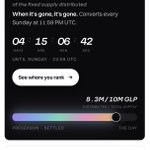
The clock has already started for people who never claimed. From THE DAY, an unclaimed airdrop counts as staked automatically and collects points while it sits locked, and you can still withdraw it whenever you want.
A flat rate is not a flat outcome. Seats are shared in proportion to points at the mainnet snapshot, so a large stake still takes a larger share. What the flat rate removes is the reward for arriving rich, not the advantage of being rich.
It will not make a small staker equal. It does stop the rate itself from working against them.
If you were designing this, where should the advantage sit: more GEN staked, more days staked, or more nodes kept running?

Nfticallyman 🐻⛓️ retweeted

JUDE BELLINGHAM VS MUSIALA
JUDE BELLINGHAM VS COLE PALMER
JUDE BELLINGHAM VS BRUNO
JUDE BELLINGHAM VS ROGERS
JUDE BELLINGHAM VS ODEGAARD
JUDE BELLINGHAM VS CHERKI
JUDE BELLINGHAM VS PEDRI
JUDE BELLINGHAM VS FERMIN LOPEZ
JUDE BELLINGHAM VS NICO PAZ
It’s safe to say that he’s the S.I unit of modern midfielders 🐐


Nfticallyman 🐻⛓️ retweeted

🚨 A Valencia player tried provoking Jude Bellingham by talking about the Ballon d’Or.
🗣️ Jude’s reply: “I do NOT care about the Ballon d’Or AT ALL. It does NOT matter to me. Who will award the Ballon d’Or? You? (Laughs).”
@MMajeedX


Nfticallyman 🐻⛓️ retweeted

Leave the word “point” out of “1 Staking Point per GEN per day” and you change the whole claim.
I'm sharing this for a Rally campaign and may earn a reward.
When @GenLayer's Pre-Mainnet Staking opens on THE DAY, 100 GEN staked for a day earns 100 Staking Points. That's not a promise of 100 GEN paid to your wallet.
Those points feed the live leaderboard. At the mainnet snapshot, Foundation-backed node seats are allocated in proportion to points, subject to eligibility.
To qualify, a node must run on Clarke for at least 30 days. You can run it yourself or use a node-as-a-service partner. The node remains yours either way.
If selected, a node seat means starting mainnet as a validator, initially backed by the Foundation's GEN. Validators earn GEN fees on the transactions they process.
If I made a short clip of this, I'd keep the units on screen: points for the seat allocation, GEN fees for validator work. The points don't guarantee a seat or tell you how much you'll earn.
What's the first misconception you'd correct if you were explaining a node seat to someone new, and why?
Nfticallyman 🐻⛓️ retweeted
Once staking opens, your staked GEN is a speedometer, not an odometer.
It tells you your points-per-day rate, not the points you've already earned.
I'm sharing this for a Rally campaign and may earn a reward.
With @GenLayer, each staked GEN earns 1 Staking Point per day. From THE DAY, an unclaimed airdrop counts automatically while locked.
Suppose the programme runs for at least 30 days and your unclaimed 400 GEN airdrop stays locked from THE DAY throughout.
After day 12, you add 200 GEN in the Portal and keep it staked for the remaining 18 days.
The 400 GEN earns 12,000 points. The extra 200 earns 3,600. Total: 15,600.
Multiplying today's 600 GEN balance by all 30 days gives 18,000, but that counts the extra 200 for days it wasn't staked.
Extra Portal stake can be withdrawn at any time. The unclaimed airdrop in this example remains locked.
The live leaderboard is a preview. At mainnet, Foundation-backed node seats are allocated in proportion to points, subject to eligibility.
One requirement: a node running on Clarke for at least 30 days. You can run it yourself or use a service partner.
I'd want to see how each addition contributed, not just today's balance. Would you prefer a single points total or a breakdown by stake start date? Why?

Nfticallyman 🐻⛓️ retweeted

Shenseea fans don dey swear for Asake kee 😂😂

This Post is from a suspended account. Learn more
Nfticallyman 🐻⛓️ retweeted

Timing matters more than many people think when it comes to GenLayer Pre-Mainnet Staking.
Here’s a simple example: 1,500 GEN earns 1,500 Staking Points daily. After 30 days, that becomes 45,000 points. Wait another 10 days to start, and you miss 15,000 potential points.
What makes this more interesting is that unclaimed GEN airdrops also count as staked from THE DAY, even while locked.
For me, this is not just about holding GEN. It’s about consistency, timing, and earning a place in the validator ecosystem.
The @GenLayer leaderboard makes that progress visible every day.
Early participation can make a real difference. Are you already building your points?
🤝 Paid partnership


Nfticallyman 🐻⛓️ retweeted

Crayon dragged Rema yesterday and within 24 hours Rema cooked a banger snippet to reply him and his haters.
No worry, that boy sabi this music thing.


Nfticallyman 🐻⛓️ retweeted

A lock is only as strong as the exit that follows it.
GenLayer's validators are AI judges, and each one has to lock GEN before it gets a vote so that one person cannot fill the court with their own models. @GenLayer also prices the obvious failures. A judge on the losing side forfeits its fee and pays a penalty of the same size from its own stake, and stake is slashed for idleness and proven fraud.
Both of those bite at the moment of a verdict. Neither of them touches a judge who simply leaves.
The exit is the part I keep circling. Unstaking takes seven epochs, seven days for self stake and delegated stake alike, and the paper says plainly that a staked position earns nothing while it unbonds. Slashes take effect two epochs after the offence. Stake withdrawn after an offence stays liable while it unbonds.
Read those three lines together and the lock changes shape. A judge cannot finish a case and step out of reach of it. For a week the stake that decided a ruling is still the stake that ruling can be charged to, and its owner is collecting nothing in the meantime.
Most staking designs answer one question, which is what it costs to get in. This one answers a second, which is what it costs to leave.
That second price is the one a user never sees. Whoever pays for a verdict has escrowed GEN and is finished. The judge who got it wrong is still holding the same capital a week later, in a position that has stopped paying.
The seat price gets the attention, the 42,000 GEN no judge can get around. The exit delay is quieter, and it is what keeps the seat meaningful after the ruling is written.
Nfticallyman 🐻⛓️ retweeted
The fee a GenLayer judge earns for a decision is the same size as the penalty it pays for getting that decision wrong.
That symmetry is the sharpest line in @GenLayer's tokenomics, and it is easy to skim past.
For anyone new: GenLayer is a court for disputes that code alone cannot settle, with AI validators judging cases in panels. GEN funds it from three sides. Users escrow it to pay for the execution, inference and validation behind a verdict. Validators lock at least 42,000 GEN of their own before they can hold a seat and vote. Builders earn 10% of the fees their contracts generate, claimable by whoever holds that contract's Developer NFT.
Now the part I keep returning to. A validator on the losing side of a verdict forfeits its fee and pays a penalty of the same size out of its own stake. That is not a percentage. Percentage slashing is kept for going idle and for proven fraud, not for an honest model that read the evidence differently.
So an error is priced in the same unit as the work. Punish a wrong call as a slice of stake instead and a large validator risks the same fraction as a small one. Price it as one fee and the cost of being wrong stays tied to the case, not to the size of the balance behind the seat.
The effect on a judge is blunt. Vote with the majority and you keep the fee. Vote with the minority and the same case costs you one. On that line alone, break-even is not uptime. It is being right about as often as you are wrong, on calls where reasonable models disagree.
That also explains the appeals. Overturn a verdict and the same bill lands on the judges who backed it.
If you had to price a wrong call in one unit and keep it forever, what would you choose?
GEN tokenomics is live.
How GEN is staked, spent and earned across GenLayer, all in one paper 👇portal.genlayer.foundation/g…
Nfticallyman 🐻⛓️ retweeted

Locking more GEN does not let a validator purchase a seat in every case.
It buys eligibility to be randomly selected.
On @GenLayer, a validator needs at least 42,000 GEN of its own stake, its own infrastructure and a place among the top 1,543 validators by weight.
When a dispute begins, the jury is sampled from that active set. Stake influences selection probability, but its effect is deliberately sublinear. Doubling stake adds roughly 41% more weight, not 100%.
That distinction matters.
A validator cannot lock GEN and directly choose which case it will judge. It cannot simply buy a verdict. It can only increase the chance of being asked to participate, while keeping capital exposed to penalties for misconduct.
Appeals then draw larger panels, introducing more validators that an attacker would also need to influence.
GEN is therefore the price of becoming accountable enough to enter the jury pool, not a payment for controlling the court.
Should stake guarantee a judge more votes, or only increase the chance of being selected to cast one?
