
Economist, Assistant Professor at the Ross School of Business at the University of Michigan, Senior Economist Obama White House CEA
New York, NY
Joined May 2011
- Tweets607
- Following567
- Followers1.5K
- Likes15.3K






Nirupama Rao retweeted

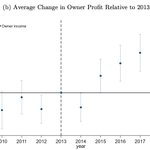
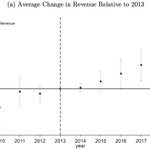
One of the best minimum wage papers to date, leveraging IRS tax data on businesses, matched to individual survey data, and a clean difference-in-difference design using 19 sizable increases in the 2010-2019 period. Sheds light on jobs, revenue, reallocation effects.


#QJE Feb 2026, #7, “Who’s Afraid of the Minimum Wage? Measuring the Impacts on Independent Businesses Using Matched U.S. Tax Returns,” by Rao (@nirupama_rao) and Risch: doi.org/10.1093/qje/qjaf053

Nirupama Rao retweeted
Recently accepted by #QJE, “Who’s Afraid of the Minimum Wage? Measuring the Impacts on Independent Businesses Using Matched U.S. Tax Returns,” by Rao (@nirupama_rao) and Risch: doi.org/10.1093/qje/qjaf053
Thrilled that my paper "The Cost of Curbing Externalities with Market Power: Alcohol Regulations and Tax Alternatives" with @conlon_chris was accepted by the Journal of Political Economy @JPolEcon!

Nirupama Rao retweeted

Equitable Growth nonresident scholar and @MichiganRoss assistant professor @nirupama_rao recently appeared on @BloombergTV to discuss tariffs.
📺 Check out a clip of the interview below and hear Nirupama's unique parachute metaphor:
bloomberg.com/news/videos/20…
Nirupama Rao retweeted

Higher minimum wages improve the quality of care provided in nursing homes without lowering employment. In the November issue, by Krista Ruffini (@KristaRuffini) zurl.co/ayiHX


On the heels of California’s new $20 minimum wage for fast-food workers, my co-author Max Risch of Carnegie Mellon University and I are posting our new working paper on the impact of minimum wage increases on independent businesses. [1/14]
nirupamarao.org/_files/ugd/e…
In the restaurant industry where minimum wages bite most sharply, exit rates rise. But rather than shuttering otherwise healthy businesses, raising the minimum wage winnows the productivity distribution of restaurants, rendering the industry more efficient. [13/14]
In this way, through exit and entry, the minimum wage shapes the productivity distribution of restaurants in a manner akin to how the emergence of new technologies (Collard-Wexler and De Loecker, 2015), exposure to international trade (Melitz, 2003), and recessions (Osotimehin and Pappadà, 2017) can shift the productivity distribution in an industry. [14/14]