
Economist, Assistant Professor at the Ross School of Business at the University of Michigan, Senior Economist Obama White House CEA
New York, NY
Joined May 2011
- Tweets607
- Following567
- Followers1.5K
- Likes15.3K






Nirupama Rao retweeted

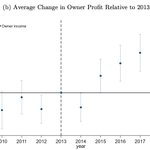
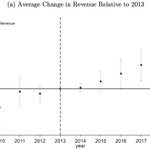
One of the best minimum wage papers to date, leveraging IRS tax data on businesses, matched to individual survey data, and a clean difference-in-difference design using 19 sizable increases in the 2010-2019 period. Sheds light on jobs, revenue, reallocation effects.


#QJE Feb 2026, #7, “Who’s Afraid of the Minimum Wage? Measuring the Impacts on Independent Businesses Using Matched U.S. Tax Returns,” by Rao (@nirupama_rao) and Risch: doi.org/10.1093/qje/qjaf053

Nirupama Rao retweeted
Recently accepted by #QJE, “Who’s Afraid of the Minimum Wage? Measuring the Impacts on Independent Businesses Using Matched U.S. Tax Returns,” by Rao (@nirupama_rao) and Risch: doi.org/10.1093/qje/qjaf053
Nirupama Rao retweeted

Equitable Growth nonresident scholar and @MichiganRoss assistant professor @nirupama_rao recently appeared on @BloombergTV to discuss tariffs.
📺 Check out a clip of the interview below and hear Nirupama's unique parachute metaphor:
bloomberg.com/news/videos/20…
Nirupama Rao retweeted

Higher minimum wages improve the quality of care provided in nursing homes without lowering employment. In the November issue, by Krista Ruffini (@KristaRuffini) zurl.co/ayiHX


Nirupama Rao retweeted

Raising the minimum wage? Study using US tax data finds more gain than pain
Most independent businesses can shoulder the added costs of higher minimum wages with new revenues, making only minor employment adjustments, according to new research from the University of Michigan and Carnegie Mellon University.
The study, which draws on the universe of U.S. tax returns to examine the impacts of minimum wages, debunks concerns that small businesses are hit hard by minimum wage increases. Still, the research reveals a bigger impact on the restaurant industry, where some small, less productive restaurants close while higher minimum wages raise worker retention rates at bigger, more productive restaurants—and even raise profits at those surviving businesses.
“For policymakers weighing tools for redistribution, our results show clearly that minimum wages do little harm to independent firms and even benefit some owners while meaningfully increasing both the earnings and employment of young and low-earning workers,” said Nirupama Rao (@nirupama_rao), a U-M assistant professor of business administration, business economics and public policy at @MichiganRoss, who co-authored the study with Max Risch from Carnegie Mellon.
“Of course, these gains to workers and owners are financed by consumers, who appear fairly inelastic in their overall demand for the goods and services furnished by independent businesses affected by minimum wage policies,” Rao said.
Rao and Risch were able to examine revenue, employment, profits and more following minimum wage increases in six states—thanks to panel data they built that match the universe of U.S. tax returns of independent businesses to the individual income tax returns of each of their workers and owners over a 10-year period. The data compare firms and workers in the states that raised their minimum wages in 2014 to those in states that didn’t.
The bottom line for workers: Higher wage floors ultimately raise the earnings of low-income workers and young workers most likely to be impacted by the policies by thousands of dollars annually. Further, on average, these workers are no less likely to be employed following the minimum wage increases.
Minimum wage hikes also affect hiring and retention, shuffling the types of workers employed in the restaurant sector and by different firms. Wage-floor increases boost worker retention as well as reduce hiring. The net impact is a modest reduction of roughly one worker per firm with the cuts nearly wholly concentrated among part-time teenage workers. These small hiring declines among some restaurants are offset by other firms.
On the firm side, the average independent business in industries such as restaurants and retail is able to accommodate the minimum wage increases through higher revenues. Among restaurants, where low-earning workers make up about 16% of variable costs as opposed to just 6% of production costs among retailers, wage hikes cause some less productive small restaurants to close.
It’s that strong, adverse effect on some small firms that helps explain opposition to minimum wage increases among some small business owners, the researchers say. But they add that at least when it comes to minimum wage increases of the size states adopted in 2014, policymakers “need not worry about a tradeoff between redistribution and job losses or swaths of distressed independent businesses.”
Contact @jeffkaroub or visit news.umich.edu for details.

ALT Concept illustration of rising wages. Image credit: Nicole Smith, made with Midjourney
Nirupama Rao retweeted

At 1 PM ET, join us online or in DC for a #TaxPolicy discussion with @peter_orszag, @SpeakerRyan, @crampell, @NatashaRSarin, @wendyedelberg, @kpomerleau, @KClausing, @nirupama_rao, @econ_harris, and more. hamiltonproject.org/event/up…

Nirupama Rao retweeted

Looking forward to this excellent panel w/ @kpomerleau @econ_harris & @nirupama_rao. In part, we'll chat about my new paper w/
@NatashaRSarin on tax reform in 2025. Our paper suggests a revenue-neutral approach to TCJA extensions & outlines many tax options to reduce deficits.

Hear insights on tax policy options, trade-offs, and consequences from @KClausing, @kpomerleau, @nirupama_rao, and moderator @econ_harris.
RSVP now to see this and more next week: hamiltonproject.org/event/up…


Nirupama Rao retweeted

Charity karaoke to close out another amazing @friendsnewyork_ annual gala!
Thanks to @LenaRockerHall for sharing the stage with this questionable talent… 😉
Nirupama Rao retweeted

1/2 Sign up to attend the 53rd Annual Spring Symposium of @NatlTax! Start Thursday, May 11 off by discussing social policy in the tax code in light of the novel COVID-19 programs that were enacted - and think through a path forward. @dkenyonnh ntanet.org/2023/01/53rd-annu…
Nirupama Rao retweeted

Today in distortions caused by crazy liquor laws:

In a bombshell, @Oregonian has uncovered that liquor control executives kept popular booze -- including Pappy Van Winkle -- for themselves, diverting it from public oregonlive.com/politics/2023…
Nirupama Rao retweeted
People always ask why I think restricting competition is a bad way to address externalities. This is why:

Using market power to address negative externalities is much less effective than simple tax instruments, which could reduce drinking by 9% and increase consumer surplus, from @conlon_chris and @nirupama_rao nber.org/papers/w30896

Nirupama Rao retweeted

This is a terrific group of papers and authors that I’m excited to see tomorrow!

On Sunday at 10:15, please join us at #ASSA2023 for “Vertical Contracting and Vertical Restraints” aeaweb.org/conference/2023/p…

Nirupama Rao retweeted
⏰ 8 AM CST: Join as our @LipstickEcon chairs "New Research on Minimum Wage Increases", where @benzipperer + Orley Ashenfelter will discuss work from #EGgrantee(s) @ashdgandhi, @KristaRuffini, @JCWetCoast & @nirupama_rao ➕ @CSanchezCumming & @CoreyHusak. aeaweb.org/conference/2023/p…
Nirupama Rao retweeted
A small number of households pay the bulk of taxes on sin goods like alcohol and cigarettes. Just accepted, "Who Pays Sin Taxes? Understanding the Overlapping Burdens of Corrective Taxes" by C. Conlon (@conlon_chris) N. Rao (@nirupama_rao), and Y. Wang zcu.io/GPw1
Nirupama Rao retweeted

Please RT: We are looking for a strong candidate as Associate Professorship (W2; 6 years/tenure track) of Evidence-based Economics at @ECONMunich @LMU_Muenchen
Deadline: October 23, 2022
job-portal.lmu.de/jobposting…
@CESifoNetwork @ifo_Institut


Nirupama Rao retweeted

If Taylor Swift dated an economist:
You were holding all else equal
When you shoulda been holding me
Nirupama Rao retweeted

Considering applying for an economics PhD? The student-led MIT and Harvard Application Assistance and Mentoring Program helps students from underrepresented groups connect with a grad student mentor. Applications are open until August 5! Learn more at economics.mit.edu/graduate/a…

Nirupama Rao retweeted
From the appendix of our recently accepted @restatjournal with @nirupama_rao and Yinan Wang. The tax per Liter of ethanol almost 20x as large for spirits as it is for beer in the US. In the UK, beer taxes are similar but spirits taxes are 3x as large (!)


Huh, apparently we are having a white claw summer due to tax arbitrage: it qualifies for the lower tax rates intended for beer products
joshbarro.com/p/why-white-cl…