

Archaeology prof at @SFU. BA from Sheffield Archaeology (since destroyed by the management). PhD from Liverpool Anatomy. Trainee Canadian. From Essex, UK.
Vancouver, Canada
Joined December 2015
- Tweets30.3K
- Following2.5K
- Followers2.7K
- Likes21K




Mark Collard retweeted

We announce the dedication of a new unit to celebrate the legacy of our Director, Dr Kumar Akhilesh (1975-2026): Kumar Akhilesh Prehistory & Human Origins Division
We will shortly announce the dates for the Legacy Lecture Series, Workshops, Grant and release of the Memorial Vol.

Mark Collard retweeted

Book your tickets!!
The @RoyalAnthro Huxley Lecture by Rob Foley on November 30 2026 @ 5:30 am - 7:30 pm at the Linean Society 😍🤩!!
therai.org.uk/events/the-roy…
Mark Collard retweeted

Imagine a world transformed by ice, followed by one reshaped by warmth and forests. Across these shifting landscapes, Neanderthals faced radically different environmental conditions.
But did their way of life evolve with the changing climate?
🔬 By comparing archaeological evidence from MIS 6 and MIS 5e, researchers uncover a surprising pattern: despite dramatic environmental shifts, Neanderthal stone tool technologies and subsistence strategies remained remarkably stable.
🪨 Did their survival depend on changing their ways, or on making the most of what they already knew?
Perhaps adaptability was not always about innovation. Perhaps it lay in the flexibility of familiar technologies, applied across different environments.
🔍 Yet, the archaeological record holds another mystery. Could rare innovations and exceptional cultural behaviours remain hidden within large-scale datasets?
🧠 When the world changes, does survival demand transformation, or can continuity itself be a form of adaptation?
📖 Read the paper to explore what archaeological evidence reveals about Neanderthal behaviour, cultural flexibility, and life in a changing Ice Age world.
Reference
Sommer, C., Haidle, M. N., Bolus, M., Bruch, A. A., Hertler, C., Kanaeva, Z., ... Kandel, A. W. (2026). Testing the limits of archaeological datasets: Neanderthal behavior during the MIS 6–MIS 5e glacial cycle indicates cultural flexibility. Quaternary Environments and Humans, 4, 100117. doi.org/10.1016/j.qeh.2026.1…
#Neanderthals #Palaeoanthropology #Archaeology

Mark Collard retweeted
A moment of appreciation for the beautiful arches in the Museum - it’s not nicknamed ‘the cathedral to nature' for nothing! 😍✨

ALT A large brick arch adorned with sculptures shaped like monkeys. In the background, there are multiple windows and arches.

ALT A group of four columns in the foreground, with a large staircase in the background. The tail of a blue whale skeleton can be seen hung from the ceiling.

ALT A large brick arch adorned with sculptures shaped like monkeys with floral elements.
Mark Collard retweeted

The deadliest primate: Contest competition and the evolution of human males
sciencedirect.com/science/ar…
Mark Collard retweeted

Atkinson has perfectly mastered the art of looking extremely unimpressed.
Rowan Atkinson interviews Elton John at Hysteria 3 (1991).
Mark Collard retweeted

‘We band of brothers, for he today who sheds his blood with me shall be my brother...’
Happy St Crispin's Day 🏴🏴
Mark Collard retweeted

Probably my favourite version. It's much less bombastic than Olivier's or Branagh's.
#StCrispinsDay


Mark Collard retweeted

The Sebastopol Monument (also known as the Welsford-Parker Monument) was built in Halifax, Nova Scotia in 1860 to commemorate the Nova Scotians who fought and died in the Crimean war. It is the 4th oldest war memorial in Canada and the only Crimean War memorial in North America.


I thoroughly enjoyed this Tiny Desk concert by the UK's Brìghde Chaimbeul.
I wish we'd been required to learn Gaelic and Welsh when I was at primary and secondary school. I think all kids in the UK would benefit from being taught the other main languages of the country, and I think the UK would benefit from them doing so.
youtu.be/_Mp_bpIZKlI?si=JWJn…

Mark Collard retweeted

The extraordinary story of French Resistance hero, FRANCFORT, Albert Lucien: Shot, executed, gunned down ... His grave was recently cared for by Gilles Guinard and his daughter.
Born June 15, 1915, in Versonnex (Ain); summarily executed on August 16, 1944, in Annecy (Haute-Savoie); farmer; member of the French Fighting Forces (FFC) Resistance.
Albert Francfort, son of Alexis and Renée Fournier, was a farmer in his native commune at the time of the events and was passing through Annecy.
Taken prisoner in 1940 in Dortmund, he escaped in 1943. He joined the Resistance as part of the Ajax network (FFC), registered in London under number F/3084.
On Wednesday, August 16, 1944—three days before the liberation of Annecy—an unidentified man was arrested at a checkpoint set up by the Germans on the Avenue d’Albigny, just a few meters from Villa Schmid, the Gestapo headquarters for the department. A German soldier, pistol in hand, marched his prisoner toward the villa; however, the man managed to seize the soldier’s weapon, shoot him, and flee.
In retaliation, the enemy ordered the execution of four hostages. Two were arrested immediately (some sources claim they were simply passing by on the street, though this seems unlikely): Albert Francfort* and Jean Gailliot*. Jean Alexis Bouchard*—who was undergoing interrogation at Villa Schmid—and Dr. Hubert Laurent*, a well-known figure in Annecy, were the other two victims of these reprisals.
Albert Francfort was thus executed by the Germans on the Avenue d’Albigny in Annecy on August 16, 1944. (Memorial of the Oppression, 3808 W 1379). According to MémorialGenWeb, he was tortured before being executed by firing squad. He was buried in Versonnex on December 10, 1944.
He was officially recognized as having "Died for France" (*Mort pour la France*) on July 18, 1946 (files no. 14,907 and 83,522), granted status as a member of the FFC (French Fighting Forces), and awarded a service certificate signed by Field Marshal Montgomery. His name appears on the stele erected at the site of the execution (in front of the present-day Sainte-Bernadette church).


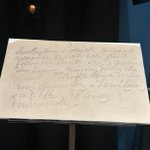
Today is the 172nd anniversary of the Charge of the Light Brigade, which took place on 25 October 1854 during the Battle of Balaklava in what is now Russian-occupied Crimea, Ukraine. The photo shows the note that led to the Charge. Among the many fascinating artefacts held by @NAM_London, it’s perhaps my favourite. The note reads as follows:
"Lord Raglan wishes the Cavalry to advance rapidly to the front — follow the Enemy & try to prevent the Enemy carrying away the guns — Troop Horse Artillery may accompany — French Cavalry is on yr left.
Immediate—
R. Airey"

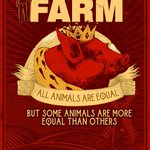
Okay, so it's a tough choice between that artefact and this one for my favourite.
nitter.cf/profmarkcollard/status…


Mark Collard retweeted

Today is the anniversary of the death of Geoffrey Chaucer, the father of English poetry… 📜✨
Historian @holland_tom uncovers the impact of the Black Death on Chaucer’s life, and how it influenced The Canterbury Tales...
Watch lecture: gres.hm/pilgrimages-holland
@TheRestHistory
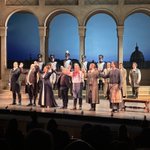
We attended a cracking performance of ‘Tosca’ by @VancouverOpera this evening. Well worth going if you can get your hands on a ticket. Three thumbs up.

Mark Collard retweeted

A wonderful obituary of Chris Wickham theguardian.com/books/2026/o…

Mark Collard retweeted
Females shape hunting of vertebrates in wild bonobos: Current Biology cell.com/current-biology/ful…

Healthcare in this province is such a mess.

WATCH: “I think they’re killing people.”
Same PET scanners used for private and public cancer scans yet @BCCancer only using a fraction of its available slots.
Patient who paid got a refund after complaining to his NDP MLA.
#bcpoli
@GlobalBC
@CUrquhartGlobal