








adi.gwei 💗 retweeted

Our CROPS guide now includes six projects 💗
@eas_eth and @0xSplits V2 are the latest additions and we’ve also shared forum reviews for @tacitfi and @Rocket_Pool, outlining what still needs work before they can join.
Here’s the full update 👇

adi.gwei 💗 retweeted
In case you missed this resource, it's a clear example of the hidden trust assumptions in everyday blockchain use!
When you bridge or swap something in your wallet, behind the scenes your transaction passes through a bunch of companies and services before it reaches Ethereum, and intermediaries can collect your data, block transactions, or even influence what you end up signing.
ethereumtransitauthority.com… makes this easier to understand by turning it into a subway map. Using actual wallet source code and network traffic, it shows where your IP, balances, recipient address, and signed transaction go, which RPCs, screening services, relays, and wallet backends get involved, and where things could go wrong. Even running your own node doesn't necessarily stop all the leaks.
At ETHBEAT we spend a lot of time looking at what protocols actually inherit from Ethereum onchain, but we've also been digging into these offchain trust assumptions through our privacy research, since a single weak intermediary there can break the whole promise of the system. Both sides have to hold up for users to actually be protected, so huge shoutout to @austingriffith for putting this together and making the offchain layer easier to understand.


what data leaks from wallets
a visualization
youtu.be/CxmUuYvj2mM

adi.gwei 💗 retweeted
'Not your keys - not your coins' sounds simple enough.
But the @fluidkey hack shows that different sources use the 'self-custody' label differently.


adi.gwei 💗 retweeted

If only there was some way of knowing that Fluidkey app had access to the keys and a hack of their infra could drain a lot of funds...

adi.gwei 💗 retweeted

relayers are backbone of funding new, private accounts, but they charge you a fee
so I built a public good, that charges no fee (only gas+buffer) and routes over @torproject
first supported privacy project is @0xprivacypools, with more to follow soon
privacy is normal

adi.gwei 💗 retweeted

Canada is going through its own version of the Chat Control mess with the C-22 bill:
blog.mozilla.org/netpolicy/2…
Highly encourage fellow Canadians to contact senators and make clear how you feel about the importance of (backdoor-free, no asterisks) end-to-end encryption, and its benefits to a secure, free and open society.
Particularly given that we're entering a difficult transition period for cybersecurity due to AI, it's even more important than before that we (i) minimize all backdoors and mass data collection, and (ii) give users very clear and legible guarantees about what kind of security they are getting, with no weasel language.

adi.gwei 💗 retweeted
New in the CROPS guide: @eas_eth 💗
We already use it for our own CROPS attestations. Here’s what earned its Ethereum deployment a place 👇

adi.gwei 💗 retweeted

Spot the difference is a kids' game, not a code review.
So I built Peekaboo: a Chrome extension that stacks the Before/After screenshots in GitHub PRs. Click to flip, or diff to see only what changed.
Free and open source 👇
adi.gwei 💗 retweeted
Someone could work out your balance even when your transaction amounts are encrypted.
If you missed @donnoh_eth's talk at Devcon, here’s a short clip showing how public information can give you away 👇
adi.gwei 💗 retweeted
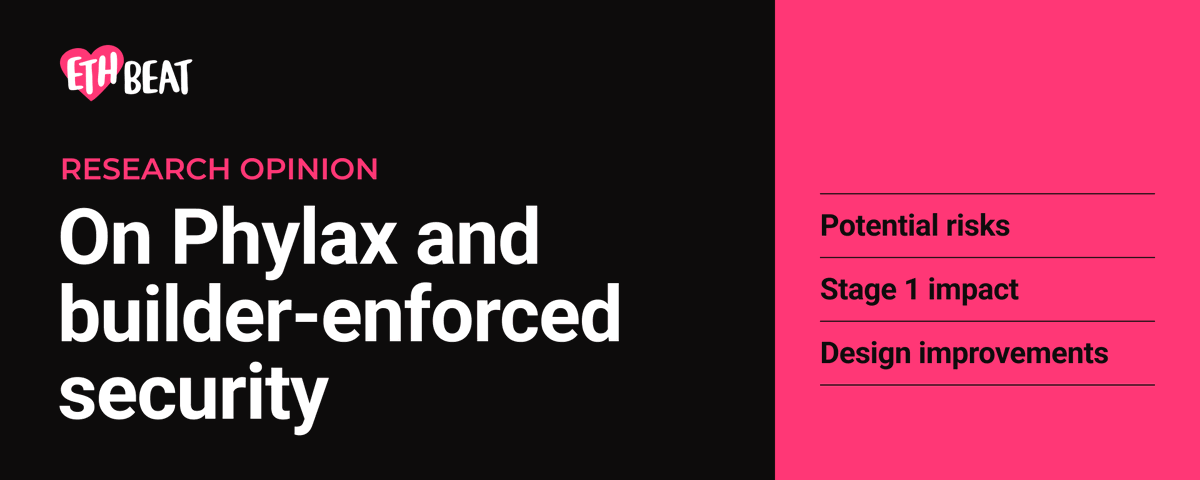
Phylax (@phylaxsystems) lets apps add circuit breakers that are enforced by block builders during block construction.
Here’s our take on the risks, the impact on Stage 1, and how to improve the design.
love watching the CROPS garden grow 🌸 welcome @0xSplits

Splitting payments! A popular, simple use case for a blockchain app that shouldn’t require the team behind it to stay around.
@0xSplits is now in the CROPS guide 💗
Our review looks at how its contracts work without the team or its interfaces, and where users still need to pay attention 👇

1
11
389
adi.gwei 💗 retweeted
With our rebrand to ETHBEAT, we launched The CROPS Guide - a curated list protocols that hold up on censorship resistance, open source, privacy and security.
Because “built on Ethereum” means little if the applications on top of it keep introducing intermediaries.
There are currently 4 protocols that make the list: @TornadoCash, @Uniswap V2 and V3, and @safe, and here’s what we check before a project is listed there 👇

adi.gwei 💗 retweeted
Catch our own @kaereste at Capital Summit in London tomorrow 💗
He’ll moderate “Staking Economics and the Market for Block Space,” discussing how validator revenue is changing and what that means for staking yield and risk.
Around town? Come say hi!

How are block space markets changing where validator revenue comes from, and what do new revenue sources mean for staking yield and the risks holders take on?
How are institutional stakers and liquid staking providers responding to these shifts, and how is the economics of block space reshaping competition between operators?
On stage:
Kaushal Vyas, EthSystems
@Kean_Gilbert, @LidoFinance
Yuki Kishi, @BitMNR
@KamBenbrik, @Bitwise
Moderator:
Krzysztof Urbanski, L2BEAT (@ethbeat_org)
Secure your spot: london2026.stablesummit.xyz


adi.gwei 💗 retweeted
When reviewing privacy protocols at ETHBEAT, we don’t stop at what a protocol promises on paper. We check the apps people actually use it with, and rate it with the most private one we can find.
Which apps we checked is now visible on each privacy protocol’s page.




adi.gwei 💗 retweeted
L2BEAT is now ETHBEAT, and one of the core ideas behind our mandate is disintermediation. Why does it matter?
Because disintermediation is still one of the most effective ways to protect individual freedom. Intermediaries concentrate power, which makes that power easier to abuse and also creates single points of failure that can affect millions of people.
The recent collapse of Ueno Bank in Paraguay showed this: ~3M people, about 60% of the country's adults, were locked out of their savings, wages and pensions overnight. And that is just the latest example. Before it, we've seen custodians misuse or freeze customer funds, banks turn deposits into equity, data holders expose users to governments and scammers, and more.
Ethereum's value lies in its decentralization, together with the CROPS properties (censorship resistance, open source, privacy, and security), which create a more durable form of stability when other systems come under pressure. Anyone can verify the chain using consumer hardware, independently built clients and open specifications.
ETHBEAT's mandate is to help ensure that the applications and infrastructure built on Ethereum actually forward those properties to users, rather than recreating the same intermediary dependencies we've been trying to reduce in the first place.
Read the full mandate here: ethbeat.org/mandate/

adi.gwei 💗 retweeted
What would a Michelin Guide for onchain protocols look like?
At @EFDevcon, @donnoh_eth introduced The CROPS guide and showed how we review projects against the four principles: censorship resistance, open source, privacy and security.
The full talk walks through the research behind the guide and introduces its first selection of projects.
If you missed it, you can watch it here:
youtube.com/watch?v=AJH9TpKg…