

Co-founder @PageIndexAI. AI × DB. Make databases great again!
Oxford
Joined July 2010
- Tweets52
- Following1.5K
- Followers135
- Likes1.8K
Ray retweeted

Search like a human does - by semantically traversing a hierarchy with jev

Inspired by @EGafni’s Twitter thread on combining Jev with PageIndex.
We show how to build long-document search with @typesafeai Jev + PageIndex.
No vector database. No embeddings.
Open source: github.com/VectifyAI/jev-doc…
🧵👇

Ray retweeted

Jev can’t do any of these:
1. Image inputs
2. String, integer, and number types
3. Dependency execution in a single call
TypeLLM can.
Try it: github.com/TypeLLM/TypeLLM
Ray retweeted

Excited to see PageIndex featured in next week's Frontier of AI Search. Thanks @softwaredoug for organizing and bringing together all these great developments across AI search and retrieval.

Frontier of AI Search continues next week with talks about PageIndex and optimizing Elasticsearch for vector search
maven.com/lls/f48679

As a DB guy, this means a lot.
The analogy holds: routing summaries at internal nodes, content at the leaves, bounded fan-out for shallow, accurate routing. We swap key comparison for LLM reasoning, so retrieval becomes inference, not lookup.
Same skeleton. New brain.

Ray retweeted
PageIndex crossed 30K stars on GitHub ⭐, now at 31.9K and still climbing fast.
With our recently launched PageIndex File System, we are building the long-context AI knowledge infra for vectorless, reasoning-based retrieval at scale.
Thanks to everyone who starred, tried, shared feedback, and built with PageIndex. More to come.

Ray retweeted
We solved the biggest problem with @karpathy’s LLM Wiki.
He pointed out the hard part: long PDFs and books don’t work well unless you process them carefully in stages.
That’s exactly what OpenKB fixes.
With PageIndex, OpenKB scales to long PDFs by turning them into a hierarchical tree for better wiki generation.

You need reasoning for retrieval.
“You don’t need a trillion tokens at once, you need the right million.”
3 takeaways from @JeffDean at @nvidia GTC (March 2026) on long context & retrieval:
1. “Models are very good when you put the right information in the context window”
→ Retrieval isn’t optional; it’s the bottleneck.
2. “The attention window is never big enough”
→ Scaling context ≠ solving retrieval.
3. “The right approach is staged retrieval”
→ Hierarchical retrieval is the future.
How do we design a hierarchical retrieval mechanism? 👇
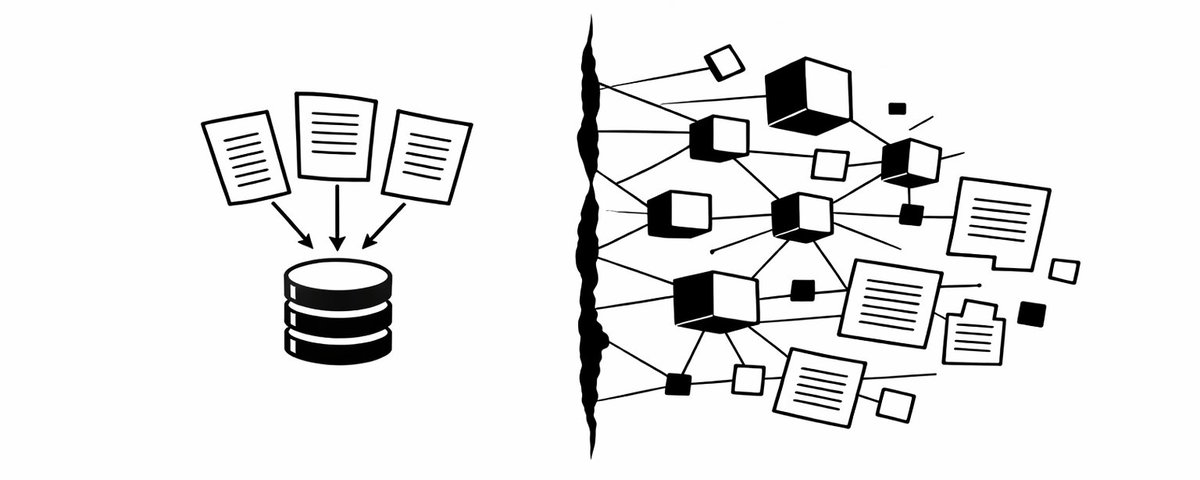
Thrilled to see PageIndex covered by VentureBeat!

PageIndex, a new open-source framework, achieves 98.7% accuracy on complex document retrieval by using tree search instead of vector embeddings. The approach eliminates the need for dedicated vector databases.
venturebeat.com/ai/this-tree…

Ray retweeted

Researchers built a new RAG approach that:
- does not need a vector DB.
- does not embed data.
- involves no chunking.
- performs no similarity search.
And it hit 98.7% accuracy on a financial benchmark (SOTA).
Here's the core problem with RAG that this new approach solves:
Traditional RAG chunks documents, embeds them into vectors, and retrieves based on semantic similarity.
But similarity ≠ relevance.
When you ask "What were the debt trends in 2023?", a vector search returns chunks that look similar.
But the actual answer might be buried in some Appendix, referenced on some page, in a section that shares zero semantic overlap with your query.
Traditional RAG would likely never find it.
PageIndex (open-source) solves this.
Instead of chunking and embedding, PageIndex builds a hierarchical tree structure from your documents, like an intelligent table of contents.
Then it uses reasoning to traverse that tree.
For instance, the model doesn't ask: "What text looks similar to this query?"
Instead, it asks: "Based on this document's structure, where would a human expert look for this answer?"
That's a fundamentally different approach with:
- No arbitrary chunking that breaks context.
- No vector DB infrastructure to maintain.
- Traceable retrieval to see exactly why it chose a specific section.
- The ability to see in-document references ("see Table 5.3") the way a human would.
But here's the deeper issue that it solves.
Vector search treats every query as independent.
But documents have structure and logic, like sections that reference other sections and context that builds across pages.
PageIndex respects that structure instead of flattening it into embeddings.
Do note that this approach may not make sense in every use case since traditional vector search is still fast, simple, and works well for many applications.
But for professional documents that require domain expertise and multi-step reasoning, this tree-based, reasoning-first approach shines.
For instance, PageIndex achieved 98.7% accuracy on FinanceBench, significantly outperforming traditional vector-based RAG systems on complex financial document analysis.
Everything is fully open-source, so you can see the full implementation in GitHub and try it yourself.
I have shared the GitHub repo in the replies!
Vectorless RAG - yet with higher accuracy.
🚀 A simple Python tutorial of Vectorless RAG with PageIndex: docs.pageindex.ai/cookbook/v…
Ray retweeted
Tired of the poor accuracy of vector-based RAG on long documents? Time to say goodbye to "Vibe Retrieval"👋
🚀 We are excited to announce PageIndex — the next-generation, reasoning-based RAG without any Vector DBs.
#RAG #LLM #retrieval
Ray retweeted
🚀 Frustrated with current PDF-to-Markdown tools that always produce the wrong heading levels? We introduce PageIndex OCR—the first long-context OCR model designed to preserve the global structure of your documents.
pageindex.ai/blog/ocr
Ray retweeted
❌ No vectors, no chunking
🧠 Reasoning-based RAG
Most RAG retrieves by similarity, but similarity ≠ relevance. Relevance needs reasoning 💡
📄 PageIndex turns PDFs into search trees your AI agents can reason through — like a smart table of contents.
github.com/VectifyAI/PageInd…

Ray retweeted
Introducing Mafin2, your next-gen AI financial copilot from Vectify AI. Learn more on our website: vectify.ai/.
#AI #Fintech #FinancialAssistant #Mafin2
Ray retweeted
Looking to fine-tune OpenAI's embeddings with your proprietary data? Introducing Mafin: a powerful and efficient framework designed for the fine-tuning of black-box embedding models.
arxiv.org/abs/2402.12177

Stay tuned!
How to improve OpenAI embeddings in your RAG pipeline?
Introducing the Fine-Tuning Augmented Embedding (FAE)! 🚀 A method that can ''fine-tune'' the black box @OpenAI's text embedding model on your data and boost retrieval performance.
See vectify.ai/blog/HowToImprove… for details.
Ray retweeted
How to choose the right chunk size when summarizing large documents with LLM?
We've developed a method to automatically determine the optimal chunk size for large document summarization, improving the quality of the summary.
See our blog vectify.ai/blog/LargeDocumen… for details.