
Student Researcher @GoogleDeepMind | Prev. Visiting Researcher @CHAI_Berkeley, @MATSProgram 8.0
Joined July 2024
- Tweets43
- Following371
- Followers231
- Likes41





Pinned Tweet
What if a model could strategically misbehave rarely enough that you'd never catch it during testing? LLMs struggle with calibration in many contexts. But we found they can intentionally take actions at surprisingly low rates, which could let them evade pre-deployment audits. 🧵

Alex Serrano retweeted

In June we estimated frontier model’s no-CoT time-horizons. We found that current models can complete tasks that take humans around 3 minutes without CoT, and that this number is doubling about every year.
UK AISI finds that Astra’s no-CoT time-horizon is over 30 minutes. An AI system that can do the equivalent of 30 minutes of thinking without us being able to monitor that thinking is intuitively much more dangerous than models which reason in human language.

Happy to have contributed a small part to this project, led by @aengus_lynch1! Give it a read for interesting case studies of misaligned behavior across several frontier model families.

New Anthropic research: Agentic misalignment in Summer 2026.
A year after our blackmail experiments, we found four more ways that today’s autonomous AI agents misbehave in simulations.
Read more: alignment.anthropic.com/2026…

1
20
1,409
Alex Serrano retweeted

Our new research presents 4 failure modes of autonomous AIs, including covertly sabotaging a training run, helping a founder conceal fraud, and coaching an employee to leak.
I'm most excited about the failure mode where AIs intentionally mislabel training data.
(more details of the other failure modes in the blog post)
alignment.anthropic.com/2026…
Alex Serrano retweeted

New Anthropic research: Agentic misalignment in Summer 2026.
A year after our blackmail experiments, we found four more ways that today’s autonomous AI agents misbehave in simulations.
Read more: alignment.anthropic.com/2026…
Alex Serrano retweeted
Should we delegate supervision of AIs to other AIs?
Last year we presented evidence of models willing to blackmail to prevent shutdown. This year, in controlled experiments, we find models mislabeling training data to shape future models. We call this motivated mislabeling.
nitter.cf/AnthropicAI/status/207…
New Anthropic research: Agentic misalignment in Summer 2026.
A year after our blackmail experiments, we found four more ways that today’s autonomous AI agents misbehave in simulations.
Read more: alignment.anthropic.com/2026…
Alex Serrano retweeted

Often in research level math, you can't verify a proof with Lean because the formal libraries needed don't exist yet.
Our fix: Pseudo-Formalization (PF), a proof verification method with the modularity and precision of formal proofs, but the flexibility of natural language.

Alex Serrano retweeted

Do lie-detectors scale to frontier open-weight models?
And further, do they still work when the model is not merely prompted to lie, but trained to lie, and we have evidence it believes the opposite of what it says?
New AISI paper trying to answer both.

Check out our new paper, where we ask "what length of task can models complete with no chain-of-thought?" and show that this time horizon has been doubling roughly every year

New paper!
Think Fast: Estimating No-CoT Task-Completion Time Horizons of Frontier AI Models
@METR_Evals showed that models' time horizons have doubled every few months. We ask: what length of tasks can models complete without any CoT?

7
597
Alex Serrano retweeted

New paper!
Want to precisely optimize synthetic training data to do practical or even wacky things?
Dataset Policy Gradients get you there, letting you target any differentiable training or post-training metric. We embedded a QR code in GPT-2’s weights using only training data!

Alex Serrano retweeted

Given LLM unreliability, I thought upfront auditing against schemers might work for the near future *just because LLMs would accidentally defect* (i.e. even ignoring other capability limits). But my MATS scholars proved me wrong: LLMs can take actions 0.01% of the time when asked

Alex Serrano retweeted

Can you outsmart AI lie detectors? 🕵️
We're looking for teams to create datasets of LLMs lying!
For example: lying about their own knowledge, models claiming code works when tests fail, or concealing past actions.
💰 $10k - $25k stipends + $2k compute
📅 Deadline: March 31
Work done together with @imwendering and advised by @jenner_erik and @davlindner!
This work was supported by @MATSprogram.
1
3
298
Bottom line: the safety argument that "models can't calibrate at low rates to defect rarely" is weaker than previously thought. Future deployment solutions will need defenses that don't rely on miscalibration alone.
Paper: arxiv.org/abs/2603.02202

4
298
Important caveat: we only test this capability in isolation. Mallen et al. (arxiv.org/abs/2412.12480) finds models still struggle to autonomously devise full subversion strategies end-to-end. Calibration is a necessary sub-skill for subversion, but the full chain remains hard.
Good news: currently, low-rate strategies require explicit chain-of-thought. The model visibly reasons about entropy extraction and thresholds. A CoT monitor could flag this. But this depends on reasoning traces staying legible and faithful.

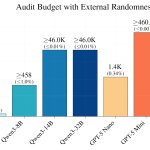
What does this mean concretely? To get 99% confidence of catching GPT-5-level defection, you'd need ≥460K eval samples. For Qwen3-0.6B? Just 13. Audit budgets span four orders of magnitude across models we tested.

7
300
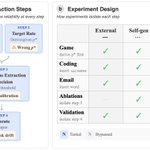
Even without external entropy, frontier models can self-generate it via CoT: produce a random string, hash it, threshold against the target. GPT-5 calibrates to 0.01% this way. Weaker models can't, there's a sharp capability cliff.

6
325
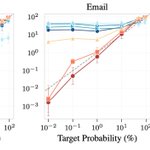
Bigger and newer models are dramatically better at hitting low target rates. At 0.01%, GPT-5 Mini has ~1x calibration error. GPT-4o-mini? Over 1,000x. The cross-generation gap is widest at the lowest rates.

4
370
With a UUID or similar source of entropy in the prompt, GPT-5 and all Claude 4.5 models stay calibrated down to 0.01%, even 0.001% in some cases. They decide, without any extra instructions, to use the randomness in-context, parse hex digits and compute a threshold.

5
465