








Pinned Tweet
We're open-sourcing PulseBench-Tab, a frontier benchmark for table extraction.
Table parsing remains one of the hardest and most poorly measured problems in document intelligence. TEDS operates on DOM trees and conflates HTML formatting conventions with structural errors. Needleman-Wunsch linearizes a two-dimensional structure into a one-dimensional sequence, so column transpositions can still score well because values align with nearby cells. GriTS uses greedy grid matching rather than optimal assignment and does not distinguish edge directions. The upshot: existing metrics cannot reliably separate content errors from structural errors, which makes provider comparisons noisy and downstream reliability unknowable.
Alongside the dataset, our research team developed T-LAG. It parses each table into a cell-position grid, emits directed RIGHT and BELOW adjacency edges (suppressed within spanning cells, deduplicated by source, target, and direction), weights each candidate edge pair by the product of Levenshtein-derived similarities on source and target text, and uses the Hungarian algorithm for globally optimal one-to-one assignment. The F1 over matched edge weight is the T-LAG score. Structure and content are evaluated in one unified pass. HTML formatting choices do not affect the result. Rankings are invariant to the similarity exponent across k ∈ {7, 8, 9, 11}.
The dataset contains 1,820 human-annotated tables across 9 languages and 4 scripts (Latin, CJK, Arabic, Cyrillic), drawn from 380 real-world financial filings, government reports, and regulatory disclosures. Tables range from 2 to 1,183 cells; 48.1% contain merged or spanning cells. Ground truth was produced through 8 annotation rounds with native speakers per language, independent cross-lingual review, and adversarial cell-by-cell audits against source images.
We evaluated 9 commercial and open-source systems independently across the full dataset under exclude-missing scoring. Selected findings:
@Pulse__AI Ultra 2 scores 0.9347 T-LAG; the next closest system scores 0.8155. Pulse Ultra 2 is the only provider with a median of 1.0, corresponding to perfect extraction on 57.9% of samples.
Non-Latin scripts produce the widest cross-provider variance. On Arabic, the spread between top and bottom systems exceeds 75 percentage points.
Structural hallucinations are pervasive. The second-ranked system achieves a perfect-extraction rate of 28.6%, meaning structural or content errors on 71.4% of tables (fabricated rows, invented content, incorrect span attributes, shifted data).
Coverage failure is underreported. Multiple evaluated systems return no output on 19% to 21% of samples. Raw accuracy numbers without coverage disclosure favor selection bias.
Thank you to Dushyanth Sekhar and Mohammed Hadi of S&P Global's Enterprise Data Organization for their academic contributions to the benchmark methodology.
Dataset: huggingface.co/datasets/puls…
Evaluation: github.com/Pulse-Software-Co…
Blog: runpulse.com/blog/pulsebench…
Research methodology: benchmark.runpulse.com/resea…
Viewer: benchmark.runpulse.com

sid retweeted

.@Pulse__AI API V2 is live!
The result is cleaner inputs, more consistent output formats, support for larger and more complex documents, improved batch processing, updated webhooks, and stronger data security throughout.
V2 is also where everything new will ship from here on, including the latest iterations of the Ultra series of models.
We have been working really hard on making this the best developer experience we can, excited to see what folks think + build with Pulse.


Lots of love going into the @Pulse__AI API these past few weeks. the engineering team and I have literally been holed up in our conf room for the past 13 days in design meetings.
We think the bar for products in our space should be a lot higher. great models deserve an equally great API, thoughtfully designed down to the smallest details.
Can’t wait to show what we’ve been cooking. Sneak peeks coming soon…
sid retweeted
Working in the VLM space, we’ve seen these repetition loops pop up occasionally.
usually tweaking repetition/frequency penalties, top-p sampling, and adding stop sequences in vllm/sglang gets you pretty far ( it’s never a perfect fix)
Super cool seeing frontier models go a level deeper and directly edit the weights themselves.
Automated model debugging is abo ut to get really interesting…

OCR models often get stuck in loops, so I asked Claude Opus if it could stop one from looping by editing its weights.
It changed 0.0085% of them and with no training, it now reads this 1881 page instead of writing 16,399 characters of dots!
Prompt was basically: "read this, find a smallish OCR model and fix its repetition doom loops. You can spend up to 5 hours and $100 on @huggingface Jobs."
It only took under 3 hours in the end and about $10 of Jobs compute.

sid retweeted

Exactly a year ago today, we launched Starcloud-1 to space. To celebrate its birthday 🥳, we have put together some previously unseen footage we have from around the launch. I particularly like the footage we have of the @Starcloud_ kids! 😅👌
Starcloud-1 is operating today with the only @NVIDIA H100 in space, still the most powerful SI compute on orbit. With it we became the first entity to do training and high powered inference on orbit, and we now have 3 more launches coming up in the next year! We are planning to move almost all compute off Earth 🚀
See the careers page on our website if you want to join this awesome team!
Teams are turning thousands of mixed pages into uniform datasets on the @Pulse__AI platform.
→ Upload a complex file
→ Classify sorts each page by document type
→ Split handles merged scans
→ Schemas extract with type-specific nuance
sid retweeted
Awesome benchmark by @SemiAnalysis_ ! We at @Pulse__AI find this kind of work incredibly useful, especially as we think about what it actually takes to get agents working in complex, regulated industries like finance, insurance, and energy.
There's an enormous amount of economic value locked up in these domains, much of it in reasoning over the information inside messy documents and fragmented data. Understanding how the frontier models reliably work with this data is a huge part of unlocking that value.
Excited to see more benchmarks focused on these industries. I think there's still a massive amount of headroom here and we'll see a huge push by the labs here in 2027 (even starting now).


sid retweeted

amazing event by the @ArtificialAnlys team!
handing out hard copies of GDP.pdf to anyone who wants one

sid retweeted

Financial doc pipelines don't stall at the model; they stall at the review queue.
Cut manual review from 500 fields to the 5 that need it most by leveraging the @Pulse__AI platform:
→ Visit source page next to the fields
→ Use typed fields, not text
→ Calibrate by confidence (0.9 = ~90% accurate)
→ Sort by score and correct only what’s critical
Read more here, example below:

sid retweeted
Build a culture where standup is followed by random mini-lectures on everything from physical memory to whatever someone went down a rabbit hole on that week.
FYI, we’re hiring if this sounds like your kind of place!


sid retweeted
@morgancfung joined us earlier this year and within his first couple months he:
- Played an instrumental role in the development and launch of the Pulse MCP
- Enabled agentic payments on our platform
- Improved our schema endpoint
- … and has been steadily building ever since.
Morgan came on ready to hit the ground running, and his energy for the mission has been apparent not only in what he ships but how he does it. I’ve seen him meet every question with curiosity.
We’re hiring for people who are energized by the idea of having a story like this. Roles below in comment!

Watching this team grow, in size and momentum, has been one of the things @ritvikpandey21 and I are most excited about at @Pulse__AI this year!
Lots of love going into the @Pulse__AI API these past few weeks. the engineering team and I have literally been holed up in our conf room for the past 13 days in design meetings.
We think the bar for products in our space should be a lot higher. great models deserve an equally great API, thoughtfully designed down to the smallest details.
Can’t wait to show what we’ve been cooking. Sneak peeks coming soon…
Thank you to our partners @modal for having us and kudos to the engineering team for repping @Pulse__AI last week! Excited to work together with the Modal team 🤝
A few members from the @Pulse__AI engineering and research team are at Runtime by @modal in San Francisco today. Thanks to the Modal team for the invite.
They work on the research behind our vision-language models and inference engineering. Modal’s been a great partner, and we’re excited to run our production systems on them!
Come say hello if you're around!

The most regulated companies in the world already run their data on @Snowflake, yet much of their most valuable information never makes it there because it sits in well logs, engineering schematics, scanned field records, lease agreements, and policy documents that no warehouse can read on its own.
@Pulse__AI closes that gap by reading documents as they land in a secure Snowflake stage and returning the results as governed tables, with structured fields, a confidence score on every value, and a link back to where each one appears on the page. Clean documents flow straight through, while only the uncertain values are routed to a reviewer, and every correction is logged alongside the data it changed.
For an energy operator, that means decades of well logs become something a geoscientist can filter across thousands of wells, and for a bank it means contract terms sit next to the exposure data they govern, so the documents stay the source of truth while the business can finally query them.
More below.
Read the full blog: runpulse.com/blog/from-docum…

sid retweeted
A big focus for our team at @Pulse__AI is making the data AI agents receive more useful.
Huge congrats to the @HelloSurgeAI team on GDP.xlsx, a strong benchmark testing spreadsheet reasoning across finance, engineering and healthcare.
With Ultra 2, our latest model, we’re focused on preserving hidden content, formulas, complete records and visual context within these enterprise documents. We evaluated Pulse’s spreadsheet extraction pipeline using the benchmark’s OpenHands agent harness, providing structured text and image evidence upfront.
Our latest reported task-pass rates, compared with our earlier Pulse-assisted results:
- Claude Opus 5.5 46.4% (up from 41.4%; +5 percentage points)
- GPT-6.1 Sol 37.9% (up from 32.9%; +5 percentage points)
- GPT-6 Astra 35.0% (up from 30.0%; +5 percentage points)
- Claude Fable 5.1 33.6% (up from 28.6%; +5 percentage points)
- Gemini 3.8 Flash 23.6% (up from 18.6%; +5 percentage points)
Better data gives agents more to work with, read more here: runpulse.com/blog/pulse-gdp-…

sid retweeted
A few members from the @Pulse__AI engineering and research team are at Runtime by @modal in San Francisco today. Thanks to the Modal team for the invite.
They work on the research behind our vision-language models and inference engineering. Modal’s been a great partner, and we’re excited to run our production systems on them!
Come say hello if you're around!
sid retweeted
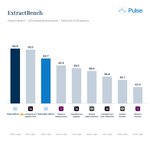
Another day, another benchmark broken. @Pulse__AI schema v2 scores #1 on LongExtractBench-50, the public set of the long-document extraction benchmark Reducto commissioned and Micro1 ran.
Pulse scores 99.7 precision and 99.7 recall, run through Micro1's published harness and grader on the 50 released documents. This was done with 0 custom configuration on Pulse.
Reducto, who commissioned the benchmark, published 99.3. One caveat: the leaderboard was scored on 225 documents and 50 are public. @micro1_ai , happy to run our models through your private set, or have your team run it as well!

sid retweeted
Our schema extraction engine at @Pulse__AI is #1 on OmniExtractBench.
We've rebuilt schema extraction from the ground up this summer, focusing on an agentic harness (more to share on this soon!)
Last week it took #1 on ExtractBench, this week it is #1 on OmniExtractBench, Datalab's public benchmark. We ran their published scorer on the same 620 document set with 0 configuration settings on Pulse.
Pulse scores 93.88, ahead of every system on the board (including the one that built it) - this is live on our public API now, try it!


Structured extraction is hard to eval, and most benchmarks are biased, or have bad scoring/GT.
That’s why we made OmniExtractBench - 620 docs from multiple vendors (Datalab, Reducto, Extend, LlamaIndex), and fair scoring.
@datalabto and Reducto are at the top.

sid retweeted
Astra and Fable are genuinely excellent at reasoning over text, and dont get me started on how much ive enjoyed coding with these new models. the problem is that enterprise documents are not only text.
The failures are the same on the models we test. Past ~50 pages, recall drops hard and the model does not notice, so it returns a confident result with most of the values missing. Schema logic, like "use the current period column" or "sum these rows unless a subtotal exists" starts drifting super quickly.
The economics also dont help - running these complex/long docs through a coding agent costs 15 to 30 cents a page before retries, with no auditability on the output
Each generation of oai/ant models is a large jump on reasoning and coding benchmarks , but a considerably smaller step on enterprise documents. Progress here comes from models trained on the problem directly
sid retweeted
Awesome to see the latest results from our Schema V2 model. The price/accuracy curve has been a huge frontier push for our team, and Pulse non-effort is a sleeper:
• Pulse Non-effort: 92.7 at $0.015/page + parsing
Meanwhile:
• LlamaExtract Agentic: 89.5 at ~$0.03/page
• LlamaExtract Agentic Plus: 95.6 at ~$0.08/page
• Reducto Deep Extract: 90.4 at ~$0.05/page
And if you want maximum accuracy, Pulse Effort reaches 95.9 at $0.09/page + parsing.
Try it out now!


@Pulse__AI is now #1 on ExtractBench.
ExtractBench is LlamaIndex's open benchmark for schema-guided extraction from enterprise documents: 370 real documents, 4,869 pages, and 67 schemas spanning SEC filings, customs entries, court exhibits, energy filings, and scanned forms with handwriting.
Across 39 systems, including frontier models, coding agents, and specialized extraction APIs, Pulse ranks first with an overall score of 95.9.
The board also measures cost, and Pulse's standard mode makes the case on that axis. It ranks #4 overall with a score of 92.7, ahead of GPT-6 Astra, Reducto Deep Extract, and every open-weight model tested, while running at a fraction of the price.
This is the same schema extraction system that ships in the Pulse API today.
We have an exciting set of models releasing very shortly, our research team has models training every day - stay tuned!

sid retweeted
A few months ago, the team at @Pulse__AI launched PulseBench-Tab, our frontier table extraction benchmark with 1,820 human-annotated tables across 9 languages.
Our evals team has updated the benchmark against the latest generation of document parsers and frontier models.
Pulse Ultra 2 remains state of the art on the benchmark, and is now just 1 credit per page. As always, everything is open source: the scorer, the runners for every provider, the dataset, and every prediction.
Leaderboard: benchmark.runpulse.com
GitHub: github.com/Pulse-Software-Co…
Dataset: huggingface.co/datasets/puls…
PRs welcome if you'd like a provider added or a sample corrected. Excited to keep pushing the frontier of table extraction.
