

We seek principles in the coordination among protein synthesis, metabolism, cell growth and differentiation PI: @slavov_n Videos: https://nitter.cf/t.co/Ku19DCIXvX
Boston, MA
Joined July 2020
- Tweets619
- Following124
- Followers3.1K
- Likes654




Slavov Laboratory retweeted

Realizing this workflow for single-cell proteomics benefited from discussions at the 2025 single-cell proteomics conference.
Facilitating such collaborations is a core part of @SCP_meeting's mission !

Parallel Squared Technology Institute aims to scale the throughput of sensitive proteomics without compromising quantitative accuracy, depth or specificity.
Today, we share a step in this direction:
🔹 A workflow supporting the analysis of 1,130 single-cell samples per day (SPD) while preserving depth and quantitative accuracy.
1/
biorxiv.org/content/10.1101/…

Slavov Laboratory retweeted
Parallel Squared Technology Institute aims to scale the throughput of sensitive proteomics without compromising quantitative accuracy, depth or specificity.
Today, we share a step in this direction:
🔹 A workflow supporting the analysis of 1,130 single-cell samples per day (SPD) while preserving depth and quantitative accuracy.
1/
biorxiv.org/content/10.1101/…
Slavov Laboratory retweeted
Proteomics has long faced a choice: Go deep, or go fast.
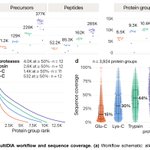
Deep, high-confidence coverage of protein sequences has traditionally required extensive chromatographic fractionation, large sample inputs and data acquisition times too long to be practical for analyzing human cohort scale samples. Scalable data-independent acquisition (DIA) workflows handle many samples quickly, but detect less of each protein and with lower confidence.
Our new preprint introduces multiDIA: It gets more from each sample without fractionation.
1/
doi.org/10.64898/2026.10.16.…

Slavov Laboratory retweeted
Congratulations to Luke Khoury on the successful defense of his dissertation.
Working, learning and growing together has been fun.
I am proud of his scientific growth.
Our research has opened a fresh perspective on peripheral immune cells:
doi.org/10.64898/2026.09.11.…

Slavov Laboratory retweeted
The regulatory variation within a cell type is remarkably informative and interesting.
This gets particularly interesting in single cells from the same cell type.
Working at the cell type level misses much of the action.
2/
biorxiv.org/content/10.1101/…

Slavov Laboratory retweeted
This gets particularly interesting in single cells from the same cell type.
Working at the cell type level misses much of the action.
2/
biorxiv.org/content/10.1101/…
Slavov Laboratory retweeted
Do you need an intro to analyzing (prote)omics data?
This series of lectures may be helpful.
We aimed to make them short & accessible.
Enjoy watching & learning !
youtube.com/playlist?list=PL…

Slavov Laboratory retweeted
Read the methods before reading the results
Read the methods before reading the conclusions
Read the methods before evaluating the conclusions
Read the methods before making conclusions
Read the methods!
Slavov Laboratory retweeted
A video summary of our recent preprint
biorxiv.org/content/10.64898…
Slavov Laboratory retweeted
How much data would it take to describe human biology ?
A very crude description of molecular abundance requires 1,000× more bites than all digital data humanity stores.
We need more than scale to close the gap.
blog.slavovlab.net/2026/09/2…

Slavov Laboratory retweeted
Using single-cell proteomics, we discovered protein (and functional) symmetry breaking in early mammalian embryos influencing cell fates.
These proteomic asymmetries are detectable at the zygote stage, intensify by the 2-cell and 4-cell stage, and correlate with the sperm entry site, pointing to fertilization as a symmetry-breaking event. The clear protein differences allowed us to define two types of blastomeres, termed alpha and beta.
⬛ These differences predict the developmental potential of the blastomeres. Similar clustering and protein enrichment patterns found in human 2-cell embryos suggest this early asymmetry might be conserved.
1/

Slavov Laboratory retweeted
Beyond heterogeneity, single-cell analysis can reveal functional coherence.
Coherence, regularity and principles advance science.
Full recording: youtube.com/watch?v=z0dIhG4C…
Slavov Laboratory retweeted
Millions of PBMCs have been analyzed by scRNA-seq. Have we seen it all ?
We profiled thousands of single PBMCs — proteomes and transcriptomes side by side — and uncovered functional coordination undetectable in the deepest scRNA-seq we could perform.
biorxiv.org/content/10.64898…
1/

Slavov Laboratory retweeted
Among the numerous metrics evaluating academics, one stands out for me:
Our intellectual heritage reflected in our students and colleagues, and their intellectual growth.
That amplifies the initial sparks and bears more fruit than any one of us could have produced.
Slavov Laboratory retweeted
Some of the most important scientific results were initially rejected before they became important milestones of scientific progress.
🔷 If you have great results, this is one of the most effective ways to help them succeed: blog.slavovlab.net/2024/02/1…
1/

Slavov Laboratory retweeted
Nature just published a tech feature on single-cell proteomics.
It highlights our journey from skepticism to robust technology and biological discoveries.
I love that the feature starts with a biological discovery enabled by the technology: cell.com/cell/fulltext/S0092…
1/

Slavov Laboratory retweeted
My personal experience is different.
I always felt motivated to take risks, and my most recognized success is based upon taking risks.
I recently talked about this experience: youtu.be/z0dIhG4C3qI?si=9JDF…

Slavov Laboratory retweeted
High-throughput omics are powerful, but they don’t substitute for thinking.
Discovering new biology often starts with intellectual input: frame sharp questions first, then choose the methods that can answer them, not the one that’s most convenient or currently fashionable.
1/

Slavov Laboratory retweeted
My personal experience is different.
I always felt motivated to take risks, and my most recognized success is based upon taking risks.
I recently talked about this experience: youtu.be/z0dIhG4C3qI?si=9JDF…


Slavov Laboratory retweeted
What sets protein gradients in the liver ?
The latest single-cell analysis from @ParallelSqTech shows it's often spatially regulated rates of protein synthesis and degradation.
Liver cells (hepatocytes) form a gradient from the portal to the central vein, with variable protein abundance along this axis.
Based on in vivo metabolic pulses with isotope labeled amino acids, we found zonated proteins whose mRNA levels don't track their protein levels: Their degradation rates do.
A clear example is Mttp, a lipid-transfer protein that rises from portal to central cells. Its RNA doesn't explain that gradient. Its degradation rate does: Mttp is broken down faster in portal cells and more slowly in central cells.
🔷 The spatial pattern is set by protein stability.
Zooming out, this wasn't a one-off. Across functional categories, zonated protein half-lives lined up with zonated protein abundance — a systematic signature of degradation shaping spatial identity.
Interestingly, portal cells showed globally longer protein half-lives than central cells, especially for long-lived proteins.
⬛ A takeaway: Spatial identity in tissues isn't just about which genes get turned on — it's also about spatially regulated rates of protein degradation. Post-translational regulation is a driver of tissue architecture.
📄 Article: biorxiv.org/content/10.1101/…
