
Computer and low level enthusiast. Learning Artificial Intelligence internals and sharing my learnings. AI Software Engineer at @platzi. Opinions are my own.
Joined February 2012
- Tweets2.7K
- Following869
- Followers2.2K
- Likes8.1K






Jhenner Tigreros retweeted

Fearless Engineering: The CS-4 is our first engineering documentary.
Through lab footage and conversations with the engineers behind each breakthrough, the film follows the creation of the CS-4, our latest wafer-scale AI system.
0:00 introducing the engineering team
1:09 Wafer-scale history
2:28 Powering the wafer
4:00 The cooling problem
4:18 Designing the cold plate
5:11 Holes in the wafer
6:33 the alignment problem
7:47 The CS-4 PRD
8:35 Designing for deployability and serviceability
11:01 Removing the motherboard
11:25 Removing internal cooling loops
11:41 inventing the power rack
12:35 A one-person lab deployment
14:03 Backpack: 50% fewer components
14:55 Connecting the compute backpack to cooling manifold
17:58 shifting Cerebras’s focus from training to inference
19:09 Building the Cerebras Cloud
20:01 CS-3 vs. CS-4 performance
20:49 3D Stacked DRAM
Jhenner Tigreros retweeted

Today I launch Separatrix 1.0: a free desktop app for nonlinear dynamics.
Type ẋ = f(x, y) and get the phase portrait, fixed points classified, Lyapunov exponents, orbit diagrams and bifurcations, copy it as LaTeX.
Offline, open source, Mac/Win/Linux.
uncrayon.github.io/separatri…
At @platzi we did the same in 40 minutes.
Watch the classes on Platzi, just create an account: platzi.com/cursos/openai-mat…

Computer created explainer videos for all 722 preprints in OpenAI's mathematical manuscript release, totaling 93 hours of video.
Watch the videos on YouTube: 722.video
Here's how Computer tackled this task:

En unas horas veremos el release de GPT-Sol[Terra,Luna,Sol]

Claude Opus 5.5 takes the top spot on the Artificial Analysis Intelligence Index, along with a 20% price cut and larger cache hit discount
Claude Opus 5.5 brings Anthropic to parity with GPT-6 Astra on evaluations like Terminal-Bench 4.0 and AutomationBench-AA, while extending Anthropic’s lead in agentic knowledge work.
At max effort it scores 58 on the Artificial Analysis Intelligence Index, the highest score we have measured by several points. Anthropic has cut Opus pricing to $4/$20 per 1M input/output tokens (Opus 5: $5/$25) and cache reads from $0.50 to $0.20.
Key takeaways:
➤ Consistent strong performance, with leading scores on six of the ten Intelligence Index evaluations: Humanity's Last Exam 61.4% (previous best 59.1%, Claude Fable 5.1), SciCode 66.9% (63.1%, Fable 5.1), GDPval-AA v2.1, AA-Briefcase v1.1, AA-Omniscience and AutomationBench-AA. On Terminal-Bench 4.0 it scores 59.6%, level with the leader GPT-6 Astra (xhigh) and +11 points over Opus 5. It remains slightly behind on CritPt, AA-LCR, and GDP.pdf
➤ Leads in agentic knowledge work: On AA-Briefcase, our private frontier knowledge work evaluation, it reaches an Elo of 1822. This is +143 over Fable 5.1, ahead on both analytical quality and presentation, and is the first time Anthropic has reached presentation quality surpassing GPT-5.6 Sol. This evaluation tests whether models can produce accurate and well-presented professional outputs using our open source reference agent harness, Stirrup
➤ Level with Opus 5 on cost per task despite 1.6x the output tokens: Opus 5.5 (max) uses ~119k output tokens per Intelligence Index task, against ~73k for Opus 5 (max), ~78k for Fable 5.1 (max) and ~27k for GPT-6 Astra (max)
➤ Four of five effort levels sit on the Intelligence vs Cost per Task frontier: Opus 5.5 max, xhigh, high, and medium all sit on the Pareto frontier, costing less or outperforming other models scoring 50+ (GPT-6 Astra, Claude Fable 5.1, and Claude Opus 5)
Other model details:
➤ Context window: 1 million token context with image and text input support, unchanged from Opus 5
➤ Pricing: $4/$20 per 1M input/output tokens, down 20% from $5/$25 for Opus 5. Cache writes $5 per 1M tokens for the 5 minute TTL, down from $6.25. Cache reads have been further discounted to $0.20 per 1M tokens, down 60% from Opus 5’s $0.50. This is a 95% discount compared to uncached input pricing, up from 90% on previous Opus models
➤ Effort settings: Five effort settings (low, medium, high, xhigh, and max). Intelligence Index evaluations were run at all five with Anthropic's default fallback enabled

2
296

Jhenner Tigreros retweeted
Little things are comming...
~7 years of intermittent work before the AI solves the problem.


Jhenner Tigreros retweeted

¡El conocimiento se comparte y se transforma! 📣✨
Si te apasiona el procesamiento de lenguaje natural, la neurociencia computacional o el futuro de la IA en nuestra región, este #MiércolesTECH es para ti.
Hablaremos con el equipo del SIMG - UNAL sobre cómo consolidar a Latinoamérica como un referente en el desarrollo de inteligencia artificial generativa a partir del trabajo colaborativo.
📆 Miércoles 16 de septiembre
⏳ 4:00 p. m. a 6:00 p. m.
📍 Centro de Innovación Bogotá
🔗 Inscripciones abiertas aquí: luma.com/cno5gqfx
#CienciaParaLaGente #LAB101 #MiércolesTECH #IAGenerativa #UNAL #SIMG #EducaciónAbierta #TecnologíaLatam

Jhenner Tigreros retweeted

Our group discovered that reasoning models produce fractals when asked to solve hard problems. We can use nonlinear dynamics to probe the thinking processes of recurrent depth models on Sudoku, mathematics, and even ARC-AGI (1/N)
arxiv.org/abs/2609.04963
Jhenner Tigreros retweeted

friends are regularly surprised when i say i don’t think math is (yet) “solved,” so in the wake of the ns result i figured i’d explain this take a bit more widely.
first, this is massively impressive and clearly an example of AI being, in some respects, far more powerful than the human mind. the team deserves huge praise for attempting and succeeding at this. i’d love to read a technical report on the project (one can always hope :)
but second, here again we ended up with a counterexample rather than a full proof: option C won the NS problem by proving the conjecture false (which was one valid way to solve the problem for sure)
notice a pattern in many of the recent frontier results in ai for math? a striking number involve counterexamples or finding a needle in a haystack.
now don’t get me wrong: this is extraordinarily hard and commendable. but it is only one aspect of mathematicians’ work.
Math is also about:
- finding deep, general mathematical understanding and explanations within proofs
- revisiting proven results to find more « elegant » proofs
- proposing new conjectures and hypotheses that might open « fruitful » directions
- taking the leap of faith of proposing entirely new, « exciting » research programs that may take decades to bear fruit
you may say these are simply further increments on the same intelligence scale, and perhaps point 2 above is already within the reach of current models. possibly
but you could also see this string of results as an extraordinarily powerful, massively parallel extension of search: explore the haystack, find the needle i.e. the counterexample that breaks the conjecture.
that would already be remarkable. but it would still leave open whether models understand the words I emphasized above: « elegant », « fruitful », « exciting ».
as tristan put it in his brief report: “the first llm generated proof levent sent me was the most horrendous i have ever read.”
despite their formidable technical abilities, models still seem to lack something mathematicians rely on constantly: a type of mathematical taste. the ability to distinguish a beautiful argument from a merely valid one, a fertile idea from a sterile one.
i’d be very curious to ask gpt or claude what they think of the result they just proved. do they find it elegant? if they ignore all the human noise about it on the web and history of math, do they appreciate the result and the path to it more than other proofs?
my suspicion is that, outside of the human knowledge that this is an important millennium prize problem, it may not 100% register it as fundamentally different from thousands of other proofs.
or, more intriguingly, perhaps the beauty they find in mathematics is actually alien to our own sense of mathematical beauty, some « horrendous » proof to us might be deeply satisfying to them…
all this to say that we might have significant progress to make in ai for math before declaring the field “solved,” (as too many are posting).
in the meantime, ai will be an extraordinary collaborator for mathematicians. i just hope access to these tools be as widely shared as possible (so that you don’t need a Leven or Sebastien working in a big lab to help you), and that companies stop using mathematics primarily as a demonstration of prowess in their private race.

We’re sharing a solution to the Navier-Stokes Millennium Prize Problem, one of the deepest problems at the frontier of mathematics.
The proof was produced by a group of agents, using an OpenAI next-generation model significantly more capable than GPT-6 Astra.
The problem concerns whether the description of smooth three-dimensional fluid motion modeled by the Navier-Stokes equations can break down. It has remained unresolved for roughly 90 years.

Leyendo Por el camino de Swann me encontré con la palabra aparceros (p. 203, 1 Edición, Alfaguara), buscando un poco en internet encontré que está puede ser uno de los orígenes de la palabra parcero junto con la palabra portuguesa parceiro, y que son primas hermanas de la palabra en latín partiārius (que significa “partícipe”) la cual sería su raíz.
Esto me llevo a preguntarme. ¿Existe alguna plataforma donde uno pueda ver la etimología de una palabra concreta, incluso si es un jergalismo? Últimamente me estoy interesando mucho en ese tema, pero no tengo idea de por dónde iniciar. Este interés surgió hace unos días cuando empecé a darle una ojeada a Guerra y Paz de Lev Tolstói (y en general autores rusos) y vi la cantidad de mezcla de Francés, Inglés y Alemán que tienen en sus obras —debido a su contexto histórico, gracias Figes— y quisiera poder leer un poco más informado, en algunas de mis ediciones me ha tocado hacer traducciones de esos idiomas y pues trato de hacerlas a punta de diccionario (no confío tanto en Google Translate para este fin). ¿Alguna recomendación? Sé que compartimos mucho con estos idiomas y el Español, pero no sé qué tanto.
Hoy terminé la lectura de El Ojo del Mundo, de Robert Jordan (La Rueda del Tiempo).
Siempre he amado a los autores que no tienen miedo de hacer descripciones extensas de las cosas más simples de su mundo: las ropas, su gente y hasta los pasajes en los que describen la orografía. Lo puedo describir como una combinación de Brandon Sanderson —quien finalmente terminó La Rueda—, con su worldbuilding, y Joe Abercrombie, con sus arcos de personajes.
Sabía en lo que me metía cuando decidí empezar esta saga, pero no esperaba que los últimos tres capítulos, en especial Sin Principio ni Final, me engancharan al punto de que no me importara nada más que continuar leyendo y quedar ad portas de un gran acontecimiento, con esa última sentencia de uno de los personajes que más intriga me ha generado en la fantasía épica (claro está, después de Dalinar).
He sido un ávido lector de fantasía y ciencia ficción desde que tuve acceso a internet y jamás había sentido tal nivel de involucramiento en una obra de este tipo —hablando de una saga completa; para mí, Juramentada, de Brandon Sanderson, fue un antes y un después en mi vida—. Esa extraña sensación de que algo se cierne; volver a ciertos capítulos con la vaga idea de haber leído algo que puede estar conectado y ver cómo el entramado se cierra a medida que el autor te da más y más migas de esa gran aventura.
Ahora, dejaré asentar la historia, los sentimientos y las cavilaciones que generarán teorías en mi cabeza, que luego veré si son ciertas a medida que avance hacia el final de esta gran aventura. Estoy seguro de que, en un par de años, cuando termine y vuelva a mis notas y a la relectura, tendré el mismo sentimiento que cuando leí por segunda vez El Archivo de las Tormentas y me di cuenta de cómo todo había sido dicho en frases y diálogos sueltos a los que mi yo del pasado les dio poca o ninguna importancia.
Viaje antes que destino
1
3
507
Hoy en platzi.com/live, a las 4:20 p. m. (hora de Colombia), estaré probando una nueva idea.
Analizaré en vivo papers relacionados con cómo se construyen los últimos modelos Open Source, la intuición detrás de las innovaciones en la arquitectura, la matemática que nos ayuda a representar esas ideas y cómo todo es un conjunto de pequeñas iteraciones que luego necesitan ser expresadas en infraestructura e ingeniería a unas escalas que ni imaginamos.
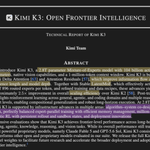
Hoy: Kimi K3: Open Frontier Intelligence (alphaxiv.org/abs/2607.24653)
Parte 1: Arquitectura del Modelo.
Lo haré cada 8 días, en el live y en el mismo horario, hasta que acabemos el reporte en su totalidad.

Jhenner Tigreros retweeted

We're open-sourcing Mixture-of-Kittens (MoK), our MoE training megakernel for NVL72s.
It fuses all Mixture-of-Experts communication and computation into a single, fully deterministic kernel, and runs up to 2.37x faster than the strongest public baselines.

ALT Bar chart: Mixture-of-Kittens reaches up to 2.37× higher MXFP8 forward throughput than the fastest public baseline on GB300 NVL72s, across Kimi K2.7, GLM 5.2, Qwen 3.5-397B-A17B, and DeepSeek V4 Pro.