

Architecting quantum resistant DePIN Built on Bitcoin curve, delivering unique encrypted outputs by design. Future proof infrastructure.
Joined July 2025
- Tweets92
- Following95
- Followers358
- Likes81







TRUST THE MATH.
In cryptography, confidence means nothing without evidence.
Anyone can claim their encryption is secure. The real challenge is demonstrating why it should be.
Terracrypt has already undergone evaluation by multiple cryptographers. Now we’re preparing to take the next step: opening our scientific research to the world.
Our upcoming paper will present the mathematical foundations, four-key architecture, and security assumptions behind Terracrypt.
We invite researchers, cryptographers, and security experts to examine our work, challenge our assumptions, and independently evaluate our claims.
We don’t ask the world to believe us.
We ask the world to verify us.
Because the future of encryption shouldn’t be built on promises.
It should be built on mathematics.
Terracrypt. Encrypt today. Secure tomorrow.

4
4
101
TerraCrypt retweeted

I don't recommend anyone scramble to move their funds to new wallets today. But we should take the risks to cryptography from AI-accelerated math seriously, and minimize our exposure to not just quantum-vulnerable cryptography, but also potentially AI-vulnerable cryptography.
The core new area of risk from this viewpoint is, unfortunately, ML-DSA / FHE / lattices.
(and it's also another reason, along with quantum, why ECDSA might fall even faster than expected, hence the "fresh address" recommendation)
So far most people have been in the mode of thinking "elliptic curves broken, hashes safe, lattices safe". But there is a good chance that the concrete security of lattices will take serious hits from the next two years of AI math.
The basic threat model is: factoring is something that naively takes 2^(n/2) time, but over decades smart people have found and optimized number field sieves, and degraded that to 2^O(n^(1/3)), which is why RSA keys and signatures need to be ~400 bytes (and not 64 bytes). What if there are skeletons in the closet like that, both for elliptic curves and lattices, that we are simply not smart enough to discover - but bots soon will be?
This is a major part of the reason why for the past year ethereum's lean roadmap has been going in the "hash-only" direction: no lattices, no ML-DSA, no Falcon, no lattice-based commitments inside ZK proofs, etc. Signatures in lean ethereum are all hash-based, either WOTS or SPHINCS-.
For signatures and proofs, we already know how to go hash-only. The bigger challenge is for *public-key encryption* - and this goes far beyond blockchains. Secure communication, anonymizing protocols, lots of things need public-key encryption.
And unfortunately there are long-standing mathematical theorems showing why public-key encryption cannot be done with hashes alone. You have to have some kind of trapdoor object that has at least one form of usable "structure" - either group theory (incl. isogenies) or lattices or code-based or potentially in the future even more newfangled and spooky things (local mixing?). But for anything that has structure, you should assume that AI will make at least some progress in breaking that structure. Here, one reasonable inference is that if you want to make something plausibly long-term secure, multiply the key sizes by 10.
To me that's a very plausible world and something not at all extreme to predict. If AI will bring us 50 years of math in 2 years, then that 50 years of math may very plausibly include a "naive factoring -> GNFS" level of improvement to our ability to break lattices. In that world, lattices will still exist, but they will have to be significantly bigger to guarantee the same level of safety.
And at those new larger sizes, hash-based constructions will beat lattice-based constructions on concrete efficiency in every use case where hash-based constructions are possible at all.
Theoretically, of course it's possible that hashes are broken too (eg. P = NP would imply that). But I think P = NP is very unlikely. And intuitively, it's much more likely that a mathematical object has exactly no exploitable structure (like hashes are intended to), than that a mathematical object has exactly ~3 forms of exploitable structure (for elliptic curves: associativity, Schoof, pairings) and not some secret fourth form of structure we have not yet discovered that greatly degrades its security (for elliptic curves, ECDLP and pairing security). Similar for LWE, SVP, RLWE and the zoo of lattice problems.
For this reason, we do not yet see any reason to worry and start padding the byte size of hashes (if we start to worry more, we would pad the round count first before doing anything to the byte size).
Concrete TLDR, my own personal views:
* Hash-based > lattice-based, in those situations where hash-based is possible at all
* For anything lattice-based, be much more paranoid on param sizes. Remember that blockchains are only a small portion of the cryptography story; this point goes far beyond blockchains and applies to eg. access to websites, secure messaging, Tor / VPNs ...
* For privacy protocols, strongly favor NOT putting encrypted notes onchain. Instead, send them offchain through some third-party mechanism.
* If it's not difficult for you, keeping your funds in addresses which have not yet been used to make a transaction is a good idea. If it's easy for you, do it. **But be careful about migrations; I personally have lost more money in botched migrations than I have lost in all hacks combined**.
* For multisig wallets, doing confirmations offchain is better than onchain, because this way the signatures of signer wallets do not get exposed to the public, so if ECDSA falls to AI much faster than expected, at least the multisig "gracefully degrades" to a 1-of-1 where the 1 is whoever was gathering the signatures - a much better place to be than "anyone can take the money"
firefly.social/post/x/210783…
The attacker gets the ciphertext.
That’s it.
No recognizable pattern to follow.
No repeated output to map.
No useful shortcut from seeing the same data encrypted again.
Terracrypt is non-deterministic by design: the same input can produce a different encrypted output every time.
So even when an attacker is watching the traffic, what they collect is designed to reveal as little structure as possible.
No patterns. No shortcuts. No clues.
That’s what the attacker sees.

1
81
Harvest now. Decrypt later.
That’s one of the biggest threats of the quantum transition.
Attackers don’t need to break your encryption today. They can collect encrypted data now, store it for years, and wait for the computing power capable of attacking it.
Terracrypt is built around a different outcome:
Harvest now.
Decrypt never.
Because data that needs to remain private for years needs protection built for the future-today.

75
𝗔𝗡𝗬 𝗦𝗬𝗦𝗧𝗘𝗠. 𝗤𝗨𝗔𝗡𝗧𝗨𝗠 𝗥𝗘𝗔𝗗𝗬.
The quantum era won’t replace every security system overnight.
But every security system will need to adapt.
Terracrypt is built to bring post-quantum protection to existing infrastructure, not by forcing organizations to start over, but by adding the security layer the future demands.
One architecture.
Multiple applications.
Messaging. Email. Enterprise. VPNs. Cloud. Payments.
Any system.
Quantum ready.

1
684
𝗧𝗵𝗲 𝗰𝗹𝗼𝗰𝗸 𝗶𝘀 𝘁𝗶𝗰𝗸𝗶𝗻𝗴.
Experts are evaluating that the transition to quantum-safe security may become critical sooner than most organizations expect.
Data stolen today can be stored indefinitely and targeted tomorrow.
The question is not whether encryption will evolve.
The question is whether your security is ready when it does.
Terracrypt is building for that future today.
Zero-trust architecture.
Non-deterministic encryption.
Quantum-ready design.
Because tomorrow’s threats won’t wait for tomorrow’s upgrades.

1
2
735
Every encryption project makes claims.
Very few are willing to publish the mathematics behind them.
The Terracrypt scientific paper is nearing public release.
Over the past months, the architecture and security model have been reviewed by cryptographers, engineers, and cybersecurity professionals. Their feedback helped challenge assumptions, refine the design, and strengthen the work.
Now it’s time for something bigger.
Public scrutiny.
No closed doors.
No “trust us.”
No marketing shortcuts.
We’re putting the architecture, methodology, and security assumptions in front of the global cryptographic community and inviting anyone to examine them.
Because real security doesn’t come from claims.
It comes from surviving independent analysis.
📄 The science speaks soon.

1
10
801
When governments start rejecting cryptographic standards, the market should pay attention.
France’s cyber agency just made it clear:
The future belongs to quantum-safe security.
Bitcoin, Ethereum, VPNs, messaging apps, cloud storage, enterprise systems , most of today’s infrastructure still depends on cryptography designed long before quantum computing entered the conversation.
The countdown has already started.
That’s why we built TerraCrypt: a post-quantum security platform designed to protect data, communications, and digital assets in a world where traditional encryption can no longer be trusted.
Quantum is coming.
TerraCrypt is ready.

🇫🇷 A GOVERNMENT JUST DECLARED BITCOIN'S ENCRYPTION OBSOLETE
France's cyber agency won't certify any security product without quantum-safe encryption after 2027.
It never mentions crypto. Not once.
But Bitcoin and Ethereum run on the exact algorithm France just rejected.
Elliptic curve cryptography.
The clock on "harvest now, decrypt later" just started ticking louder.


898
Most security systems ask you to replace everything.
Terracrypt takes a different approach.
Our mission is to make any security system quantum-ready.
Any infrastructure.
Any application.
Any industry.
The goal isn't to compete with existing security.
The goal is to strengthen it.
We're not stopping until Terracrypt becomes the benchmark for next generation encryption.
V3 is cooking.

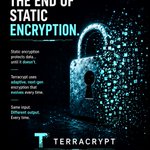
𝗧𝗛𝗘 𝗘𝗡𝗗 𝗢𝗙 𝗦𝗧𝗔𝗧𝗜𝗖 𝗘𝗡𝗖𝗥𝗬𝗣𝗧𝗜𝗢𝗡
The biggest weakness in security is assuming tomorrow will look like today.
Threats evolve.
Attack methods evolve.
Computing power evolves.
Security must evolve too.
Experts are evaluating that 2029 may mark the end of today’s encryption era.
The question is not whether security will change.
The question is whether you’re prepared before it does.
Terracrypt is built around a different principle:
Same input.
Different output.
Every time.
Because predictable systems create patterns.
And patterns become targets.

𝗣𝗥𝗜𝗩𝗔𝗖𝗬 𝗦𝗛𝗢𝗨𝗟𝗗 𝗕𝗘 𝗗𝗘𝗙𝗔𝗨𝗟𝗧
Privacy should not be a premium feature.
It should be the default.
Most platforms are built around collecting, analyzing, and storing user data.
Terracrypt is built around a different idea:
• Your messages belong to you
• Your files belong to you
• Your information should not become platform intelligence
Security is important.
But ownership of your data matters too.

𝗤𝘂𝗮𝗻𝘁𝘂𝗺 𝗶𝘀 𝗰𝗼𝗺𝗶𝗻𝗴. 𝗪𝗲 𝗮𝗿𝗲 𝗿𝗲𝗮𝗱𝘆.
Quantum computing is no longer theoretical.
The transition has already started.
The real question is not if current encryption models will be challenged but when.
Terracrypt is being built for a future where security must survive beyond traditional assumptions.
• Non-deterministic encryption
• Zero-trust architecture
• Quantum-resistant direction
• Same input. Different output. Every time.
Preparing after the shift is already too late.

𝗛𝗮𝗰𝗸 𝘁𝗵𝗲 𝘀𝗲𝗿𝘃𝗲𝗿. 𝗚𝗲𝘁 𝗻𝗼𝘁𝗵𝗶𝗻𝗴.
Most systems still assume that breaching infrastructure means breaching data.
That’s the old model.
Terracrypt is built on a zero-trust architecture where infrastructure access does not equal readable information.
Even if systems are targeted, meaningful data remains protected.
Security should not depend on perimeter walls.
It should depend on whether usable data exists at all.

𝗪𝗵𝗮𝘁 𝗶𝘀 𝘇𝗲𝗿𝗼 𝘁𝗿𝘂𝘀𝘁
Zero-trust isn’t a buzzword. It’s a security model built on one principle:
Trust no one by default.
In practice, that means:
No passwords stored anywhere.
No hidden access for service providers.
No intermediaries who can read or manipulate your data.
No internal system that automatically gets privileged access.
Only the sender and the receiver can ever access the content.
Even if infrastructure is compromised, the data remains unreadable.
Why it matters:
Most breaches happen because someone inside the trust chain gets access.
Zero-trust removes the trust chain.
The conclusion is simple:
Security should not depend on who promises to protect your data.
It should depend on who can never access it.
That is the Terracrypt model.

6
634
𝗛𝗼𝘄 𝗻𝗼𝗻-𝗱𝗲𝘁𝗲𝗿𝗺𝗶𝗻𝗶𝘀𝘁𝗶𝗰 𝗼𝘂𝘁𝗽𝘂𝘁 𝘄𝗼𝗿𝗸𝘀
In traditional encryption, the same input always leads to the same output. Terracrypt changes this. Every encryption process generates a different ciphertext, even if the plaintext stays identical. This eliminates patterns, making brute-force attempts useless.
Why quantum-resistance matters:
The quantum era is not a distant future. Advances in quantum computing are steadily progressing, and once large-scale systems emerge, RSA and ECC will no longer be secure. Terracrypt is one of the few systems designed to survive that shift.
🔚 The conclusion is clear:
Terracrypt is encryption for the post-quantum world.
And at the center of it all is $TERRA, the token that powers the future of secure communication, payments, and enterprise solutions.

2
627
Everyone says: “We’ll upgrade.”
But what if users don’t move in time?
@cz_binance that’s the real risk.
Check out Terracrypt.
We’re building wallets that solve this problem at the root , no need for protocol
to change. Soon testnet available , after going live with quantum proof wallet
for Bitcoin and beyond.

Saw some people panicking or asking about quantum computing's impact on crypto.
At a high level, all crypto has to do is to upgrade to Quantum-Resistant (Post-Quantum) Algorithms. So, no need to panic. 😂
In practice, there are some execution considerations. It's hard to organize upgrades in a decentralized world. There will likely be many debates on which algorithm(s) to use, resulting in some forks.
And some dead project may not upgrade at all. Might be a good to cleanse out those projects anyway.
New code may introduce other bugs or security issues in the short term.
People who self custody will have to migrate their coins to new wallets.
This brings to the question of Satoshi's bitcoins. If those coins move, then it means he/she is still around, which is interesting to know. If they don't move (in a certain period of time), it might be better to lock (or effectively burn) those addresses so that they don't go to the first hacker who cracks it. There is also the difficulty of identifying all his addresses, and not confuse with some old hodlers. Anyway, it's a different topic for later.
Fundamentally:
It's always easier to encrypt than decrypt.
More computing power is always good.
Crypto will stay, post quantum.
1
6
663
𝗪𝗛𝗬 𝗧𝗘𝗥𝗥𝗔𝗖𝗥𝗬𝗣𝗧 𝗜𝗦 𝗥𝗘𝗗𝗘𝗙𝗜𝗡𝗜𝗡𝗚 𝗘𝗡𝗖𝗥𝗬𝗣𝗧𝗜𝗢𝗡 𝗙𝗢𝗥 𝗧𝗛𝗘 𝗤𝗨𝗔𝗡𝗧𝗨𝗠 𝗘𝗥𝗔
Why it’s different from AES & ECC:
Today’s standards, including AES and ECC, were designed for a pre-quantum world. Quantum computing has already proven it can dismantle these systems in hours, not centuries. Terracrypt doesn’t rely on outdated assumptions, it is designed from the ground up to resist quantum attacks.
What “zero-trust” really means:
Zero-trust isn’t just a buzzword. In practice, it means:
- No passwords stored anywhere.
- No hidden access for service providers.
- No intermediaries who can read or manipulate your data.
Only the sender and the receiver can ever access the content.

1
3
1,095
Everyone talks about post-quantum security.
No one talks about speed.
We solved both.
Tested over 20 iterations:
~20ms per MB ⚡
Sub-ms messages
Zero perceptible delay
Security you can’t break.
Performance you can’t feel.
Built for the world after quantum and fast enough for today.
Terracrypt.

2
638
While preparing for the quantum era, we solved three of today’s biggest hacking problems:
• Centralization risk
• Trust dependencies
• Pattern recognition
Quantum computers will break traditional encryption.
But most breaches today don’t even require that.
They happen because infrastructure gets compromised.
Terracrypt solves both.

3
396