

Architecting quantum resistant DePIN Built on Bitcoin curve, delivering unique encrypted outputs by design. Future proof infrastructure.
Joined July 2025
- Tweets92
- Following95
- Followers358
- Likes81







TerraCrypt retweeted

I don't recommend anyone scramble to move their funds to new wallets today. But we should take the risks to cryptography from AI-accelerated math seriously, and minimize our exposure to not just quantum-vulnerable cryptography, but also potentially AI-vulnerable cryptography.
The core new area of risk from this viewpoint is, unfortunately, ML-DSA / FHE / lattices.
(and it's also another reason, along with quantum, why ECDSA might fall even faster than expected, hence the "fresh address" recommendation)
So far most people have been in the mode of thinking "elliptic curves broken, hashes safe, lattices safe". But there is a good chance that the concrete security of lattices will take serious hits from the next two years of AI math.
The basic threat model is: factoring is something that naively takes 2^(n/2) time, but over decades smart people have found and optimized number field sieves, and degraded that to 2^O(n^(1/3)), which is why RSA keys and signatures need to be ~400 bytes (and not 64 bytes). What if there are skeletons in the closet like that, both for elliptic curves and lattices, that we are simply not smart enough to discover - but bots soon will be?
This is a major part of the reason why for the past year ethereum's lean roadmap has been going in the "hash-only" direction: no lattices, no ML-DSA, no Falcon, no lattice-based commitments inside ZK proofs, etc. Signatures in lean ethereum are all hash-based, either WOTS or SPHINCS-.
For signatures and proofs, we already know how to go hash-only. The bigger challenge is for *public-key encryption* - and this goes far beyond blockchains. Secure communication, anonymizing protocols, lots of things need public-key encryption.
And unfortunately there are long-standing mathematical theorems showing why public-key encryption cannot be done with hashes alone. You have to have some kind of trapdoor object that has at least one form of usable "structure" - either group theory (incl. isogenies) or lattices or code-based or potentially in the future even more newfangled and spooky things (local mixing?). But for anything that has structure, you should assume that AI will make at least some progress in breaking that structure. Here, one reasonable inference is that if you want to make something plausibly long-term secure, multiply the key sizes by 10.
To me that's a very plausible world and something not at all extreme to predict. If AI will bring us 50 years of math in 2 years, then that 50 years of math may very plausibly include a "naive factoring -> GNFS" level of improvement to our ability to break lattices. In that world, lattices will still exist, but they will have to be significantly bigger to guarantee the same level of safety.
And at those new larger sizes, hash-based constructions will beat lattice-based constructions on concrete efficiency in every use case where hash-based constructions are possible at all.
Theoretically, of course it's possible that hashes are broken too (eg. P = NP would imply that). But I think P = NP is very unlikely. And intuitively, it's much more likely that a mathematical object has exactly no exploitable structure (like hashes are intended to), than that a mathematical object has exactly ~3 forms of exploitable structure (for elliptic curves: associativity, Schoof, pairings) and not some secret fourth form of structure we have not yet discovered that greatly degrades its security (for elliptic curves, ECDLP and pairing security). Similar for LWE, SVP, RLWE and the zoo of lattice problems.
For this reason, we do not yet see any reason to worry and start padding the byte size of hashes (if we start to worry more, we would pad the round count first before doing anything to the byte size).
Concrete TLDR, my own personal views:
* Hash-based > lattice-based, in those situations where hash-based is possible at all
* For anything lattice-based, be much more paranoid on param sizes. Remember that blockchains are only a small portion of the cryptography story; this point goes far beyond blockchains and applies to eg. access to websites, secure messaging, Tor / VPNs ...
* For privacy protocols, strongly favor NOT putting encrypted notes onchain. Instead, send them offchain through some third-party mechanism.
* If it's not difficult for you, keeping your funds in addresses which have not yet been used to make a transaction is a good idea. If it's easy for you, do it. **But be careful about migrations; I personally have lost more money in botched migrations than I have lost in all hacks combined**.
* For multisig wallets, doing confirmations offchain is better than onchain, because this way the signatures of signer wallets do not get exposed to the public, so if ECDSA falls to AI much faster than expected, at least the multisig "gracefully degrades" to a 1-of-1 where the 1 is whoever was gathering the signatures - a much better place to be than "anyone can take the money"
firefly.social/post/x/210783…
TerraCrypt retweeted

You have no excuse any more for not using post-quantum cryptography. I have you covered on desktop, cloud, mobile and web. 🤓 #rust #golang #flutter #typescript


TerraCrypt retweeted
🎙 Streaming Tokens Ep. 6
🎙 $TERRA x $QS
Another Epic session will be live tomorrow! This time a new project @terra_crypt and the legend from @Quick_Sync
🗓Date: 18th Tuesday, Time: 4 PM UTC
🔗 stagex.space/s/eN1LRIud
Join for Alpha!


Terracrypt Joins the TON x Ignyte Global Challenge
We are proud to join the TON x Ignyte Global Challenge, a global hackathon bringing together the brightest minds in Web3, AI, and blockchain innovation.
With $30,000 in prizes, mentorship from top-tier experts, and the opportunity to pitch at Dubai’s Museum of the Future, this event marks a major step for Terracrypt as we continue to expand our technology and ecosystem.
Our focus during the hackathon will be on building next-generation Telegram and crypto applications - solutions that bridge real utility, scalability, and user experience within the TON ecosystem.

TerraCrypt retweeted
🧵 Entry Quantum Resistant Review
🧵 @terra_crypt
So I saw that $TERRA community is pushing hard, so I did research them at night as well (couldn`t sleep anyway...) So here is what I found about them!
Let`s read!
◻️ What is Terra?
So here is something novel (we do like it) as they are introducing an encryption system that is design for the post-quantum times, that means the hype could go their way!
It`s built on the proven secp256k1 elliptic curve that is used in Bitcoin as well, but added with a four-key architecture and a something called "magic step".
I like the multi-layer key design and non-deterministic process idea... this makes it one of the top class encryption solution with Zero Trust and scalable solutions... so basically a privacy beast, with enterprise-grade integrations possible!
◻️ Four-Key Architecture:
1. Key A Salting Layer: that adds entropy and masks original data.
2. Key B Encryption Formula: this performs the elliptic curve encryption step.
3. Key C Wrapping Key 1: this provides secondary encapsulation.
4. Key D Wrapping Key 2: that adds a final protection layer.
Nice idea to calculate each key independently so no single point of compromise possible... good stuff here!
◻️Magic Step:
So this is interesting... After the 4th key operation, a post-processing "magic step" is applied. I feel the wizard coming! So this guarantees nondeterminism, that is ensuring even if the same plaintext is encrypted more than once with the same keys, the outputs are always different.
They also support shared Diffie-Hellman keys for encrypted communication between users, what it means a sender encrypts a message, and the recipient decrypts using the shared DH key without leaking intermediate values. Good tech here.
◻️ So what I like about the project:
▪️ Good novel idea
▪️ Post quantum tech
▪️ Good branding
▪️ Good lite paper
▪️ Decent website
▪️ Good grinding community
▪️ Nice kols backing
▪️ Four-Layer Key Security
▪️ Unique Non-Determinism
▪️ Good roadmap
▪️ Using $QS StageX tech
▪️ Didn`t launch yet
▪️ Good X posts from main account
◻️ What I think can be change:
▪️ Website can be tweaked
▪️ Missing long paper
▪️ Haven`t found tokenomics yet
▪️ Already $TERRA ticker used by few projects
◻️ Conclusion:
Quantum is coming, so this is a very cool idea for a security project, and the tech seems to be very cool, nice lite paper, and I see good backing! We will see how it will perform, so far so good!
DYOR and NFA I am doing my own research, don`t know the team and the post is not sponsored in any way!
Help me make more reviews by like and sharing this one! Thx!


🧠 𝐇𝐚𝐜𝐤𝐢𝐧𝐠 𝐅𝐫𝐢𝐝𝐚𝐲: 𝐓𝐫𝐚𝐧𝐬𝐔𝐧𝐢𝐨𝐧 𝐓𝐡𝐢𝐫𝐝-𝐏𝐚𝐫𝐭𝐲 𝐋𝐞𝐚𝐤 (𝐍𝐉)
4.4 million people just became targets.
A third-party vendor working with TransUnion was breached, exposing personal identifiers, birth dates, and credit data.
This one is different from a standard “data leak.” When credit bureaus get touched, the fallout can be long term, identity theft, loan fraud, ruined credit scores, endless remediation. In this incident, a vendor with access to enriched consumer files became the attack vector, and sensitive fields like birth dates, ID numbers, and credit data were exposed.
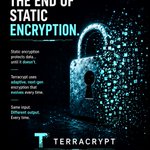
Terracrypt changes that logic.
✅ Every record is encrypted through multi-key non-deterministic encryption, meaning it never exists in readable form.
✅ Zero-trust validation ensures third parties can never see data they don’t need.
✅ Isolated key layers - four independent encryption keys and a unique “magic step” guarantee that even identical data never encrypts the same way twice.
With Terracrypt, stealing data doesn’t mean owning it.
It means holding empty shells - mathematically sealed, permanently unreadable.
Because in the post-quantum era, privacy must be built, not promised.

TerraCrypt retweeted

AMA Alert | @terra_crypt
Wednesday 17th September at 1 PM UTC on StageX → app.stagex.space/j/KmgIPPWH
We’ll dive into encryption, quantum security, and future integrations.
If you’re building for true privacy, this one’s for you.
