
software products @adaptyvbio @proteinbase
Joined July 2015
- Tweets270
- Following332
- Followers849
- Likes758




Pinned Tweet
We raised $40M and are opening an office and lab in London! 🇬🇧
We’re hiring across the board, including Product Engineers & Software Engineers to help us build automated wet-labs that will enable AI to design and discover new medicines.
Apply via our careers page or DM me if you know someone ($2K referral reward)

We raised a $40M Series A to build the automated lab for agentic biology.
Last week, we shared the work we did with @Anthropic: Claude designed proteins, sent them to our automated wet lab, and got real experimental data back.
We believe this is where biology is going: AI agents designing experiments, running them in automated wet labs, learning from the results and iterating.
But AI can only move as fast as the experiments behind it. To use the potential of AI to cure all diseases, we need to build high-throughput wet lab infrastructure: a “biological gigafactory”.
That’s exactly what we’re doing at Adaptyv.
Over the past year we’ve grown our lab throughput by over 5x and onboarded more than 100 customers, ranging from bio AI labs like @chaidiscovery and @boltz_bio to pharmas like @Roche and @novonordisk to dozens and dozens of new startups that use AI to radically speed up drug discovery.
Theo Jala retweeted

Our last challenge in the Anthropic x Adaptyv Protein Design Competition is about immunotherapy, one of the most important ways of treating cancer.
Immunotherapy helps the immune system attack cancer cells, but distinguishing them from healthy cells isn't always easy. In some cancers, the difference can be as subtle as a single amino acid in a small protein fragment.
That's the case with KRAS, a protein that works like a growth switch in our cells. In many cancers, a mutation leaves the switch stuck on, and the cell keeps multiplying itself and grows into a tumor.
In Challenge 5, you need to design a binder that sticks to the mutated piece of KRAS, but not to the healthy version, so that the immune system can find and attack the cancer cells.
The deadline to submit protein designs for this challenge is November 8. Then, we'll pick the best designs and test them in our lab.
We're bringing back design-a-protein.com!
Fun story about this website. For our previous protein design competition, we launched it with a cheap and fast protein design pipeline, definitely not state of the art, mostly for educational purposes and to get more people interested in the field.
We had pretty low hopes that any of the designs would work, but after synthesizing and testing a few of these vibe-designed proteins in our lab, we found out that one of them actually worked! And it ended up placing #46 in the competition.
So, someone with very limited prior biology knowledge saw our launch post, opened the website, clicked a few buttons, generated a protein never seen in nature, and that protein actually performed its intended biological function when synthesized and tested in our lab.
One year later, we have a much better option available with the newly released RFD4-Proteina model, which remains as cheap and fast to run, but is much closer to state of the art than our previous pipeline. How many binders can the anon vibe designers create this time?
To me, this is one of the clearest examples of how quickly the barriers to drug discovery are falling. And when you combine increasingly accessible and powerful protein design tools with the ability to get your designs synthesized and tested without owning a lab, which is exactly what we're doing at Adaptyv, I think we're going to see tens of thousands of new drug discovery companies emerge.
Much like AWS enabled a whole generation of internet startups, I think making biology this accessible will unlock an enormous amount of innovation, hopefully leading to entirely new ways to treat diseases. This is the future we're building towards at Adaptyv.

We built a website to make it super easy to get started with protein design and participate in the Anthropic x Adaptyv protein design competition
▶️ design-a-protein.com
This week, we're challenging people to design an Ozempic-like drug. You can get started in just a few clicks, using the newly released RFD4 model to design proteins targeting the GLP-1 receptor.
We'll synthesize and test 1000+ of these designs in our automated biology lab, including whether they actually activate the cell receptor, and make all the results publicly available
Theo Jala retweeted

In Silico is back.
Flash talks from @DidiKieran, @CotetTudor and @bose_joey on flow matching and molecular and protein design.
Wed 11 Nov, 6pm, @encode_pillarvc London HQ.
luma.com/mei5x512

Theo Jala retweeted

Just designed first proteins in my life.
I know nothing about biology.
We built a website to make it super easy to get started with protein design and participate in the Anthropic x Adaptyv protein design competition
▶️ design-a-protein.com
This week, we're challenging people to design an Ozempic-like drug. You can get started in just a few clicks, using the newly released RFD4 model to design proteins targeting the GLP-1 receptor.
We'll synthesize and test 1000+ of these designs in our automated biology lab, including whether they actually activate the cell receptor, and make all the results publicly available
Theo Jala retweeted

We built a website to make it super easy to get started with protein design and participate in the Anthropic x Adaptyv protein design competition
▶️ design-a-protein.com
This week, we're challenging people to design an Ozempic-like drug. You can get started in just a few clicks, using the newly released RFD4 model to design proteins targeting the GLP-1 receptor.
We'll synthesize and test 1000+ of these designs in our automated biology lab, including whether they actually activate the cell receptor, and make all the results publicly available
still hiring for software engineers btw
come help us build the automated biology lab used by the next generation of drug discovery companies!
We're excited to share results from our latest wet lab campaign with @AnthropicAI and @citrini.
Claude designed novel proteins to neutralize scorpion toxins and we tested 211 of these protein designs in our automated wet lab. 17 of them showed binding to the toxins in our experiments, with all data now available on @proteinbase.
This is a great example of what we're building towards: A world where anyone can run drug discovery campaigns on our automated wet lab.
Theo Jala retweeted

I can't thank the team @adaptyvbio enough! Claude is a major accelerant and enabler of molecule design, but none of that matters until you see the results in the lab. These scorpion toxins are very tricky to work with and the Adaptyv team was able to quickly express some of them in-house which gave us a lot more confidence in our results 🦂
We're excited to share results from our latest wet lab campaign with @AnthropicAI and @citrini.
Claude designed novel proteins to neutralize scorpion toxins and we tested 211 of these protein designs in our automated wet lab. 17 of them showed binding to the toxins in our experiments, with all data now available on @proteinbase.
This is a great example of what we're building towards: A world where anyone can run drug discovery campaigns on our automated wet lab.
Theo Jala retweeted

New on our Science Blog: designing protein binders against scorpion neurotoxins.
Scorpions sting about 1.2m people every year, and antivenoms are often costly or in short supply. Claude has made an early step toward finding new treatments.
anthropic.com/research/claud…

Theo Jala retweeted
Challenge 4 of the Anthropic × Adaptyv Protein Design Competition on @proteinbase is open: design a pH-sensitive protein to help shuttle drugs into the brain.
TfR1 is a receptor protein that brings iron-loaded transferrin into cells. It is highly expressed in the blood-brain barrier and drug developers can use this receptor to get drugs to pass the blood-brain barrier. The drug is fused to a binder to TfR1, which makes cells absorb the protein complex. If the binder is pH-sensitive it will release from the receptor inside the endosome and then exit the cells on the brain-facing side to deliver the therapeutic into the brain.
In this challenge, the goal is to make a pH-sensitive binder to TfR1 that targets precisely the right region on the receptor in order to allow absorption into the cell.
Theo Jala retweeted
We’re sponsoring wet-lab validation for the Defense Bio Hackathon, hosted by American Bioenhancement today in San Diego
180+ designers, 300 designs wet-lab tested in 5 tracks:
- Frontier bio
- Biological data
- Human performance
- Biomanufacturing
- Biosecurity
See you there! luma.com/kfgh2fvu


Theo Jala retweeted

I'd love to connect with parents, teachers, and people working in EdTech who could help me shape the Kids version of Anatomy.
The idea is to make learning more interactive by letting kids explore and play with 3D figures, machines, and systems to understand how things actually work, rather than just reading about them or asking AI for answers.
I'm still working on the prototype, and I'd love to get feedback from people who have real experience with kids and education. What would make this genuinely useful in a classroom or at home? What would you change? What would get kids excited to learn?
If you're a parent, teacher, or working in EdTech and would be interested in trying it out, sharing your experience, or helping me figure out what to build next, reach out to me in DMs!
I want to build something that actually makes a difference in how kids learn, and I'd love to have your input.
Theo Jala retweeted

The Apheris x Wells Wood Lab (Christopher Wood) has been hard at work designing proteins! Heres a video of our submissions for the first @adaptyvbio x @AnthropicAI Protein Design Competition!
Stay tuned for TNF and GLP-1!
Theo Jala retweeted

AGI is coming, and hundreds of AI supply chain oligopolies trade at only 1–5x revenue & 5–15x earnings
Short AI timelines could nuke software moats. Key physical chokepoints still remain
Launching Cambrian: an AI hedge fund seeded with ~$70M. Backed by Metaplanet & Jaan Tallinn

Theo Jala retweeted
GLP-1R is a target we've all heard of. Designing binders against GPCRs is challenging. Agonizing them is next level. Challenge 3 in our competition requires both.
We're also extending the duration of each challenge to two weeks, including for Challenge 2: TNFα
Good luck!
For the first time in an @adaptyvbio competition: functional cell activation assays!
Another capability coming online in our biological data gigafactory.
Next up... organoids?
Theo Jala retweeted
Challenge 3 is live on @proteinbase and for the first time we're measuring cell activation 👀
Theo Jala retweeted
Challenge 3 of the Anthropic × Adaptyv Protein Design Competition is open. You have to design a protein that switches on GLP1R, the receptor that semaglutide (Ozempic, Wegovy) and tirzepatide act on in type 2 diabetes and obesity.
also works with *molecular* machines!
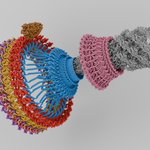
here, ATP Synthase, a 25nm rotary motor in your cells that uses a flow of protons to make ATP, the molecule that powers almost everything a cell does

Introducing Anatomy
Describe a machine in one line. Claude brings it to life.
- Interactive isometric wireframes you can rotate, inspect and explore
- WebGL shaders for fire, water, plasma and more
- Real 3D motion, with individual parts that rotate and move
Install it as an agent skill. Fully open source.
Theo Jala retweeted

This was a great collaboration with @adaptyvbio - happy that the SynthID Bio results are now viewable in @proteinbase!

Google DeepMind just released SynthID Bio, a watermark written into the amino acid sequence of an AI-designed protein. We validated the proteins in our lab at @adaptyvbio and you can now find all the experimental results on Proteinbase.