

@thmslj
Account based inUnited States
About this account
- Account based in
- United States
- Connected via
- United States Android App
Account-level information from X, not a live location or the device used for a specific post.
⚞ Head of Eng @ Varick Agents ⚟ Transforming Enterprise Organizations with AI Agents
Joined August 2026
- Tweets29
- Following32
- Followers5
- Likes11
Thomas LJ retweeted

HIGH PRIORITY HIRE @ VARICK: Forward Deployed GTM Engineer
We have ~$600M in pipeline and not enough people to close it. New leads come in every day from a mix of sources (X, our newsletter, email, DMs, etc.).
You'll be responsible for wrangling this pipeline: outbound, inbound, and even outbound on hiring (an extension of selling). You'll also have a huge impact on our messaging, marketing, design, and product roadmap, since you'll be on calls every week with dozens of the largest companies on earth, from the Fortune 500 up to the Fortune 10.
Applied AI is still early, and we're going to dominate it. You'll be central to driving the next 9 figures of revenue at Varick.
Comp: $150K-$200K base, up to 1% equity, and commission on every deal you work, up to $1M a year.
Have you done at least one of the following?
- Finished top 10% of your SDR, BDR, or AE team for 2+ quarters
- Spent 2+ years at a top bank, consulting firm, or PE fund with strong performance
- Started something of your own that made $100K+ in revenue
- Built your own outbound engine (Clay, scrapers, agents) and can show the reply rates
If you're a mercenary who's ready for long, intense hours, apply below or DM me.
$20k bonus if we hire someone you send my way.
Applied AI main challenges are :
- problem understanding
- product ease of use
AI transformation main challenges are:
- your org chart
- depth of your vendor expertise
The former is exciting, the latter is enduring. Point solutions are a great, exciting patch to look at, but the impact multiplier is inherently lower. Transformations take time in Enterprise.
Thomas LJ retweeted

Before we automate a workflow, we always audit the client's current process.
This client used 17 steps to pay one invoice. For them, that was a simple workflow.
The audit took 2 to 3 weeks of interviews and process mining.
After the redesign:
- 17 steps to 7
- 24 days of cycle time to 6
- 6 exception loops to 1
- 18% straight-through rate to 87%
- $31 per invoice to $6
At 18%, most invoices went through an exception route.
We fixed that with process reengineering. Agents were only one part of it.
Show the client the full mess first. It breaks their heart, but they need it.

Thomas LJ retweeted
We spent the day with ~20 CHROs and Chief People Officers from some of the largest companies in the world (collectively responsible for millions of employees) in Napa this week.
Here’s what they asked, what we told them, and where they are in their adoption of AI.
1. Do we need to train everyone on how to use AI? Is that even HR’s job?
Partly. Most companies are a barbell in terms of AI adoption. Roughly 5-10% of employees are using it already (on their own). Most aren’t using it at all. Focus on empowering the first group and running a short training program for the second group. Even spending 1 day, or 1 hour per day for 1-2 weeks on how to prompt effectively is extremely valuable. Create a leaderboard for the skill files that save people the most time, but don’t create one for tokens used.
2. Should we let everyone build agents? How do we prevent sprawl?
Let everyone build agents, but do it all on the same layer with the same context, and owned by the same person. If you let 400 people build agents in 400 different places, you’re going to have a) tech debt, b) a crazy token bill, and c) 6 agents all trying to do the same thing. Let everyone use sidekicks (Microsoft Copilot, ChatGPT, Claude, etc) to do their work, but have a small group of people take the work off of everyone’s plate with agents that work in the background, built on top of the systems of record.
3. How do we re-engineer processes in HR?
The first step is to map out how the process actually works - not how it’s supposed to work. For example, when a new employee is onboarded, the date they start in the ATS may be different than the date they start in the HR system. This almost always results in an email from someone in HR ops to the hiring manager to confirm the start date, which then almost always results in a late order of the laptop, which then results in the new employee not having access on day 1. And none of that is documented in the process. Once the process is mapped out, a process that has 15 steps can be reduced to 5, and 4 of those 5 steps can be handled by agents. This works for anything: payroll corrections, benefits, leave requests, employee tickets, etc. We’ve seen payroll corrections drop by 90% this way.
4. How do we make people feel like AI isn’t going to take their job?
Be honest about what changes. Agents take the 90% of the work that repeats, and people keep the 10% that needs judgement, which is usually the part they got into HR for. One of the best ways to sell the implementation is to show the teams what their job will look like when the agent is live. This is another reason to include key stakeholders, who are currently running the process, from day 1. If the plan is to capture all of their tribal knowledge into the agent, they need to see something in it for themselves.
5. What steps of the process should be human-led vs. fully agentic?
This decision comes down to two key factors: risk and cycle time.
If a step in the process is low risk (think answering a question based on an HR handbook) but high volume, it makes sense for the process to be fully agentic. On the other hand, if the step is high risk (terminations, investigations, comp exceptions, etc.), it should be led by a human, though there may be opportunities for agents to help with the prep work. Most steps, however, fall in between these two extremes and should be built as agents propose + human approves, with full traceability and reversibility.
6. Who on our team should be our forward deployed engineers?
Forward deployed engineers should be big picture thinkers who aren’t stuck in the ways things have been done at your company for the past 10 years. They should be knowledgeable on AI and at least a little bit technical. In an HR department, these people often are your HRBPs or your HR ops-minded folks who have already automated much of their job through spreadsheets and macros. Give these folks real problems to solve. You don’t need them to become certified.
7. How can we keep up with the latest in AI?
You can’t, really. It changes too fast. Subscribe to some newsletters, but know that most things break on X before anywhere else.
That being said, you can get 99% of the value from AI agents with models that are a year old. You don’t need to have the shiniest, most up-to-date model to build valuable agents for your HR team.
Key takeaways from the session:
1. Nobody in the room was asking if they should be using AI. Every company in the room had rolled out a copilot or ChatGPT to the whole company, so the question was more around why it hadn’t changed anyone’s week.
2. HR is being tasked with training the rest of the company on AI, often without adequate budget or authority, so the first question is often “Is this even our job?”
3. Despite #2, HR’s own jobs are often the last to be tackled, as teams are focused on rolling out AI to the rest of the company while still running their own processes (even simple ones like onboarding) through email and spreadsheets.
4. There is fear on both sides: employees are worried about how AI will impact their jobs, and CHROs are worried about what they’ve empowered their teams to build.
5. Most people in the room thought they needed to keep up with the latest in AI. They don’t.
We solve these every day at Varick. Work with us below:

This. I would add that
1. Accountability and liability can't be cheaply designed and one-shot'ted, choose your vendor (or eng team) wisely
2. Accessibility == adoption. 1 channel isn't enough
3. Distribution has always been a moat, how fast your vendor really transforms your processes is a real edge

AI agent adoption is still very bimodal right now. You have coding and coding adjacent tasks which have taken off, and then everything else.
And even within coding, you have a very wide continuum of adoption patterns, with some likely a small percentage of developers deploying background agents working on projects in parallel, and the rest of everyone else still working with agents 1:1.
Then, there’s the entire rest of knowledge work where real agentic adoption is still very early. The reason for this is that most of the workflows still need to reengineered to work with agents.
This isn’t the same as deploying a chat system for better research efficiency, but instead requires workflows to be rebuilt, data to be wired up in new ways, new practices for accountability and liability of decisions when agents are in the mix, governance and compliance paradigm changes, security upgrades, and more.
We’re still so unbelievably early in what this is going to look like outside of a few categories of work right now. This is why you can basically expect 100X more agent adoption from what we’ve seen so far.
Non-human identities outnumber people 45 to 1 in the average enterprise (Cloud Security Alliance, May 2026). Every agent we ship adds to that count, so each one gets a scoped, expiring identity instead of a borrowed human login.
Thomas LJ retweeted
Top 25 questions the world's largest C-Suite executives ask us re: AI transformation in the enterprise:
1. Are AI transformation firms more like McKinsey or Palantir?
2. We launched Copilot for everyone to use, but why hasn't it changed anyone's week?
3. We've done training, custom GPTs, enablement. What's next?
4. Where do we even start with AI?
5. How do we choose the first workflow to AI-enable?
6. Should AI be owned by IT or the business?
7. Do we really have to train all 10,000 people in the company?
8. How do we enable everyone to build agents, without ending up with agent sprawl?
9. Why are our token costs increasing?
10. How do we know if using AI is really cheaper than just hiring another person?
11. Which steps should remain human?
12. How do we communicate AI won't replace our team's jobs? (Will it?)
13. Will we own the agents you build for us?
14. What does maintenance look like in 6 months?
15. Will our data leave our environment?
16. What models should we be using? What do we do when they're deprecated?
17. Can we run these agents inside our ERP, or will people have to use a new tool?
18. Do we need to clean up our data first?
19. How long until we start seeing ROI?
20. When you talk about ROI, do you mean headcount?
21. How do we keep growing our business without increasing headcount?
22. Why did our last pilot project die in POC purgatory?
23. Our process documentation doesn't match what our team actually does – how do you know what to automate?
24. How do we keep up with how quickly AI is changing?
25. If AGI becomes a reality tomorrow, where should we point it?
We solve these every day at Varick. Work with us below:
Thomas LJ retweeted

HOW TO BECOME A FORWARD DEPLOYED ENGINEER (53 MIN MASTERCLASS)
Some forward deployed engineers are getting PAID $1M+/year (kinda crazy, I know)
And I REALIZED almost nobody talks about HOW they do it in any detail. It's basically nowhere online.
So I asked someone who does it ALL DAY LONG for Fortune 500 companies to walk me through it, step by step. and he shares EXACTLY how he does it
youtube.com/watch?v=1a5HxU52…
Here's what I learned:
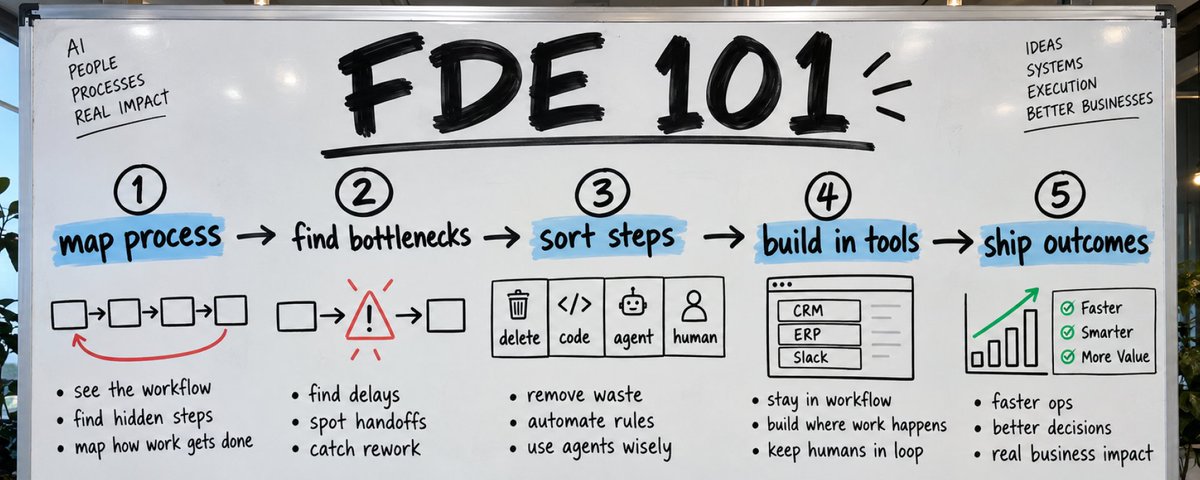
1. They start by listening, not building. They interview the people doing the work and let agents quietly read the company's data for a few weeks. The real process is almost always 3x longer than the one on paper.
2. They sort every step into four buckets: delete it, automate it with a simple rule, give it to an AI agent, or keep a human on it. A surprising amount ends up in the first bucket.
3. They build inside the tools the company already uses. Nobody has to learn a new app. When a human needs to sign off, it's just a Slack message.
4. They use the cheapest model that gets the job done. Most of this work doesn't need the most expensive AI.
5. They measure everything before and after, then come back 6 months later and prove it worked.
This + concrete client examples + way more on today's episode of @startupideaspod (thanks to @vasuman)
A full course pretty much on the topic aivalable to you 100% for free.
This episode is for ANYONE who wants to be a FDE or who wants to make their company AI-native by deploying agents.
Watch
Thomas LJ retweeted
My interview with Celonis on the state of Applied AI in the Enterprise, below.
Thanks for having me on, @billdetwiler!

AI layered over a broken process doesn't pay back.
@vasuman of joined @billdetwiler to explain why.

bad FDE:
customer knowledge → vendor engineer → bespoke implementation → permanent dependency
strong FDE:
customer knowledge → structured process/context model → reusable platform capabilities → customer ownership → lifts *both* the customer and the vendor
What's keeping me up at @varickagents? Delivering governed, measured value to enterprises, not a demo. We're heads down solving for:
- governance adoption
- agents act beyond intended scope
- identity and credential sprawl
- unknown and shadow agents
- prompt injection leading to exfiltration
- cost and unclear value
- output quality
- agent supply chain
If these challenges resonate with you, talk to us. @vasuman and @dkfromdk would love to hear from you.
If you'd like to work on these problems, we're hiring 🌞
Cognition's revenue is real, but at 48x run rate with no public margin, revenue proof and unit economics proof remain two different questions
Type 1 / type 2 decisions also apply to agent actions. Did somebody say system 1 / system 2?
As long as your evals are in place, very interesting time to make your agentic loops faster while not giving away control.
At @varickagents, we've deployed a "night watch". Engineer-type persona agents don't look only at linear tickets, but also compare codified goals against telemetry, transcripts, slack, vanta, and more.
Everyone gets a personalized report every morning and gets flagged when something needs attention.
Work that can be automated gets added to linear, is picked up by coding agents, and diffs are ready for review.
What I like most about Jev is the reminder that there are other latent ML problems worth solving using innovative AI. It's refreshing.
Since 2022 the field has been racing towards frontier reasoning and depth, but most of the ML running in production is classifiers, rankers, matchers etc. Not generative.
My ideal pile to take up next: entity record linkage, ranking cold start, multi-armed bandits.
ps: if these challenges sound fun to you, come work with @vasuman and I at @varickagents. We're hiring in SF.