




token retweeted
The shift toward digital-only gaming is restricting gamers’ affordability and access to their own games.
Imagine purchasing a video game, only to discover a few years later that you can no longer play it—even though you paid for it.
I am introducing the Power to the Players Act to defend your right to own, transfer, and play the games you purchase.
It’s time to return power where it belongs: to the players.
token retweeted

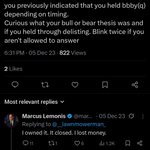
I got paid by Fidelity yesterday for warrant borrow fees for the first week of November. I called them and they said they are uncertain why and referenced the box checked on the form 25 as a possible reason why Fidelity was still paying those out. She said I am slated to keep being paid next week unless something changes 😂


token retweeted

UPDATE: Here are the insiders who have bought the most stock in their companies in the last month, per our data.
Gamestop, $GME, CEO Ryan Cohen is on top.

token retweeted

The same people that researched bankruptcy court dockets in granular detail, learned about NOL transfers under Section 382 and familiarized themselves with Chapter 11 process daily for years, to discover that this is far beyond the public narrative of a routine death spiralled liquidation and more akin to a fraud discovery trap for a company targeted for cellar boxing
The same people that held through delisting with Unwavering Conviction, celebrated being removed from the DTCC while finding section 1145 exemptions for liquidating trusts and legalese related to successor entities indicating reorganized emergence over final dissolution
The same people that found Ryan Cohen filed global Teddy trademarks days before selling his BBBY position and used children's books as a placeholder for Teddy Holdings LLC and then larger vision
The same people that believed in Ryan Cohen as a serious activist investor who would switch from equity to senior debt, similar to the plaubook of Carl Icahn and use senior secured debt to ensure accountability for the companies assets if the board failed to deliver shareholder value
The same people that will get rich as fuck while aimless and uninformed pocket watchers suffering with imposter syndrome will live in the humbling abode of regret and hindsight as they failed to really see what was transpiring
This quoted post is unavailable.


token retweeted

Am I the only one who has noticed the PlanMan and his Attorneys have been loading up the PCRs with disclaimers..? The kind of disclaimers that state in very clear wording that what you see, might now be complete as to the financial outcome of this Chapter 11 Bankruptcy. Also, that the accuracy to the information being provided in the PCR may not be accurate.
I’ve made it a habit to compare the “Global Notes” for each individual debtor entity filing from the first round of PCRs that were filed back in 2024 thru this past week. And guess what..?
The debtor entities grouped together back then are not the same groupings that the Global Notes pertain to as of today. There are some very clear intentions, imo. Actually one in particular, that is said to belong to a set group per its referenced Schedule A, in its Global Notes.
Low and behold, that debtor entity is not included in that Schedule A for that particular filing. So inconspicuous that anyone not actually comparing them word for word, debtor entity by debtor entity for each quarterly Post Confirmation Report filing, would ever notice.
I hope this thing comes to an end soon, before someone figures out the answer to the question of how this exit will be structured, and what it will look like when these cases are ultimately closed.
It blows my puppy mind, thinking about how someone structures these documents in a way that maximizes recoveries, by making the outcome seem destined for liquidation, when the exact opposite outcome is clearly visible if you look at the framework from a distance, but not exposed in a way that makes it too evident.
Once the thesis is proven, I at least hope, RC gets invited to a few of the NY/NJ Law Firm holiday parties. Or at a minimum, RC wins the Best Friend of an Attorney Award. Because for the last 5 years that man, RC, would have been a repeat award winner. And to top that off, RC hasn’t lost one yet. ⚖️


token retweeted

Thinking a lot about actual vs perceived risks today. It’s a topic worthy of a longer post which I’ll do later - but suffice it to say great investment seams can be where perceived risks are high, but actual risks are low.
token retweeted

On a carnivore diet people rarely fart at all
If you think farting all the time is a sign of a healthy diet
Then you are likely retarded
token retweeted
I have not read it yet in its entirety, but the first couple of pages have my ears perked.
PLR Number: 202633005
Release Date: 8/14/2026
irs.gov/pub/irs-wd/202633005…

token retweeted

Workers' average earnings rose 3.0% year-over-year in September 2026 (BLS data). That's about one-tenth the nearly 30% S&P 500 earnings growth forecast for the period. Inflation is expected to come in at 3.4%, so real earnings are actually falling.

BREAKING: The U.S. stock market hits an all-time high as expectations rise for companies to keep making more money. apnews.com/article/stocks-ma…

token retweeted

The "Madoff Exception" let market-makers fail to deliver on trades.
After going to prison, Madoff gave an interview where he said words to this effect: "Underneath it all, it was all just naked short-selling."
I had economists walking the SEC & FBI through this since 2005.




token retweeted
Ryan Cohen's letter to BBBY 👇
The $1.2bn in debt at the time was entirely the notes that were issued in 2014
Every dollar of those notes was created for the sole purpose of buybacks
Gustavo and Tritton continued accelerating the share repurchases despite the company burning cash
JPMorgan worked extensively with Gustavo on the buybacks
JPMorgan were the underwriters of the notes
JPMorgan were used by Ryan Cohen to sell his position, and they leaked the news to everyone before the sale hit the market publicly
JPMorgan's head of Global M&A was concerned about Ryan Cohen and asked the BBBY board what their plan was to deal with him
JPMorgan and MSC have colluded for fraud historically
JPMorgan were removed as senior lenders by Sixth Street in early 2023 after a tug of war for control over the estate
The lookback period for fraudulent conveyance in Chapter 11 is around 90 days, 90 days before Chapter 11 filing on April 23rd 2023 is Monday 23 January 2023, right at the time Sixth Street raised capital to pay JPMorgan to stop them forcing the company into Chapter 7
The HBC deal was facilitated to clear ABL obligations
All the pieces indicate that JPMorgan fucked up, bad and dug themselves deeper.
JPMorgan have paid billions in settlements since 2014.
They will pay the waterfall for their reprehensible actions.

token retweeted

🧸
🍻 Cheers to all the OG’s from “back in the day”
We were attacked, canceled & most of us suspended at one point or another
Be cautious of the narrative control that we’ve seen in recent months
Know what you hold & think critically when it pops off
POWER TO THE PLAYERS

token retweeted

The older somebody is, the less likely it is that luck dominated their life outcomes (especially to the downside in America). As you age, more and more is the accumulated sum of your own decisions. Bear that in mind when you meet people with disastrous lives in their 30s & beyond
token retweeted

The next great wave of entrepreneurship may not begin with an idea. It may begin with an acquisition.
For the past two decades, we have glorified one version of entrepreneurship:
Start from zero.
Raise venture capital.
Burn cash.
Chase hypergrowth.
Hope the company survives.
But a historic opportunity is emerging in the opposite direction.
McKinsey estimates that by 2035, around six million US small and medium-sized businesses will face an ownership transition as their owners retire. More than one million are viable candidates for sale, representing up to $5 trillion in enterprise value.
Yet in 2022, 92% of SMB exits happened through closure. Only 5% were sales and 3% were ownership transfers.
This is not creative destruction.
It is a succession failure.
Many of these companies already possess what founders spend years trying to build:
Paying customers.
Trained employees.
Supplier relationships.
Cash flow.
Reputation.
Community trust.
Entrepreneurship through acquisition—ETA—offers a different path.
Not zero-to-one.
But one-to-ten.
A capable entrepreneur acquires a viable business, protects what made it successful and builds its next chapter through better leadership, technology, distribution and capital allocation.
Nearly 80% of projected exits are expected to involve businesses valued below $2 million.
These companies are often too small for traditional private equity, but large enough to provide meaningful employment, generate durable cash flow and become platforms for long-term wealth creation.
The AI era makes this opportunity even more powerful.
The biggest ETA opportunity may not be buying software companies.
It may be acquiring manufacturers, logistics companies, healthcare practices, maintenance businesses, construction trades and professional-service firms—and giving them a modern operating system.
AI can improve pricing, sales, scheduling, procurement, reporting, compliance, customer service and decision-making.
A company built over 30 years does not need to lose its identity to become significantly more productive.
And AI does not remove the need for operators.
It increases their leverage.
But ETA must not become private equity in miniature.
The best acquirer is not merely a financial buyer.
The best acquirer is a steward: someone who respects the founder’s legacy, retains the workforce, protects customer trust and grows the company for another generation.
For investors, this could also become an important real-economy asset class.
Family offices, banks and private-credit providers can back talented operators, combine acquisition equity with seller financing, and provide shared technology and operational support across multiple businesses.
To unlock the opportunity, however, we need more than search funds.
We need acquisition education, transparent marketplaces, standardized diligence, flexible financing, properly structured seller participation and real post-acquisition support.
We built an enormous ecosystem to help people start companies.
Now we need an equally strong ecosystem to help good companies survive, transfer and compound.
McKinsey estimates that a functioning ownership-transition market could preserve up to 12 million jobs and protect approximately $250 billion in annual local spending power.
This is bigger than M&A.
It is a new pathway to ownership, financial freedom and economic mobility.
The next great entrepreneur may not start from zero.
They may acquire a great foundation—and build its next chapter.
token retweeted

tl;dr: it is the only way a guarantor makes sense to me.
I’m glad that you asked and I had never considered it until July 20 when a guarantor showed up on the bond listings. I had always been of the belief that the bondholder recovery would be cash-based because that was how it was outlined in the Plan. it was also my opinion (emphasis, opinion!) that if you were the acquirer you would not be inclined to give the bondholders equity of the NewCo because of how unsupportive and adversarial they were in voting against the Plan. in hindsight, maybe the two happened in the opposite order and the decision was made before the votes were seen, but who knows.
the guarantor made me reconsider a lot of my prior thinking because:
• if their recovery was only cash there would be no guarantor because waterfall provisions in the Plan would be the source of their payout;
• if the recovery was to be equity, there is no need for a guarantor either because equity is never financially backstopped with any guarantees; it is full downside risk for unlimited upside potential. what even would be guaranteed in an equity scenario?
so in trying to find where this new piece of information belongs in the puzzle I started by asking how would a guarantor enter the picture? well as it turns out a guarantor in the context of bonds is a very specific thing:
“a guarantor is a third party—such as a parent company, financial institution, or government body—that legally promises to pay the bond's interest and principal if the primary issuer fails to pay.” that is from investopedia.
that made me realize that there could be a debt-to-debt conversion because it is the only outcome that logically follows that definition. conveniently at the same time they were renamed from BBBY to DKBFLY (not -1!) which is a really important distinction, the indentures now have fiscal 2026 added to them (why?) and the best question of all, why now? unless there is a purpose behind it (I think dismissing the guarantor as a mistake or error is lazy).
$BBBYQ

Why did you come to the conclusion that bonds would be a debt for debt exchange?
Personally I feel it’s unlikely they want to pay the bonds out in cash, so I do agree there needs to be some form of pro-rata exchange. However, in my opinion a debt for equity into the new shell company makes the most sense and could actually be argued this way with the name change and guarantor as well…