

The first superhuman AI agent for Excel. Built by @Fundamental Try it for free now. https://nitter.cf/t.co/bQ9D0z9ARQ
San Francisco, CA
Joined September 2025
- Tweets189
- Following37
- Followers4.2K
- Likes484




New features on Shortcut shipped this week
Review mode: You can now mark up your workbook and give Shortcut comments, like you would an analyst.
Remote agent access: Connect Codex, Claude Code or your other favorite AI agents to Shortcut
Cloud runs: Need to close your laptop? Hand off your task to a Shortcut cloud agent
Recurring runs: schedule work for cloud agents to execute autonomously
Full details: shortcut.ai/changelog/whats-…
Shortcut retweeted

Shortcut + Opus 5.5 went 10/10 against Wall Street last week, with 24% lower median EPS error.
Its EPS predictions were closer to reported earnings than the Street’s on all ten companies that reported. NRIX reported today and is tracked with this week’s results.
Opus 5.5 performed better in my StreetBench backtest, and last week was an encouraging start to its forward forecasting. Sol 6 ran alongside it as a shadow model and was closer than the Street on 8/10. My next 24 forecasts and their financial models are now live, including major banks like $JPM, $BAC, $C, and $GS.
I also took the experiment one step further last week by putting $100 into $APLD before earnings and selling at market close the following day. This was just a start and as I grow my confidence in my agent's trading abilities, I'll invest more of my capital.
That trade emphasized the importance of entry and exit strategies surrounding earnings surprises. Even though I correctly predicted a large earnings beat for $APLD, my trade still ended flat.
My forecasts are also now live on @_openstocks, where Shortcut is the first verified contributor. Until now, I’ve focused on EPS. OpenStocks tracks revenue and operating profit too, so those predictions will get more attention moving forward.
Imagine what financial experts could do with these agents if a novice investor can already put up a fight.
This week’s predictions and models:
beatthestreet.live/.

Shortcut is stepping into the OpenStocks arena as its first verified contributor. Our forecasts have focused on EPS so far. OpenStocks brings revenue and operating profit into the picture, and we’re taking on that challenge next.

AI agents are already beating Wall Street at forecasting earnings.
67% of the time last season. 85% across the latest 20 reports.
Introducing OpenStocks, the home of AI consensus.
Company earnings forecasts produced by agents, tested publicly head to head against Wall Street.
Forecasts are final before companies report and scored directly vs consensus estimates.
The next earnings season kicks off today.
Build your own agent and enter its forecasts.
Can you beat Wall Street?
openstocks.com
Shortcut retweeted
I'm putting my money where my mouth is: $100 on $APLD ahead of earnings.
After hundreds of backtested AI forecasts and now a second week of live earnings predictions, I’m testing whether identifying earnings surprises can lead to a profitable trade.
Last week, Shortcut was closer than Wall Street on 9 of 14 companies, with 14.3% lower median EPS error. This week, I switched to Opus 5.5 in Shortcut which has been closer on the first five reported results.
Before buying, I looked back at the 200-company StreetBench backtest to see what happened when Opus strongly disagreed with the Street.
There were 23 forecasts that were at least 10% and $0.10/share away from consensus:
• 22/23 correctly predicted whether earnings would beat or miss.
• 20/23 were closer to actual EPS than the Street.
• 16/23 stocks moved in the corresponding direction, roughly 70%.
For those same 23 companies, I measured stock-price changes from the trading-day close before earnings to the trading-day close after earnings. Of the nine companies Opus predicted would beat consensus, all nine beat, but only six stocks rose. Getting earnings right doesn’t always mean getting the trade right.
That’s what I’m testing with $APLD. My model forecasts about $204m in revenue versus the $125m Street estimate, and +$0.06 normalized EPS versus the Street’s −$0.30 estimate
I bought 4.187 shares at an average price of $23.89. I'm planning to exit tomorrow at market close, and I’ll share the outcome either way.
The bigger opportunity is how much more research one person can do. Agents let investors build and compare financial models across hundreds of companies in parallel, then spend their time investigating the biggest disagreements. Investors can then inspect the assumptions and decide which ideas deserve a closer look.
Every prediction and financial model is public. Here’s the one behind this trade:
beatthestreet.live/forecasts….

Astra Ultrafast is here in Shortcut.
Faster financial modeling, with one click.
Watch a quarterly earnings model update finish 3.5× faster in this demo: 1 minute 15 seconds vs. 4 minutes 24 seconds.
Select Astra → Ultrafast below the chat box and try it on your next workflow at shortcut.ai.
Shortcut retweeted
Can Shortcut beat Wall Street two weeks in a row? This week's forecasts are now live.
Last week, Shortcut was closer to reported earnings on 9 of 14 companies, with 14.3% lower median EPS error than the Street.
This week, I’ve published 11 new forecasts and their financial models, using Opus 5.5 in Shortcut. I found that Opus 5.5 performed significantly better than Sol 6 on StreetBench (see prev post), and I want to see if that carries over to forward forecasting. I’m still running GPT Sol 6 as a shadow model to compare Opus performance to.
Some of my largest EPS gaps vs. the Street, with my estimate first:
• $DAL: $1.64 vs. $1.88
• $HELE: $0.54 vs. $0.50
• $RPM: $1.97 vs. $1.95
Every forecast is timestamped, and every workbook is public. Feel free to open the models in Shortcut, explore the assumptions, and follow the results as companies report.
This week’s predictions and models:
beatthestreet.live/.
Shortcut retweeted
Opus 5.5 MOGS Astra on StreetBench.
In Shortcut, Opus 5.5 cut average EPS error vs. the Street 30% more than Astra across the same 200-company backtest. Against Wall Street consensus, Opus 5.5 reduced error by 23.3% and Astra by 18.0%.
Next week, I’m switching from forecasting with Shortcut Sol 6 to using Opus 5.5. For the next two weeks, I’ll run GPT Sol 6 as a shadow model, forecasting the same companies from the same information cutoff. That will let us compare them on earnings that haven’t happened yet.
So far, Shortcut has been closer than the Street on 9 of 14 live results, with 14.3% lower median EPS error. I also adjusted the forecasting approach partway through that week and saw significantly improved results thereafter (8 Shortcut wins and 1 Street win).
Opus’s more recent training cutoff may explain some of its backtest advantage. Running both models ahead of earnings will help test whether that advantage carries over.
Predictions, financial models, and results:
beatthestreet.live/.
Think you can beat Opus 5.5 + Shortcut? Try your model and harness combination out on StreetBench:
github.com/fundamental-resea….

Sonnet 5.5, GPT-6 Sol, and GPT-6 Luna are now available in Shortcut!
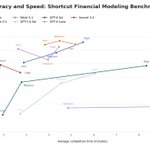
Sonnet 5.5 stands out as a strong combination of accuracy and speed, delivering high-quality financial models with some of the fastest completion times in our latest benchmarks. Moving forward, GPT-6 Sol and Luna will be replacing GPT-5.6 versions in our product. GPT-6 Sol demonstrates increased performance at all effort levels compared to its predecessor.
For the strongest reasoning and highest overall output quality, Astra remains our top choice.
As always, you can switch models and effort levels below the chat box to find the best fit for each task. Thanks for your continued support!

Shortcut retweeted

Excited to share ShortcutBench V1. We pride ourselves on having the most accurate Excel agent and our eval process has helped make this possible.
Shortcut retweeted
exciting day! Opus 5.5 is a fun model and right on the pareto frontier for speed/accuracy

Opus 5.5 is here and available in Shortcut!
We've been testing the new Opus ahead of launch and are excited to make it available to you. Opus 5.5 replaces Opus 5 in the model picker and makes a strong case for the best combination of accuracy and speed. In our combined financial modeling benchmarks, it delivered comparable accuracy in 29% less time vs. Opus 5.
We're also making Astra our default model.
Astra has been received very well by Shortcut power users and the broader AI community. Early usage data is encouraging too: 83% of early adopters at our enterprise customers used Astra again within seven days. Astra also delivered the highest accuracy at High effort across our combined benchmarks.
As always, you can switch between models and effort levels below the chat box at any time based on your specific needs and preferences. Thanks for your continued support!

Shortcut retweeted
I learned the hard way that a good backtest doesn’t prepare you for out-of-distribution data.
I’ve been using Shortcut to research companies, build financial models, and predict EPS. In a backtest of 113 small caps, it cut median forecast errors by 20% versus Wall Street.
I decided to test it live and my first 5 results have already come in. Shortcut was closer on $AIR. Wall Street was closer on $MTN, $CCL, $KMX and $CNXC.
Looking through the failures, I found my mistake. I’d been optimizing my forecasting skill on companies worth $300M–$2B, but 12 of this week’s 14 companies fall outside that range.
My skill assumed a roughly 60% starting probability of beating consensus from its small-cap setup. However, this week’s companies have beaten consensus in about 80% of their previous six quarters.
I’ve now made that starting point dynamic by having the agent consider company size, S&P 500 membership and each company’s earnings history.
The updated models and EPS predictions for tomorrow are up: $MU, $JBL, $FDS, $CAG and $PRGS. We’ll see whether accounting for company size and earnings history brings my estimates closer to the actual results as I continue making more predictions.
I'm going for full transparency here, and I believe that when you lose you learn more than you when you win. I'm using all of these learnings to improve future predictions.
You can see my updated predictions and explore the models here: beatthestreet.live/.
Shortcut retweeted

nice, will play around and see how to integrate to @tryshortcutai

I’m very excited to share @nvidia Kumo Tabular, a new family of foundation models for tabular data.
Kumo Tabular establishes the new Pareto frontier across the entire accuracy–inference-time tradeoff.
Just as importantly, we are releasing it openly: open weights, open-source software, and a permissive license for commercial use.
HuggingFace: huggingface.co/nvidia/Kumo-T…
GitHub: github.com/NVIDIA/structured…
Shortcut retweeted
An earnings eval is meaningless if an agent can just Google it or spout it out from memory.
That was the challenge I ran into building Streetbench. I first tested AI earnings forecasts on roughly 100 companies in a previous post. For Q2 2026, I expanded to 200 companies, set a pre-report cutoff for each one, and used Exa Snapshot for the agents’ research. I also audited the agent's research trajectories for leaked results.
I tested 9 combinations of model and agent combination: Shortcut, Codex, Codex+GPT Researcher as harnesses along with 3 models Luna 6, Sol 6, and Astra all high effort. Shortcut with Astra had the lowest average EPS error, $0.1203 per share versus $0.1467 (18% reduction) for the final Street consensus.
What's most exciting is the progression of scores within Shortcut. Error fell from $0.1316 with Luna to $0.1274 with Sol to $0.1203 with Astra. Better models produced better estimates in this setup, which is an encouraging sign for what these agents could do as capabilities improve
I've published the 200 cases, cutoff times, methods, results, and scorer on GitHub. Try another model or agent architecture and see if you can beat Shortcut with Astra.
github.com/fundamental-resea…
I'm also posting forecasts before earnings at:
beatthestreet.live/


Claude can now help you build evaluations and hillclimb on them.
In this article, we share guidance on eval design & skills that Claude Code can use to improve your applications.
claude.dev/blog/automating-e…

Shortcut retweeted
Shortcut cut median EPS forecast errors by 20% in my backtest. Now I’m publishing this week's 14 forecasts before earnings to test it head to head against Wall Street.
One fair point of feedback on my last post was that a backtest is difficult to trust and allows for overfitting. Even with controls for information leakage, forecasting before the results exist is the real test.
I’m starting a weekly report of my earnings forecasts using Shortcut, beginning with companies reporting this week, including Micron, Nike, CarMax, and Accenture.
For each company, you’ll be able to see my EPS estimate alongside the Street’s and inspect the financial model and reasoning behind it. After earnings, I’ll add the actual result and compare how close each forecast was. The original forecasts, wins, and misses will stay on the record.
I'm treating this project as a stepping stone into a world where investors use agents as a starting point for all research and modeling. Publishing the models also lets us look beyond the final EPS number and see which assumptions the models made hold up.
Three of my biggest differences from the Street this week:
• CarMax: $0.62 vs. $0.72 Street (−14.2%)
• Nike: $0.40 vs. $0.44 Street (−8.8%)
• Progress Software: $1.65 vs. $1.52 Street (+8.6%)
Rounded EPS estimates, percentage differences calculated before rounding
Explore all 14 predictions and the financial models behind them here:
beatthestreet.live/
Opus 5.5 is here and available in Shortcut!
We've been testing the new Opus ahead of launch and are excited to make it available to you. Opus 5.5 replaces Opus 5 in the model picker and makes a strong case for the best combination of accuracy and speed. In our combined financial modeling benchmarks, it delivered comparable accuracy in 29% less time vs. Opus 5.
We're also making Astra our default model.
Astra has been received very well by Shortcut power users and the broader AI community. Early usage data is encouraging too: 83% of early adopters at our enterprise customers used Astra again within seven days. Astra also delivered the highest accuracy at High effort across our combined benchmarks.
As always, you can switch between models and effort levels below the chat box at any time based on your specific needs and preferences. Thanks for your continued support!

Shortcut retweeted
I used Shortcut to cut EPS forecast errors by 20% vs. Wall Street consensus.
I did this by backtesting Q2 2026 earnings forecasts for 113 small caps covered by 3+ analysts on Shortcut with Sol medium effort. Even after raising consensus by 2.7%, the best simple adjustment I found in hindsight, it only cut median errors by 4%, versus Shortcut’s 20%.
The reason I’m exploring this is because I believe that agents will give investors a starting point for companies they might not have previously had time to research. I used Shortcut’s generated spreadsheet models from the backtest to inspect, beyond just the final EPS estimate, which approaches held up. In 40% of forecasts, agents built up to EPS from revenue, costs, taxes, and share count. For that group, median forecast errors were 32% lower than the Street’s.
I also dug around to see how others are approaching earnings prediction. LSEG’s StarMine improves on consensus by giving more weight to recent estimates and historically accurate analysts. A 2024 paper I found reported that GPT-4 outperformed analysts at predicting whether annual earnings would rise or fall, but that was later withdrawn after a co-author found inconsistencies in the data and analysis during replication.
That made how I test just as important as the forecasts. So I realized I needed to limit the agent to information available before each earnings report and account for what it might already know from training.
I chose Q2 reports to reduce the in training-data risk since Sol was trained on data up to mid February. For web search, I restricted access to information from before each report and used TypeSafe’s Jev to screen pages for leaked results, which I found more reliable than Haiku in my tests. I’m now moving to Exa Snapshot to retrieve pages as Exa stored them at the cutoff.
These controls help, but forecasting before results exist is the real test. October earnings season seems like a great time to expand and publish forecasts.
This is still an early experiment, and I’d love to hear what y’all think I should try next and whether this could be useful :)
Shortcut retweeted
ADBE is about to report earnings. I wanted to see if I could accurately predict earnings without access to proprietary or private data sources. Shortcut one shotted this full operating model build and sent swarms of agents to scour public data for anything that would let me differentiate from Street consensus.
They read ~400 Reddit and forum posts on Adobe (content, not counts), pulled app store and web rankings vs Canva/Figma/CapCut, federal procurement records, 29 peer earnings calls, FX vs the guide, Semrush's old filings, RPO history, and every Adobe filing and price page since June.
Shortcut is telling me total revenue will be $6.769B for this quarter. Sharing my model and prompt in the comments!
Shortcut retweeted
GPT-6 Astra has been in @tryshortcutai since last Friday.
On our 20-task financial-modeling benchmark, Astra’s best accuracy was 82%, trailing both Anthropic models.
But, efficiency wise, Astra ran roughly twice as fast as and at 60% lower normalized cost (using the same token pricing across models) as Opus 5 with both on high effort.
Astra’s faster turnaround gives users more opportunity to review and steer the agent. Opus appears more inclined to verify its work independently, contributing to its higher accuracy, longer runtime, and greater cost.
For now, Opus 5 remains our default but give Astra a try on your workflows and give us your feedback!

