

Professor. Ultra-realism. Politics. Theory. Class. Violence. Sociology. History. Criminology. Anthropology. Personal account.
Sunderland, England
Joined January 2013
- Tweets1.3K
- Following2.7K
- Followers5.9K
- Likes5.6K


Pinned Tweet
Out now!
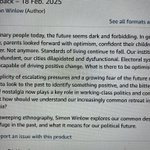
The Politics of Nostalgia: class, rootlessness and decline
£17.99 but you can get 30% with the code EME30 on the Emerald website:
bookstore.emerald.com/the-po…


Simon Winlow retweeted

BREAKING: The US says the Vatican is only two weeks away from developing a nuclear weapon.

Simon Winlow retweeted

A predatory private equity firm bought WHSmith, changed the name to a generic title with zero brand recognition, forced the company to borrow tens of millions in order to line shareholders' pockets and crashed the business into the ground in a year.
And Labour just let it happen

BREAKING: TG Jones owner Modella Capital says it is putting the high street chain up for sale.
Sky's @MarkKleinmanSky reports.
trib.al/KV3iWAG
📺 Sky 501, Virgin 602, Freeview 233 and YouTube
Simon Winlow retweeted

Not a job guarantee. A private sector wage subsidy.

Simon Winlow retweeted

I'm grossly over-simplifying here, but very basically all organisms try to minimise individual sacrifices and maximise flourishing and reproduction when either static or moving between environments. As emotional sophistication and predictive intelligence developed, it became possible to pre-emptively sense and identify an order of sacrifice and, eventually, to imagine the self as a victim. Empathy became essential to the avoidance and minimisation of sacrifices in both the 'planning' and active stages, especially when moving towards and testing out new spatial environments. It went all wrong when the more advanced primates and humans began to construct symbolic group identities, large 'extended families' that could restrict empathy as they imagined and symbolised themselves as potential collective victims of 'rival' internal classes and external groups that might elevate themselves to more secure places in the order of sacrifice - thus the elite fear of both workers and hostile enemies. This of course was exacerbated during the agricultural revolution when primitive agricultural techniques, expanding populations and a growing sense of scarcity made land acquisition necessary. Then it gets very complex psychologically, politically and culturally, but in a nutshell history became a long-running zero-sum game. The fundamental obstacle to the extension of empathy, cooperation and solidarity beyond the 'elite' internally and the 'tribe' externally is the continuation of a heightened sense of scarcity and potential collective victimhood. Neoclassical economics and its associated politics/culture do most damage by constantly positing both resources and money as scarce, which is how they understand value and justify accumulation, hoarding and usury. Put that in the dustbin and we might start getting somewhere.
Simon Winlow retweeted

Weltwoche: How do you convince the left that this supranational globalism contradicts its own ideals?
Fazi: The problem is that there is no real socialist left any more. What passes for the left today has almost nothing to do with the old labour movement; it’s a progressive-liberal mush that revolves around individual identity. The left once wanted to overcome differences and unite people on the basis of shared class interests. Liberal progressivism does the opposite: it finds all these ways of dividing workers, based on what pronouns you use, etc. Honestly, I’m less interested in convincing the left than in combining the best ideas of both traditions: the old left’s ideas of economic democracy and the cultural common sense of conservatives. The old Europe was half Christian, half socialist, united by the idea of the common good. Left and right today are above all tools used by the elites to divide people. We all need peace, development and economic sovereignty — and that is neither left nor right.
Read the whole interview here: thomasfazi.com/p/european-in…


“European integration is one of the main causes of the erosion of democracy in Europe”: my interview with Die Weltwoche
Thomas Fazi comes from the left and still describes himself as a socialist — a rarity among critics of the EU, whose opposition today mostly comes from the right. Since his first book on the euro crisis in 2014, he has viewed European integration as a process that was elitist and hostile to democracy from the very beginning. In his new book, Die Brüsseler Tyrannei oder Der diskrete Staatsstreich (Westend Verlag), he takes this thesis to its furthest conclusion.
Weltwoche: Mr Fazi, please introduce yourself briefly. Who are you, and what is your greatest concern?
Fazi: I’m an author and journalist, and I’ve been writing for a long time about economic issues, but above all about European integration. My first book, a critique of the EU’s response to the euro crisis, came out in 2014. I’m something of an anomaly in that I come from the socialist left, and indeed I still consider myself a socialist, whereas scepticism towards the EU today comes almost exclusively from the right. Yet it used to be the left that stood in the front line of the struggle for sovereignty and against the EU. My position has remained the same: European integration is one of the main causes of the erosion of democracy in Europe.
Weltwoche: You say the EU didn’t simply lose its way, but was an anti-democratic project from the outset.
Fazi: Exactly. In my book I argue that this is not an original benign project that has gone astray. It was an elitist, oligarchic project from the start — it’s just that this is now becoming impossible to ignore. The countries that use the euro, above all, no longer have any sovereignty; the key economic decisions are taken in Brussels and Frankfurt. And for me, sovereignty is the precondition for democracy. We already saw during the euro crisis how these institutions imposed Brussels’s neoliberal agenda on states — often against the will of citizens, of voters, even of governments.
Weltwoche: And today?
Fazi: Today it has turned into something even more frightening: a virtually historically unprecedented continental empire that rules over the lives of 450 million people without being open to democratic challenge. It runs vast propaganda operations, channels money to NGOs, the media and universities, censors through instruments such as the Digital Services Act (DSA) and now intervenes directly in national elections. In Romania, an entire election was annulled in 2024. And to crown it all, the EU is leading an insane drive towards war with Russia. Far from being a peace project, it has turned out to be a war project. The EU has become an existential threat to Europe.
Read the whole interview here: thomasfazi.com/p/european-in…

Simon Winlow retweeted
Certainly more complex - today most of the money supply is issued as private bank credit - on average about 90% stock and over 60% flow - rather than direct government spending, but the banks must be licensed (chartered) by the state to issue its currency. Taxes certainly help to control the 'demand side' of inflation - a contentious notion itself - but not the supply side.
There's some truth in the claim that dealing with China can dampen down imported inflation, but the major supply-side problem is energy. The analysis above falls down because it regards dependency on the bond market as the only way nations can 'fund' themselves. This is technically untrue but at the moment politically and financially locked in.
Despite this current artificial 'reality', a mainstay of which is the US$'s role as the overvalued reserve currency, China plays a clever game with its huge domestic bond market - innovation targeting, de-risking, value-chain manipulation etc. - which forces private investors to focus more on productive investment, with a core focus on cheap, clean energy while we mess around with stupid AI systems. Equally, it manipulates the global bond market by reducing reliance on US bonds and neutralising disciplinary power by moving to custodian accounts (like Euroclear). It also shifted to production-oriented incentivising bonds from foreign entities operating both abroad and in China, backed by state guarantees - Panda Bonds, Dim Sum Bonds, Sovereign Green Bonds.
However, the big picture is that since all currency is issued directly or indirectly by governments, bonds have been technically unnecessary since 1971 when fiat issue replaced the gold exchange standard. This was seen as a huge 'crowding out' threat by the global creditor class - even though it doesn't have to be - who took advantage of electronic transfer systems to roll out the secondary bond market globally, manipulating yields and prices to 'discipline' governments' fiscal powers.
This 'money-market power' - the bond market backed up by the FX market - from which China/BRICS are gradually escaping relies on governments' and central banks' willingness to favour private capital by giving it safe interest-bearing savings accounts, which, essentially, is all bonds are. 'Funding' and 'public debt', strictly and technically speaking, don't exist, they're purely ideological concepts. An international agreement to issue non-tradable bonds and deploy capital controls alongside an international clearing currency would crush money-market power and force big capital into safer productive investment - i.e. less focus on AI etc. and more on infrastructure, energy, utilities and public services. An outcome similar to China's but making all the incentivising game-playing optional rather than necessary.
However, here we hit the brick wall at the end of our current cul-de-sac - we simply lack the politicians and central bankers with the courage to do that. Big private capital is still their beneficient but punitive God in the Sky - this has been the core belief since the first war bonds were issued in C12 Venice.
Simon Winlow retweeted
Milei is the extreme and deranged exponent of what @Thomas_Raymen calls 'the assumption of harmlessness'. This was classical liberalism's big mistake. It infects the liberal firmament and it reached its pinnacle in neoliberalism and libertarianism. routledge.com/The-Enigma-of-…


Simon Winlow retweeted
Chickens coming home to roost.
For over 20 years, @URealists criminologists argued that from local drug distribution to the global corruption of the corporations and the Epstein class, crime/harm were not in overall decline but mutating into more sophisticated forms. We were happy to accept that some traditional crimes were declining, yet we were still denounced by the UK's number-crunching neoliberal apparatchiks as 'crime decline deniers'.
We warned that the expanded surveillance and incarceration behind much of the actual decline were not long-term fixes. We also warned that the police and criminal justice system, recruited into paramilitary political repression and identity politics posturing, would be unable to cope with the accelerating mutation. We were unerringly right, but our research and theoretical framework barely figured in the major textbooks.
Rowley's 'reforms' will just be more sticking-plasters. Forget politics and structural socioeconomic change - as long as we remain liberal, tolerant and anti-authoritarian, everything will work out fine. Let's not assume that economics is the only social science discipline suffocated by neoliberalism's Panglossian end-of-history thought control. bbc.co.uk/news/articles/cvgl…

Simon Winlow retweeted

Only 15% of capital flowing from major financial institutions goes toward business investment. Where does the other 85% go? Citing research by economists Moritz Schularick and Alan Taylor from 2014, Financial Times editor @RanaForoohar explains how Wall Street increasingly trades existing assets instead of financing the real economy.
Read more: evonomics.com/financializati…
Full video in comments.
Simon Winlow retweeted

You can cancel an election and ban the winner from running (Romania), you can ban your opponents from ever running again (Hungary), you can threaten to ban the main opposition party and subject it to relentless investigations by the secret police (Germany), you can threaten a ban on the leading presidential candidate and make them wear an ankle monitor (France), every member of your circle can be investigated for corruption (Spain), you can try and cancel local elections because you will lose them (Britain), and you can storm the constitutional court with riot police because you want to control it (Poland).
You can just do all these things. The secret is you just have to be on the right side of the European Commission.
Simon Winlow retweeted

BAD BUDGET
We needed a fiscal stimulus to create jobs, improve public services and fix our crumbling schools, hospitals and infrastructure. But while spending on these was cut, £10bn was found for Ukraine.
Do you agree with @JohnHealey_MP's priorities?👇
independent.co.uk/news/uk/ho…

Simon Winlow retweeted

For a Labour Chancellor to declare during a Scrooge Budget in which a painful year is promised to his own people that he had “made the day” of a foreign leader by handing him an EXTRA £10 Billion desperately needed at home is such a cognitive dissonance as to be scarcely believable. That NOBODY in the House protested renders it a rubber-stamp assembly of a kind simply unrecognisable to a long-standing parliamentarian like me.
Simon Winlow retweeted
Someone should really tell Merz that when you’re playing the oldest trick in the elites’ book — engineering a fake external threat to distract from the class war you’re waging against your own people — you shouldn’t be so friggin obvious about it. Amateur.

Simon Winlow retweeted

@ProfHall1955 @winlow_s Dan Briggs and I were right in our predictions in Riots and Political Protest. A decade on and Europe this morning seems to be proof of it.
routledge.com/Riots-and-Poli…

Aucune place pour la violence dans notre République.
Ceux qui ont cassé, attaqué les préfectures comme les commerces, pillé jusqu’à nos mairies, seront poursuivis et punis.
Aux forces de l’ordre, garantes du droit à manifester, je dis le soutien de la Nation.
Nous ferons tous bloc face aux semeurs de chaos, qui ne cherchent qu’à abattre nos institutions et empêchent ceux qui expriment pacifiquement leurs revendications de le faire.
Simon Winlow retweeted

J'y reviens. Tous les économistes libéraux et leurs perroquets de l'officialité médiatique sont passés à l'offensive contre la philosophie de notre contre-budget. Celui-ci est directement inspiré des travaux des économistes hétérodoxes. C'est une occasion rêvée de mener le débat au moment où le modèle néolibéral est entré en agonie avec la politique de Trump et le succès de ses compétiteurs chinois. Il est temps d'entendre les économistes de l'alternative.
Simon Winlow retweeted

The annual British tradition of sitting in a freezing house pretending you're not cold because you don't want to put the heating on has officially begun.
Simon Winlow retweeted

"Postal workers across the UK are warning of a nightmare Christmas.. the @CWUnews says 400 postal workers a week are leaving Royal Mail.."
The solution is simple. Nationalise Royal Mail & start running it for the benefit of the country, not a foreign billionaires bank balance
Simon Winlow retweeted
"...the bond market stops giving it the benefit of the doubt." What does this mean? Global wealth funds looking to indebt, asset-strip and buy everything in sight to rent out won't 'invest' in the goods and services France really needs because they won't get enough free money back as 'interest'.
So when France issues euros to pay for what it needs, the moneylenders start panicking about being crowded out, private agencies start downgrading the nation's credit status, traders helped by supine central bankers start manipulating money markets to demand more free money and trigger an inflationary spike, and bought-off politicians and mass media whip up a mass panic to discredit the government.
Let's call this what it is - a locked-in system of global usury, the extortionate private moneylending once condemned by all the major religions. Only the wealthy and their grubby little technicians will prosper in such a system. It's like the world run by Wonga International.
The revolution we need is actually a 4,400 year restoration - to restore the issue of currency as a public utility for investment in social needs and targeted, sustainable economic growth. Not necessarily what will give private moneylenders safe havens and the most free money in the shortest time. But this time we clamp down harder on those who seek to corrupt the system for personal gain. Can't wait to kick the bastards in their opportunity costs so hard they'll never recover.

France is getting downgraded by every major rating agency at once, and the reason is a deficit it cannot control.
France has blown through the EU's 3% deficit limit every year for the better part of a decade. It hit 9% of GDP in 2020 and still runs around 5.5%, and the government's big new plan is to get the deficit down to 5% by 2027. They are calling that progress.
All five agencies, Fitch, Moody's, S&P Global, DBRS and Scope, have cut France, several of them below AA for the first time in modern history. When a core economy treats a 5% deficit as an achievement, the bond market stops giving it the benefit of the doubt. France is the test case for every government that runs deficits forever.


Simon Winlow retweeted

French President Macron:
A key factor in European competitiveness was very cheap gas coming from Russia. That ended in 2022.
But our great export market was China. That is over too. Europe now has a trade deficit with China. Today, every day, we lose €1 billion in trade with China.
Two years ago, several countries were still net exporters. Germany, for example, remained a net exporter to China until 2025. That is over — even for Germany.