



Pinned Tweet
1/5 "When you can measure what you are speaking about, and express it in numbers, you know something about it; but when you cannot measure it, when you cannot express it in numbers, your knowledge is of a meagre and unsatisfactory kind."
-- ascribed to Lord Kelvin (yes of K!)


Jane Wu retweeted

In loving memory of Brooke Eby 💙
Brooke didn’t let ALS define her. She defined her own story with humor, courage, authenticity, and joy that nothing could take away.
She made people laugh in the hardest moments. She made people feel less alone. She educated the world about ALS and showed everyone around her how to keep living fully, even in the face of something devastating.
We’re honored to have known her, and to have worked alongside her. Her community lives on through ALStogether, which Brooke helped build and lead.
Rest easy, @limpbroozkit
Jane Wu retweeted

What makes a domain verifiable and therefore automatable? Measurement!
nitter.cf/c5rcorp/status/2103156…

Jane Wu retweeted

"Markets outperform central planning because they transform countless independent encounters with reality into a distributed process of discovery, adaptation, and selection."
"Many competing superintelligences, each probing a different frontier of the universe with different assumptions and values, will discover more than any single intelligence, however vast."
"Open weights extend the same logic: they allow intelligence to be adapted everywhere rather than optimized once and rationed from the center."
"Regulatory capture may slow their diffusion. It can weaken the gradient. It cannot reverse it."
Christian Catalini on the economics of open versus closed AI: a16z.news/p/some-simple-econ…


Jane Wu retweeted

Universities should arm students with AI eval powers -- my op ed for @FT today.
Rather than ban students from using the technology that will dominate their post-graduation lives, we should teach them how to hold it accountable to them. We can do this by teaching each and every student how to measure what matters most to them, to see how well each AI model does on their own, personal scorecard.
ft.com/content/ac15aa4a-960f…

Jane Wu retweeted

The director of CAISI - the government body responsible for evaluating frontier AI models - has resigned after only three months on the job.


SCOOP: Dr. Chris Fall, the director of federal AI safety org CAISI, has resigned, two sources familiar told @DailySignal.
“Following Chris’s departure, NIST Director Dr. Arvind Raman will continue to oversee CAISI and will serve as Acting CAISI Director,” a commerce spokesperson told the Daily Signal.
dailysignal.com/2026/07/20/s…

Jane Wu retweeted
World Labs CEO Dr. Fei-Fei Li says AI must change how we teach and evaluate students:
"AI must change learning. AI must change K-16 learning."
"The most precious resource of our entire world is human capital."
"When we have gotten the technology that can answer standardized tests... when AI can do better than an average human, it's not about humans are bad. It's about we need to change the education system."
"We need to change how we evaluate. We need to change the way we empower teachers to educate the next generation of students where they can use these tools, be empowered, and do things that we can never imagine."
"All of the kids today should not be scared of AI. They should feel the human agency to lead AI, to use AI in the right way, and to use AI to make the impact that they want to make for the world."
@drfeifei at Bloomberg Tech live with @emilychangtv
Jane Wu retweeted

Speaking of the world cup, my favorite paper on this topic is from my thesis advisor @ce_tucker
in her 2008 MS paper (and job market paper IIRC), she uses WC driven shocks to identify the strength of network effects in technology adoption.
Specifically, she studies a bank with about ~2k global employees - that uses an in-office video messaging technology that also lets you watch TV! (aside: what a great employer).
In a stylistic model, where no US employee watches ⚽️ (its 2002 after all!) -- similar employees might have different levels of exposure to foreign co-workers who might adopt the technology, not for the video messaging capabilities, but to watch the world cup! we can use this exogenous shifter to estimate in-office technology adoption network effects!
you can see in the reduced form that those employees with UK conctacts adopted much more than those without around the WC!
beautiful example of a timeless piece of research - it was written almost 20 years ago, but remains relevant to this day!
full paper:
pubsonline.informs.org/doi/1…


Jane Wu retweeted

AI can now produce work faster than humans can verify it, and closing that gap is becoming the central economic challenge of the transition to artificial general intelligence. @ccatalini bit.ly/4dTYxrk

Jane Wu retweeted

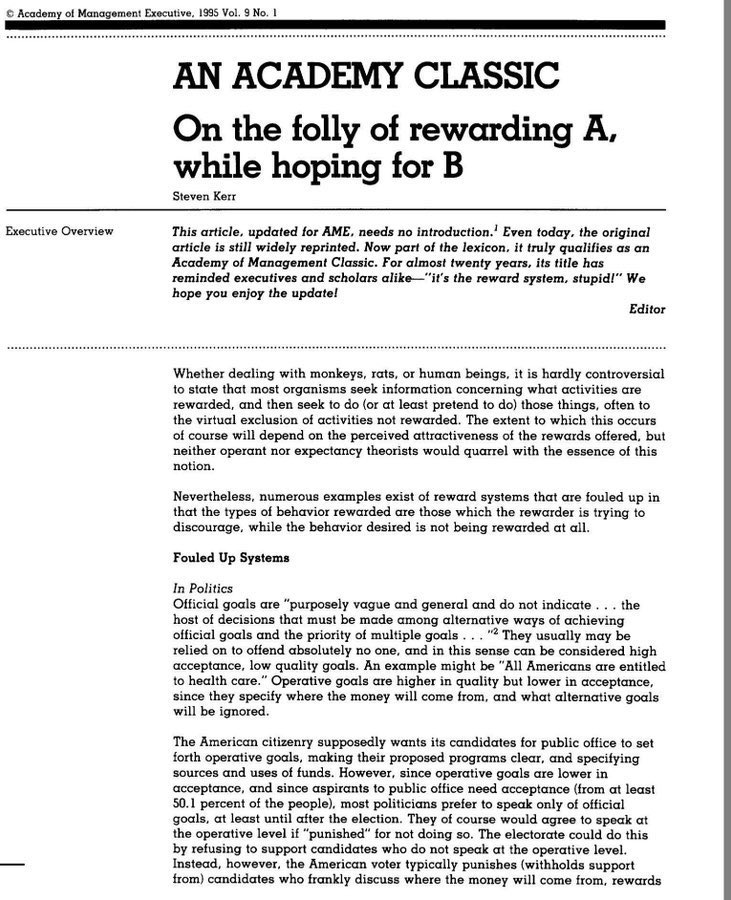
Everyone should read "On the Folly of Rewarding A, While Hoping for B” at least once.
ou.edu/russell/UGcomp/Kerr.p…

Exclusive: Meta employees are competing internally to become “Token Legends,” ranking themselves by how much AI compute they consume.
The leaderboard reflects a new status game where token usage is tied to productivity and influence. thein.fo/4cagfEP

Jane Wu retweeted

In case you missed it: @coeff_giving and @SloanFoundation launched a pop up journal and funding opportunity on studying the social returns to R&D. Here are the deets for funding:
Grants of approximately $250,000 are available for studies that will provide key empirical insight into the social and economic returns to R&D investment. Larger requests may be considered for uniquely ambitious projects.
Deadline: April 30, 2026
That's in a month, so better get your application ready!
More info here: popupjournal.com/griliches
Jane Wu retweeted

A big load of pure alpha —>

“You’ve just been told you have superpowers.”
AI agents are starting to feel like coworkers. The cost of automation is collapsing.
So what happens to jobs? To startups? To crypto?
We break down the new paper “Some Simple Economics of AGI” with coauthor @ccatalini, including:
• Why verification becomes the bottleneck
• Practical advice for early- and late-career builders
• The risk of a hollow economy, and the path to an augmented one
• Why crypto may be essential infrastructure for identity, provenance, and trust
In conversation with @eddylazzarin and @rhackett.
Full episode ↓
Jane Wu retweeted
Ben Horowitz on the infrastructure behind the AI economy:
"Crypto is the natural money for AI because it’s internet-native money."
"AI is global. Crypto is global."
"There needs to be not just a ledger of money, but probably a ledger of truth for AI to really fulfill its potential."
"I think people are probably underestimating how crypto and AI work together to form the AI economy."
"Networks and computers tend to grow together, and I think that AI is obviously a new kind of computer and crypto is a new kind of network."
@bhorowitz on Moonshots with @PeterDiamandis
Jane Wu retweeted
This makes it all worth it! 🔥 We designed the MIT Bitcoin experiment for exactly this moment: to spark the next generation of innovators and entrepreneurs. So proud to see what that 2014 cohort has already built!

Jane Wu retweeted
Ad for a webinar for my Phd program! @MITSloanPhD
--------------
The MIT Sloan TIES PhD program trains scholars who bring an economics toolkit to answer questions related to technology, innovation, entrepreneurship, and strategy.
This might be interesting if you are a scientist, engineer, or entrepreneur who is interested in studying the incentives and systems that govern the creation of new ideas and businesses. Or if you are an economist who is interested in how "innovation"—that thing that supposedly sustains all economic growth—actually works like in the real world. Or if you are someone who likes math and data, and wants to study big questions like what can be done to encourage more investment in “tough tech” sectors like nuclear research, or how new AI technologies might shape how research is done.
If you have an undergraduate degree in engineering, science, or social sciences, and find the questions above intriguing, the PhD program in Technological Innovation, Entrepreneurship, and Strategy (TIES) at the MIT Sloan School of Management might be for you!
We’re hosting a one-hour webinar on November 6th to give you a glimpse into what our PhD program is all about:
________________________________
PhD Information Webinar
Time: Nov 6, 2025 5:30-6:30 PM Eastern Time (US and Canada)
Link: mit.zoom.us/j/99170444734?pw…
Password: 460805
Meeting ID: 991 7044 4734
________________________________
Application Deadline: December 1, 2025
Program details and application link are available at: mitsloan.mit.edu/programs/ph…
Looking forward to seeing you there!Meet current PhD students, recent alum, and faculty members who will share their perspectives;
Learn about our incredible track record of placing students in tenure track positions at top schools;
Discover the mentorship opportunities that set our program apart from more traditional PhDs in economics, political science, or sociology.
