

i work in consumer m&a. i break down the earnings, deals, and shelf battles behind everyday brands, and what they mean.
New York, NY
Joined October 2025
- Tweets2K
- Following608
- Followers125
- Likes357




costco launched its own prebiotic soda at about 83 cents a can. olipop and poppi run about twice that, per inc.
the club brand just showed shoppers what the category can sell for.
once a store brand makes the same gut-health claim, the claim stops being the reason to buy. you're competing on taste, brand and shelf placement.
if the only difference is the claim, the cheaper can wins.

tyson charged about 10% more for beef this year and still lost $1.2b on it.
it sold 10.6% less beef on $21.7b of sales, so higher prices couldn't cover the cost of scarce cattle. meanwhile jimmy dean and hillshire farm made $1.3b.
39
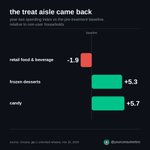
glp-1 was supposed to be bad news for candy. two years in, circana's data shows the opposite.
by year two, households on the drugs index 5.7 points above their own pre-treatment baseline on candy, measured against households not on them. their overall food and beverage spending is still 1.9 points below that same baseline.
the overall basket is still below baseline. the treat is not.

the uk gave mccormick until wednesday to offer a fix on its $44.8 billion unilever foods deal.
the problem is narrow: dry mixes and sauces in the uk.
if the fix is a sale, it could be a rare shot for a mid-size buyer to get a branded business from a forced seller.
a big merger can leave a small brand on the table.
1
167
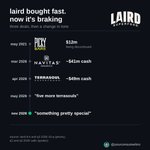
laird superfood's ceo said in may he'd love to do "five more terrasouls." this week he said the next deal would have to be "pretty special."
laird, the plant-based creamer and coffee brand, has bought three companies. picky bars in 2021, which it's now discontinuing. then navitas organics and terrasoul superfoods this year.
the reason for the go-slow is plumbing. terrasoul came with a factory in fort worth, and he says laird's erp "can't handle additional expansion." he expects to stay cautious "probably for the next six months."
the strain shows up in the numbers. gross margin fell to 29.6% last quarter from 36.5% a year ago.
you can only buy as fast as you can absorb.

1
1
118
kdp's filings show it now expects the last 40% of ghost to cost more, from $689 million at the 2024 close to $912 million as of september.
the brand earned that mark. this month kdp said it had crossed $1 billion in retail sales.
kdp paid about $990 million for 60%, which valued 100% at about $1.65 billion. the new mark on the last 40% implies about $2.28 billion.

2
90
“wellness” is becoming a crowded place to look different.
33% of new us launches in selected food, beauty and supplement categories carried a wellness claim this year, up from 24% in 2021, per mckinsey.
its survey also puts effectiveness alongside price as the top buying factor.
my take: one benefit shoppers actually notice beats five benefits they have to read about.
before adding another claim to the pack, find out whether the first one earns a second purchase.
1
4
207
store brands just hit a record 23.7% of items sold this year (circana, through nov 1).
national brands still grew dollar sales 1.9%, mostly by raising prices.
what's the one thing you'll never buy store brand?
2
73
Your Consumer Bro retweeted

🚨🚨Big update: after spending my career in investment banking and B2B SaaS, I’m going into CPG.
Introducing…
DUMB PROTEIN.
Protein got over-engineered into candy, popcorn, cookies, and ramen so we’re going the opposite direction. Back to the roots.
Clean-label chicken jerky bites.
26g protein, 180 cals (*nutrition soon to be confirmed)
No more jerky for truck drivers. This is for the hustlers.
Join the waitlist. dumbprotein.com

crowdstrike outage 2.0 just dropped. half of corporate america just found out their entire business runs on outlook.
3
355
most groceries are still bought in stores. planning around that alone could mean missing where spending is growing.
online food and beverage dollar sales rose 15.5% while store sales fell 2.8%, per circana, year over year for the four weeks through october 4.
for cpg brands, getting on the shelf is only half the job. can shoppers find you in search? is the product available to order?
the next distribution win might not be another store. it might be getting found in the ones you're already in.
1
106
big food is going back to what it knows how to run.
kellogg split in two in 2023. within two years, buyers had agreed to take both halves, the snacks side for $35.9 billion.
now kraft heinz is selling most of its north american coffee business and unilever is combining its foods business with mccormick.

1
2
108
mars plans about $1.4b of us factory spending in 2027, its biggest year yet.
the private maker of m&ms and snickers already makes 94% of what it sells in the us right here. the kellanova deal added pringles, cheez-it and more us plants.
my read: with tariffs swinging, a plant near the shopper is the hedge.
the cheapest tariff is the one you never pay.
1
117
america’s no. 2 grocery retailer by spending share charges you to walk in.
costco now captures 8.4% of us food and beverage spending. kroger takes 8.2%, per numerator’s panel for the year through september.
for cpg brands, bigger packs need their own packaging, freight and pricing math.
but i’d rather own a brand earning healthy margins with heavy costco exposure than one barely breaking even across a beautifully diversified customer base.
customer concentration matters. so does having profits to concentrate.
Your Consumer Bro retweeted

Over 100 of our brands are founder-led growth stage brands - nearly all of them want to exit their businesses, but they all fall into the same trap:
They grow too fast
And It takes me about 1 second to be able to tell which ones are falling for it
You can figure out the ones who are growing too fast by looking at 2 columns on the P&L; revenue and operating income; if ebitda isnt ~5% or higher, and growth is over 60/70%, you're doing it wrong.
These founders see brands like Hero Cosmetics, rhode skin, or Coterie growing like weekds, but they tend to not realize that these are very unicorny businesses that are having their cake and eating it too on profitability and growth
There are 2 exceptions to what I am about to explain:
1) you are early on in your J curve, fine, but you're not ready to sell now - there's an entire class of capital providers we aptly refer to as 'growth equity' who will invest unprofitable businesses that with steep growth trajectory. The playbook is to find one of these investors, grow some more, find positive ebitda then exiting to a strategic or financial buyer
2) a strategic NEEDS you and is not so much concerned with financial valuations.
However if you are planning for a fairway PE exit, you are doing yourself a disservice by pursuing that level of growth, as buyers will generally not give you any credit or value after a certain level of growth.
This comes down to a concept conventionally known as 'the rule of 40' - the balance of revenue growth rate + ebitda margin equaling 40, when ebitda is positive.
40, really not THAT high of a number. These days maybe its more like the rule of 50, but the concept prevails: you really only need so much growth; and anything beyond 40 or 50% - most PE buyers are going to look at it and just throw their hands up in the air and say we dont know how to underwrite this
said differently:
You are SO much better off growing 50%, then 40%, then 35% versus 150%, 50%, 10%
It makes the business much more predictable and therefore more underwritable for PE buyers
The chart below shows that many recent strategic acquisitions were well in excess of the rule of 40, with strong ebitda all around. If this is you, you'd generally earn a higher exit multiple - brands over the rule of 40 had median 4.5x EV/Sales exit vs sub rule of 40 had 3.3x EV/Sales exits
And remember, the brands highlighted below are the best of the best. If you want to maximize optionality and be able to attract the most buyers possible, most founders would be better off focused building real, solid businesses that balance growth with profitability vs. swinging for the fences to become the next brand on this chart.
though we do like to see that too :)
