

Posttrain, Memory, Multimodal Ace Top Talent Intern @dotsstudioai ex Intern @Zai_org , @TsinghuaSAIL
Beijing, China
Joined September 2017
- Tweets427
- Following726
- Followers100
- Likes1.1K




Yiming Shi retweeted


OpenAI claims the matrix multiplication exponent is exactly 2.25
The textbook method for multiplying two n × n matrices takes roughly n³ arithmetic operations. In October, OpenAI reported a way to bring the exponent down to 2.25. That left open whether someone could find an even faster algorithm
Today’s paper claims to rule out every exponent below 2.25
Read here: alphaxiv.org/abs/2611.matrix…

Yiming Shi retweeted

Opus 5.6 is unceremoniously the most powerful model I've laid my hands on. This is insane.
claude.ai/artifact/Cy2d8Vn63…
Have a go.

Yiming Shi retweeted

How can we distill frontier models on agentic tasks without access to their CoT?
In our latest paper, we introduce a method that uses the reasoning summaries returned by closed-model providers and matches standard full-CoT fine-tuning on long-horizon tasks.
CoT-proxy training works by introducing a train-eval format mismatch: during training, we place the summary after an *empty* think block and before the action/tool call. During inference, this additional training signal transfers to the student's own reasoning, without forcing it to mimic the summary verbatim.
Distilling GPT-5.6 Luna into post-trained Qwen3-4B raises the student's performance from 2.7% to 27.8% on SWE-bench Verified.


Yiming Shi retweeted

This agent memory paper is f*cking gold.
Anthropic's engineers tested what actually makes Claude remember between sessions. Spoiler: it's not saving more.
The 6 parts:
Part 1 → purpose
Tell Claude what memory is for, not how to use it.
A fixed "record only failures" rule cost the strongest models much of their gain.
Part 2 → keep it small
In Pokémon, Sonnet 3.7 saved 413 files across 225 folders and won 1 badge.
Fable 5 kept 9 files and a global.md, and won 4.
Part 3 → save what you can't see
Strategy, plans, tested rules.
Never what the screen already shows every turn.
Part 4 → dreaming
Claude re-reads its notes against the transcripts and corrects the wrong ones.
With the fixed note it got through Mt. Moon. With the wrong one, it never did.
Part 5 → the wiki
Linked pages that grow session after session.
2 sessions → 128 sessions: 13% → 48% of graded criteria.
Part 6 → one small index
Only the first 200 lines or 25 KB of MEMORY.md load every session.
Everything else waits until it's needed.
An agent that saves everything remembers nothing.
All 6 parts are in one prompt on the page. Drop it into Claude Code.
6 parts. 1 prompt. 0 forgotten sessions.
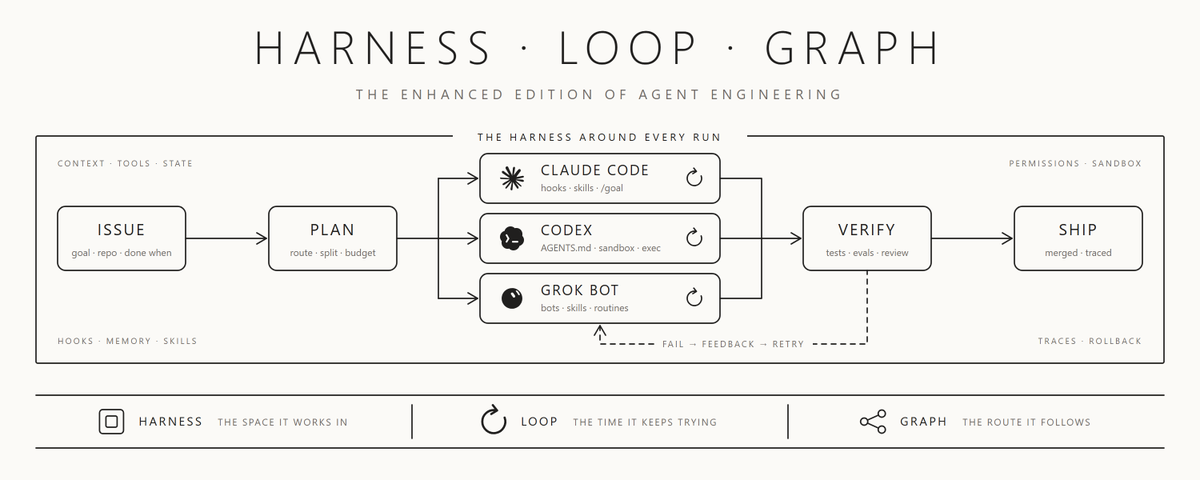
Full harness engineering guide in the quote below ↓


Yiming Shi retweeted

New slide deck on the biggest open problems in post-training and how the field got to where it is today. Largely, this is a statement of my goals with Trillium Labs (not that we can do every project at once). Stay in touch if you're working on any of these in the open!
Opens with the evolution of post-training and ends with a debate on how RSI is changing this type of research.
The research areas on my mind:
1. Harness specialization and design – How do we design environments for context management that enable new paradigms of using LLMs?
2. Character training – How do we create the personality of models and how does this impact safety, trust, and diffusion of LLMs?
3. Open-source RL environments – How do we create scalable, open data methods?
4. Reasoning efficiency in RL – How do we control and manipulate the reasoning efficiency of LLMs?
5. Scaling laws for RL – How do we design principled experimentation methodology for large-scale post-training?
6. Multi-agent scaling laws – What are the main axes of inquiry into multi-LLM systems and collaborations?
Re-recording video soon :) was from a recent visit to Cornell




Yiming Shi retweeted

Nvidia the champion of Western Open Source isn't working out well so far.


NVIDIA Nemotron 3.5 Super VL from @NVIDIAAI on ARC-AGI (Verified):
- ARC-AGI-2: 1.94%, $0.02/task
- ARC-AGI-1: 22.67%, $0.03/task
Nemotron 3.5 Super VL is the first NVIDIA model we've evaluated on ARC-AGI.

Yiming Shi retweeted

Over the course of 19 months, the cost to reach 75% on ARC-AGI-1 fell 99.95%: from o3-preview at $26/task to DeepSeek V4 Flash at $0.01/task.
On ARC-AGI-2, it fell 99.44% in just 6 months: from Gemini 3 Deep Think at $13.62/task to Dots3-Note Preview at $0.08/task.

Yiming Shi retweeted

Announcing dots. Dots work 24/7 for you, learn from your feedback, have their own computer, browser and can be connected to over 4k apps in our ecosystem.
They’re powered by Astra our best model yet. Included in your Pro plan, without drawing down on any of your usage. You can even call a dot while it’s working.
We’re getting you started with your primary dot today and soon you’ll be able to create entire teams of them.
Yiming Shi retweeted

Thank you @arcprize for independently evaluating dots3-note Preview, released one month ago. It scored 76.8% on ARC-AGI-2—a new open-weight SOTA at $0.08/task.
ARC-AGI matters because it tests whether models can infer new rules and solve unfamiliar problems. ARC-AGI-3 testing is underway.
dots3-note Preview also became the first AI model with an officially verified perfect score at IMO 2026 (42/42). On IOI 2026 problems published after its release, it scored 440.5/600 with simple test-time scaling—gold-medal level, equivalent to 7th on the human leaderboard.
Still a preview. For the full release, we’re improving reliability and the long-horizon agentic experience.
Dots3-Note Preview from @dotsstudioai on ARC-AGI (Verified):
- ARC-AGI-2: 76.8%, $0.08/task
Dots3-Note Preview sets a new SOTA score for open-weight models on our verified ARC-AGI-2 leaderboard.

Yiming Shi retweeted
Pretty insane result from RedNote (they promised as much, but now it's confirmed). This is 5.4 Xhigh, Gemini 3.1 Pro territory. 280B 16B active, pennies. Text+Vision+Audio in. "Preview".
Masterful work.

Dots3-Note Preview from @dotsstudioai on ARC-AGI (Verified):
- ARC-AGI-2: 76.8%, $0.08/task
Dots3-Note Preview sets a new SOTA score for open-weight models on our verified ARC-AGI-2 leaderboard.
Yiming Shi retweeted
Dots3-Note Preview from @dotsstudioai on ARC-AGI (Verified):
- ARC-AGI-2: 76.8%, $0.08/task
Dots3-Note Preview sets a new SOTA score for open-weight models on our verified ARC-AGI-2 leaderboard.
Yiming Shi retweeted

Why is RL so sensitive to training-inference mismatch (TIM)?
With each training step, the trainer is pulled toward the sampler, resulting in accumulating drift.
We exploit this intuition to devise a novel correction method to stabilize RL under TIM, called Score Centering.
Yiming Shi retweeted

This is notable. DeepSeek, a lab usually first to pioneer novel algorithms and architectures, is saying that at this point, the ROI of improving data quality far exceeds that of working on novel post-training algorithms.
I think this has already been true for some time for non-lab practitioners. If you're doing llm post-training, 80% of your effort should go into looking at your data.
This means:
- Hiring experts to dig through your RL tasks
- Sifting through rollouts and sft data by hand to remove suspicious samples. Make sure all tasks are actually passable.
- Making sure your data is diverse in both difficulty and category.


Yiming Shi retweeted
From synthetic unfamiliar environments, to real-world verifiable tasks—and eventually, toward the open-ended complexity of real life.
We began in synthetic environments such as ARC-AGI-3 and Slay the Spire 2, where the model must explore, form hypotheses, update memory, and keep learning over thousands of interactions.
We then moved toward real-world but still verifiable tasks, combining multimodal understanding, reasoning, coding, and tool use.
The next step is much harder: open-ended tasks in real life, where user intent unfolds over time, tasks span days or weeks, and external conditions keep changing. Our simulated real-life environments are an early step toward studying this challenge—not the destination.
This video follows that journey and where we hope to go next with dots3-note Preview:
studio.dots.ai/dots/dots3-en…