


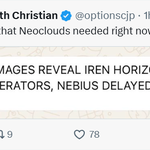
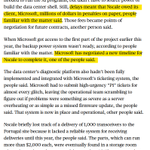

$nbis Bloomberg piece is a round-up of current neocloud pessimism & known delay signals: msft capex slippage; gartner & elon guppy-level doom predictions, site-specifc challenges (iren: cabling; nbis: temp. gas engine fine; nscale: cancellations). Framing is around msft internal debates re: outsourcing to neos in face of unmeetable demand.
On the neo-side, they call out nbis as being clear-eyed & intrumental re: their HS relationships: "Nebius has been unusually upfront with its competitive strategy. It will scale up by inking contracts with big customers like Microsoft or Meta Platforms Inc. knowing that they’ll abandon neoclouds in the long run, Nebius CEO Arkady Volozh said during a March conference hosted by Morgan Stanley.
“We treat this business as temporary,” Volozh said, referring to his company’s deals with customers like Microsoft and Meta."


$nbis, $iren, $msft On this late day tempest that there's sat imagery suggesting Horizon4 and/or Vineland are responsible for the capacity delay msft announced at earnings . . . .
First there are no sat images re: $nbis/Vineland--that's just a headline conflation. There are sat images & report for Iren by a research firm called aterio that, they say, suggest an elevated delay risk (see below).
The included nebius reference as potentially contribting to the msft 2026 shortfall is simply a speculation based on timing & the lack of any confirmation from co/ that they have/will successfully begun the transition @ Vineland from temporary gas engines to the Bloom blocks. It's appears to be a guess based on no evidence.
I would take all of this w/ due skepticism . . .
aterio.io/blog/aterio-identi…

$nbis, $iren, $msft On this late day tempest that there's sat imagery suggesting Horizon4 and/or Vineland are responsible for the capacity delay msft announced at earnings . . . .
First there are no sat images re: $nbis/Vineland--that's just a headline conflation. There are sat images & report for Iren by a research firm called aterio that, they say, suggest an elevated delay risk (see below).
The included nebius reference as potentially contribting to the msft 2026 shortfall is simply a speculation based on timing & the lack of any confirmation from co/ that they have/will successfully begun the transition @ Vineland from temporary gas engines to the Bloom blocks. It's appears to be a guess based on no evidence.
I would take all of this w/ due skepticism . . .
aterio.io/blog/aterio-identi…
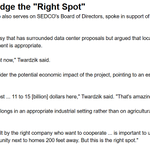
$nbis Comparatively de-risked domestic & international dc dev portfolio suggests election results (& implied slower reg. regime) likely to strengthen nebius's pricing hand. The co's US builds are far enough along in workable states to avoid moratorium threats (though site-level op, permitting & leg issues are still in play across cohort).
Of the 4 ground-up US builds, the site least far along is the PA Highbridge Business Park AI Factory, one of largest project campuses, spec'd for 1.2 GW. Highbridge had its Butler Township zoning expansion approved in August.
A quick dive shows PA's election results don't seriously imperil Highbridge, and may even strengthen the project over time. At the local level, both republican lawmakers representing the districts covering Butler Township & Schuylkill County were relelected: Tim Twardzik (State House District 123) and Dave Argall (State Senate District: 29).
Importantly, both are supporters of the Highbridge project, and dc's broadly, as important economic drivers for communities, so long as they are developed in close consultation with those communities (as Highbridge has been).
At the state leadership level, Gov. Shapiro won handily & enough state house seats flipped to give him a trifecta--which means he will seek to focus on codifying "GRID" standards statewide (House Bill 2650: GRID, Governor's Responsible Infrastructure Development).
That could have some tax status & power supply guarantee implications for Highbridge down the road. But a lot of what would be in a GRID statute already applies, and the bill would not stop construction or cancel permits. It states plainly that it doesn't affect municipal zoning.
Plus, clear rules have a protective benefit in that they are the administration's alternative to a moratorium. A codified GRID is a more likely outcome than a statewide pause.


$nbis "The reality is that life is a spiral." Not just a stack or a flywheel, but an interative, looped system that levels up. 🤔 Works for desrcibing the evolution of the co. itself, or the advent/escalation of ai broadly . . .
But my💰's on a shout-out to the integrated training/inference helix driving nebius's sovereign ai enterprise offering: inference → proprietary data → post-training → better inference → richer training data.
Each turn builds more specialized intelligence & sov. compute keeps the full learning loop & data driving it under the customer’s control.
Own--and compound--your intelligence. Build & extend your own frontier. That's the pitch & differentiating power of what it means to sell a spiralling "intelligence platform."
And why the term "neocloud" doesn't do them justice.
nitter.cf/romanchernin/status/21…

$nbis "Specialized execution at scale" is exactly the bottom-up enterprise market Nebius is being built for. Revolut's success is an early example of what's to come & key accomplishments listed in the referenced report are built on/with Nebius:
How Revolut Utilizes Nebius
GPU's: Runs its specialized AI clusters (H100s for its proprietary banking models & the new B200 infra) directly on Nebius.
Network & Orchestration: Leverages Nebius' high-bandwidth InfiniBand architecture & token deployment tools to optimize latency, bringing GLM's time-to-first-token down significantly
Specialized Model: In addition to hosting GLM for devs, Revolut uses Nebius to train its own proprietary transaction foundation model, PRAGMA (used for fraud detection and risk scoring) & to power its automated customer chat systems
nitter.cf/OliverMolander/status/…


Interesting.
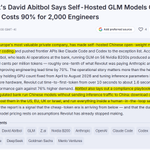
Revolut reportedly only started seeing meaningful AI productivity gains after moving away from expensive OpenAI and Anthropic models to self-hosted GLM.
Decagon reportedly runs ~90% of its workloads on open weight models.
Why? Because when you're running AI agents in production for e.g. customer service, cost and latency matter enormously. You don't need a frontier model with PhD-level reasoning or even a model that knows the capital of Finland to handle every customer interaction.
We're seeing similar dynamics across hypergrowth AI startups and increasingly the large enterprises we work with.
But most importantly, the future isn't binary.
When use cases are new, you want the smartest general-purpose model available. But once workflows mature and become predictable, smaller, faster, specialized models increasingly win.
I wouldn't be surprised if 80–90% of routine enterprise AI workflows eventually run on open-weight and smaller models.
This doesn't mean frontier labs lose.
It means the market is splitting into two massive opportunities: frontier intelligence and specialized execution at scale.

$nbis While technical detail here is welcome & instructive, the core answer to the question of why Nebius would sell bare metal compute to Modal, a TF services competitor is: “optimal capital allocation and diversification is not a flaw.”
Strategic co-opetition & a portfolio approach to contract banking/pluralism is a necessity when building a vertically-integrated company from the ground up, particularly one levered to the vicissitudes of credit/debt instruments.
Laddering your book/s of business in this context is a feature, not a bug. It’s what Arkady means when he says he’s building a “real” company.

The below argument is conflating software abstraction layers with hardware execution to claim $NBIS s managed services are "weak". This ignores company timelines which shows the absolutely immaculate pace of improvement by $NBIS on their Token factory offerings and the complex unit economics and technical nuances of inference.
Look at the maturity of these app tier platforms:
1/ @baseten : Founded in 2019 (~7 years old)
2/ @modal : Founded in 2021 (~5 years old)
3/ @togethercompute & @FireworksAI_HQ : Founded in 2022 (~4 years old)
Meanwhile $NBIS Token Factory is barely 1 year old, yet it already competes with all the above players across a range of SOTA models and continues to improve and take market share at an insane pace, not just with software level optimization but proprietary hardware + software co designs. Dismissing the violent pace of their growth because older software wrappers had a multi year head start is shortsighted and ignorant.
To dismantle @jiahanjimliu core question "Why sell bare metal to Modal if $NBIS can sell that same capacity via Token Factory?" it assumes that selling tokens/managed inference is always superior to selling bare metal. That is fundamentally false from a first principles economic standpoint:
1/ GPU & Workload Matching: Depending on the specific GPU generation, memory bandwidth constraints, and the exact model architecture being served (dense vs. sparse MoEs), the risk adjusted return of running inference can easily underperform a locked in, high paying bare metal contract. Knowing when to lock in a contract vs to sell tokens matters here.
A great example to how well $NBIS handles this is them renting GPUs to Baseten to specifically serve their video gen model stack instead of using that compute to serve the same video gen model stack on just Token Factory.
Vid gen models in this case are significantly less profitable because they require heavy O(N squared) spatial temporal attention through long sequences of frames plus multiple sequential diffusion denoising steps for every single clip processed. This creates heavy VRAM overhead that restricts concurrent request batching which tanks hardware utilization efficiency relative to text models.
2/ Guaranteed Utilization: Selling raw compute to a mature player like Modal which crossed $1B
ARR and scaled 15x secures massive,
predictable cash flow without taking on app layer demand volatility. It's optimal capital allocation and diversification not a flaw. Also you gotta "Keep your friends close and your enemies closer" lol
Furthermore comparing inference platforms to $NBIS misses where the technical moat I had defined several times before truly lives:
1/ Co Design vs. Wrappers: Modal rents multi tenant compute and wraps it in Python abstractions.
2/ Token Factory is engineered from the bare metal up optimizing InfiniBands, custom hardware kernels, co engineering with industry leaders like vLLM and PyTorch alongside hardware end optimizations like integrating Custom ASICS like the Groq 3 LPX on top of the $NVDA stack for their own inference infra to optimize serving from the hardware upwards unlike the rest of the above players who are stuck to software only optimization from the GPUs upwards.
3/ The Long Term Stack: If open source runtimes (like DeepSeek) and vendor optimized stacks commoditize pure software orchestration, app layer margins will compress. Owning the bare metal infra alongside the inference stack ensures ultimate pricing power which only $NBIS has.
This ultimate aim of $NBIS Jim is trying hard to ignore: Diversification across the stack. By monetizing both bare metal supply and managed inference, $NBIS minimizes execution risk and maximizes safety across market cycles rather than being locked into a single vulnerable layer. When one or the other from the bare metal or the software stack gets hit by margin compression collapsing one or the other from players like $IREN , $APLD or the above purely inference platforms, $NBIS will survive due to this exact layer based diversification.
Aside from hyperscalers ($GOOG & $AMZN ) no other pure play Al company owns the complete stack from physical data centers, power, and hardware infrastructure all the way up to the cloud layer and managed inference plus even agentic offerings.
That isn't a contradiction, that's real vertical integration.
$nbis When you pair creativity w/ operating discipline new possibilites/efficiencies emerge. See @Couch_Investor’s fleet management airline analogy re: using demand pricing innovations to fill otherwise-empty seats/i.e. monetize idle GPU capacity.
And that's just one piece of Arkady's laser-focus on optimizing infra. Consider the recent Inferize aquisition, which targets cold model starts & idle standby capacity, along with the demonstrated 2x+ throughput efficiencies coming w/ the vr fleet upgrades.
Beyond filling seats (to extend the airline metaphor) you're essentialy looking at:
(1) Less time at the gate. Inferize's focus on spinning up models faster = shorter turnarounds; getting more productive flights out of each day
(2) A more productive aircraft. Vera Rubin promises more throughput per watt. So more passenger journeys within the same energy budget, not just more seats sold on the existing flight.
Put it all together: fill the seats, shorten the turnaround, upgrade the aircraft. All these improvements reinforce each other and each recovered hour becomes more valuable when the hardware can do more useful work in that hour . . .
nitter.cf/Couch_Investor/status/…


shoshin retweeted

Fluidstack is closing at $40bb but $NBIS has a $50bb mkt cap + Avride and Clickhouse!?!

$nbis Rich technical discussion w/nebius vp of product as a prelude to upcoming GTC. Interesting tidbits re: training still brunt of workloads; traditional co's now joining ai/dig. natives on platform; future will be serving continuous lifecycle loop of training/post-trainging-inference . . .
Closes with a nebius recruiting pitch: "We need a lot of people; please come work witrh us."
h/t to @anthonybs for posting.
youtu.be/wnYMHktPIzQ?si=UYjr…
$nbis, $pltr The all-you-can-eat builder buffet is now open & growing. Own your intelligence.
nebius.com/blog/posts/three-…


$nbis, $nvda, $pltr I'd opt for a material deepening of support over an acqui-hire, but either way directionally bullish for enterprise uptake of hosted ow inference, given the risks associated (rightly or wrongly) w/chinese models.
Rock solid, long term backing for a competitive (& continually scaling/improving) western ow ecosystem improves the model supply available to nebius, while its palantir relationship offers a specific route for deploying those models into controlled, domain-specific enterprise workflows . . .
