

L'avenir est ce que nous allons faire. 🧰 Senior Economist @OECD. 🎓 Board @lavoceinfo, @scuolapolitiche & Labor Chair @PSEinfo. ⚠️ Opinions mine.
Paris, Europe
Joined January 2013
- Tweets15.9K
- Following1.9K
- Followers5.2K
- Likes17.5K




Pinned Tweet
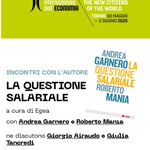
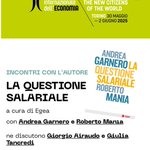
📢 Venerdì 21 marzo esce un piccolo libro su un grande tema, la questione salariale italiana.
📉 Con @mania_roberto abbiamo provato a capire come mai i redditi da lavoro in Italia siano fermi dagli anni Novanta e come si inverte la rotta.
📖 In pre-ordine in libreria e online.

Sono trent’anni che i redditi dei lavoratori italiani non crescono. Un’anomalia assoluta tra le economie avanzate.
Perché è accaduto? E come se ne esce?
In libreria dal 21/3, “La questione salariale” di @AGarnero e @mania_roberto è disponibile online, qui: tinyurl.com/LaQuestioneSalar…

ALT Il libro "La questione salariale" di Andrea Garnero e Roberto Mania (Egea, 2025)


Andrea Garnero retweeted

Lavorare meglio, guadagnare di più?
Ormai è sotto gli occhi di tutti: in Italia esiste una questione salariale.
📌L’incontro al Festival @citta_impresa di Bergamo, venerdì 6/11: tinyurl.com/FestivalImpresaS…
📖E il libro di Andrea Garnero e Roberto Mania: tinyurl.com/QuestioneSalaria…

Le proteste dei giovani ci ricordano che il tema non è solo quanti posti di lavoro si creano, ma quali opportunità si aprono per chi entra oggi nel mercato del lavoro. Alcune riflessioni su IA, occupazione, salari e produttività in questa intervista per l’Eco di Bergamo👇

Andrea Garnero retweeted

1/9 Great piece by @jburnmurdoch: the recent jump in US tech productivity looks more like a response to post-2022 shocks than an AI effect, and it is hard to extrapolate from. Agreed. Two caveats, though.

Quick thread on AI and productivity:
Lots of people say this chart shows AI is now showing up in the productivity data.
But I made this chart to argue the opposite: a trend that pre-dates AI and only shows up in the US doesn’t look like AI.
Here’s how I’m thinking about the data and underlying dynamics:

Andrea Garnero retweeted

What are the effects of a mandatory reduction in working hours?
We study the effects of France's 35-hour reform on employment, output, and productivity.
New paper with @ElioNimier, @NinaRoussille, C. Montialoux, A. Roulet.
🧵⤵️
1/19

Good to see @CompBureau calling for stronger action on non-compete clauses across Canada. They draw extensively on OECD evidence on how #noncompetes can reduce labour mobility, innovation and wage growth. Proud to see our work helping inform the policy debate.
@DanAndrewsEco

In an open letter, Interim Commissioner Jeanne Pratt is urging provinces and territories to foster more competitive labour markets by limiting the use of non-compete agreements: canada.ca/en/competition-bur…

ALT A person signing a document while another person points at a specific part on the document. Text in image: We’re urging provinces and territories to limit widespread use of non-competes
Andrea Garnero retweeted

In an open letter, Interim Commissioner Jeanne Pratt is urging provinces and territories to foster more competitive labour markets by limiting the use of non-compete agreements: canada.ca/en/competition-bur…
ALT A person signing a document while another person points at a specific part on the document. Text in image: We’re urging provinces and territories to limit widespread use of non-competes
Andrea Garnero retweeted

Company wage policy in a low-wage labour market
Giulia Giupponi @giulia_giupponi @Unibocconi, Stephen Machin @s_machin_ @LSEnews @LSEEcon
ow.ly/xvZb5101Yvz

Andrea Garnero retweeted

New Substack post with @soumitrashukla9. Work has never been just about the income earned sans effort costs, as typical in economic models. Key aspects of people’s identity, their meaning, and sense of agency are all wrapped up with what they do for a living.
There has been a lot of conversation lately about how technological change, particularly AI, may disrupt this relationship, from Ezra Klein's column on his own mathematician father’s grapplings with losing meaning in mathematics, to Francis Fukuyama's post on AI, agency, and recognition. In this piece we take a historical perspective on how technological transformation has disrupted identity and meaning by affecting jobs, and how workers and society responded to these changes.
Much of the debate around AI and jobs has centered on wages and material consequences, but losing one's work is also intertwined with how people view their place in society. Most people know about the Luddites—skilled weavers and knitters—who protested the devaluation of their mastery. What’s less known is that the Luddites were actually experts in using the machines as well, and that their protests prompted prominent economists like David Ricardo to rethink the role of automation in society, and later inspired the Arts and Crafts movement. A century later, when recorded sound displaced 20,000 cinema musicians, their campaign against "canned music" and two-year recording ban pressured labels into funding live performance.
Soumitra and I have been working on versions of this essay for months. He led the piece, and we’re both really excited to get it out there.
Link to the post here: aleximas.substack.com/p/tech…


The most revealing part of this conversation between Jon Stewart and Jacob Coxon wasn't Coxon's warning about A.I. doom, but his description of A.I. utopia, and Stewart's incredulous response. I wrote about it — and Francis Fukuyama's "Last Man," and A.I. easily solving the problems that bedeviled my father's field of mathematics for decades — here: nytimes.com/2026/10/18/opini…

Andrea Garnero retweeted

🇮🇹 The employment and output puzzle finally makes more sense
And so, after countless revisions, here we are with the so called Italian "employment and output puzzle". The figure shows the latest vintage of each series, and the picture has changed once again. This time, however, it finally makes considerably more economic sense.
First, since 2019, hours worked and real GDP have grown at essentially the same pace, whereas previous vintages implied negative hourly productivity growth, something that never made much sense to me.
Second, hours worked per employee are now higher than in 2019, consistent with the substantial increase in permanent employment and the sharp decline in temporary contracts.
Third, over the past three to four years, employment and output have grown at essentially identical rates, finally resolving the question we have been hearing for the past three years. How can employment keep increasing while GDP barely grows? Never made sense to me!
What remains puzzling is the productivity boom of 2021 and 2022, as well as the timing of the very weak GDP growth observed since 2022, particularly given the scale of the fiscal stimulus.
I see two possible explanations. Either output was overestimated in 2021 and 2022, and I remain skeptical about some of the deflators used at the time, or output has continued to be substantially underestimated since 2022.
At this point, I would probably lean toward the first explanation, because the overall picture since 2019 finally looks consistent with that of an economy that remains fundamentally incapable of generating productivity growth, but has nevertheless expanded considerably through higher employment and more hours worked. But again, I'm really not sure here, so it could well be the latter.
A glass half full, or perhaps only one third full, if you prefer.
In any case, the puzzle is still there, but at least several pieces finally seem to fit together.
End. Peace. 🕊️

Andrea Garnero retweeted

How do non-compete clauses affect worker mobility in #Canada?
New @OECD evidence finds they are widespread and increasingly used, while no-poaching and wage-fixing agreements can also restrict labour market competition.
🔗 Read the paper: brnw.ch/21x6qoM

Andrea Garnero retweeted
🇮🇹 Le continue revisioni al rialzo del PIL hanno cambiato il quadro macroeconomico e ridimensionando il famoso puzzle occupati/PIL. Ma perché gli errori vanno quasi sempre nella stessa direzione?
Ne scrivo su @lavoceinfo. Grazie per l'ospitalità.
lavoce.info/archives/114295/…

Andrea Garnero retweeted

Great thread. Loss of a skilled job isn’t just loss of income - it can be loss of craft, meaning, a sense of self.

🧵1/10 Given the recent reactions of mathematicians over rapid advances in AI, I think it is important to remember that technological change has historically been a very personal event for people.
Over the history of technological progress, looms have fallen silent, switchboards have gone dark, and factory lines have shrunk bringing with them a human crisis of identity and what it means to be a master of one's craft.

Today, UK PM Burnham announced his intention to limit the use of non-compete clauses.
To know how prevalent these clauses are, which workers they cover, and what they entail, see the country note 👉oecd.org/en/publications/non…
@OECDeconomy @OECD_Social

Burnham set to launch crackdown on non-compete clauses ft.trib.al/Gs7qtiV

Andrea Garnero retweeted
In 2025 just five companies (Amazon, Alphabet, Meta, Microsoft and Oracle) were responsible for 37 percent of the global capex of the top 100 U.S.-listed nonfinancial companies.
The last time investment was that concentrated was the early 1970s, when AT&T reigned supreme.

Andrea Garnero retweeted
Do non-competes come at a productivity cost?
New @OECD evidence links higher use of non-compete clauses to weaker labour reallocation and slower knowledge diffusion, with potential consequences for #productivity growth.
🔗 Read the paper: brnw.ch/21x6gap

Andrea Garnero retweeted

Première note "policy paper" du LIFT. Pourquoi l'IA ne rend pas (encore) la France plus productive. Ecrit avec @BunelSimon et accessible sur le site du labo
heclift.github.io/website/fi…
Les Français utilisent l'IA générative à titre individuel au moins autant que les autres Européens, mais leurs entreprises l'intègrent moins : seules 18 % l'utilisent, contre 26 % en Allemagne, et l'intégration reste superficielle, concentrée sur le développement de produits plutôt que sur les fonctions transversales

New @EU_Social-@OECD_Social brief on EU #automotive. Three highlights:
- China's role in supply chains went from nothing to 3%.
- 80% of workers report marked change but 1/3 does not receive training.
- Job loss means a cut of 57% in earnings. Six years on, still down by 25% .


Andrea Garnero retweeted

How should long-term employment contracts be regulated? We show that optimal regulation prices the use of non-competes, tying stronger non-competes to higher wages. This limits inefficient worker lock-in and raises pay at better matches.
econometricsociety.org/publi…
