

Lennert De Smet retweeted

🚨 Can we trust that the “concepts” in concept-based models actually mean what we think they mean?
Our new work, Prototype-Grounded Concept Models (PGCMs), makes concept alignment directly inspectable and correctable. #ICML26
Paper: arxiv.org/abs/2604.16076 🧵 (1/5)
Just a little under 5 days left to submit your work on #tractable #probabilistic #models to TPM [email protected] (June 12, AoE)! If you have ongoing projects or recently accepted papers that are #tractable, #causal or #neurosymbolic, then check the CfP at
tractable-probabilistic-mode…
Lennert De Smet retweeted
Our accepted ICML paper on prototype-based Concept Bottleneck Models is now on arXiv! We introduce Prototype-Grounded Concept Models (PGCMs), enabling verifiable concept alignment through interpretable visual prototypes 🔍🧠. Check it out at: arxiv.org/abs/2604.16076
Lennert De Smet retweeted

When you prompt an LLM for code, you get one deterministic program. However, the LLM actually defines a distribution over many programs, and existing methods discard it‼️ PPoT uses this distribution to extract free performance and efficiency gains. 🧵👇
Lennert De Smet retweeted

Lena Zellinger, Nicola Branchini, Lennert De Smet, V\'ictor Elvira, Nikolay Malkin, Antonio Vergari. [csLG]. How to Approximate Inference with Subtractive Mixture Models. arxiv.org/abs/2604.16714

If you care about enforcing constraints over time without breaking your computational resources, then read our new blog post over at @aihuborg!
It focuses on showing how our neurosymbolic Markov models beat the SOTA in out-of-distribution generalisation and so much more.


Relational neurosymbolic Markov models ift.tt/bJTtBEY

Lennert De Smet retweeted

Obsession with statistics or not .. better make sure evaluations make sense and we're not tuning the random seed.
Don't need to know all the fanciest statistical tests, but doesn't seem like that's the issue typically (to me) 🤷♂️
Heard of some statistical precipices ..
Just under 10 days left to submit your latest endeavours in ⚡#tractable⚡ probabilistic models❗
Join us at TPM @auai.org #UAI2025 and show how to build #neurosymbolic / #probabilistic AI that is both fast and trustworthy!


Lennert De Smet retweeted
🚨 New paper: “Towards Adaptive Self-Normalized IS”
TLDR; To estimate µ = E_p[f(θ)] when p(θ) has intractable partition, instead of doing MCMC on p(θ) or learning a parametric q(θ), we try MCMC directly on p(θ)| f(θ)-µ | - variance-minimizing proposal.
arxiv.org/abs/2505.00372

Lennert De Smet retweeted

We developed a library to make logical reasoning embarrassingly parallel on the GPU.
For those at ICLR 🇸🇬: you can get the juicy details tomorrow (poster #414 at 15:00). Hope to see you there!


Lennert De Smet retweeted

Our paper Massively Parallel Expectation Maximization For Approximate Posteriors is now on arXiv! In this work we introduce the QEM method for fast approximate posterior estimation in Hierarchical Bayesian models. 🧵👇

Lennert De Smet retweeted

We are going to present our poster "Sum of Squares Circuits" at AAAI in Philadelphia today
Hall E 12:30pm-14:00pm poster #840
We trace expressiveness connections of different types of additive and subtractive deep mixture models and tensor networks
📜 arxiv.org/abs/2408.11778

Lennert De Smet retweeted

🔥 Can AI reason over time while following logical rules in relational domains? We will present Relational Neurosymbolic Markov Models (NeSy-MMs) next week at #AAAI2025! 🎉
📜 Paper: arxiv.org/pdf/2412.13023
💻 Code: github.com/ML-KULeuven/nesy-…
🧵⬇️

Lennert De Smet retweeted

Unsure where to submit your next research paper to now that aideadlin.es is not updated anymore? Is the location for you as important as the conference?
Then check out 🗺️ deadlines.pieter.ai

ALT screenshot of deadlines.pieter.ai. The screenshot shows a map view with several AI conferences.
Are you interested in more scalable reasoning under uncertainty and attending NeurIPS? Then pass by our poster #3708 later today at 4.30pm!
TL;DR Probabilistic inference of integer arithmetic for probabilistic reasoning can be massively accelerated with tensors and the FFT. 🚀
Lennert De Smet retweeted
🚨 Interpretable AI often means sacrificing accuracy—but what if we could have both? Most interpretable AI models, like Concept Bottleneck Models, force us to trade accuracy for interpretability.
But not anymore, due to Concept-Based Memory Reasoner (CMR)! #NeurIPS2024 (1/7)

Very happy to present the CatLog trick at @NeurIPS in a couple of days!
If you are using REINFORCE for your discrete optimisation problem, then upgrade to CatLog for orders of magnitude lower variance while staying unbiased.
arxiv.org/pdf/2311.12569.pdf

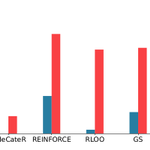
ALT IndeCateR (the estimator derived from CatLog) outperforms the competition in terms of both bias and variance, even when the competition is given a higher computational budget.
1
5
141
CatLog gradient estimates get their provably lower variance by exploiting the structure of the underlying probability distribution in combination with Rao-Blackwellisation.
In other words, if you know how your categorical distribution factorises, you can easily apply CatLog.
1
94