

Economist @UCBerkeley @BerkeleyHaas
Berkeley, CA
Joined July 2019
- Tweets871
- Following601
- Followers6.4K
- Likes1.3K




Pinned Tweet
AI companies trained their models on web content no one clearly owned. Now courts are deciding who does.
This looks unprecedented. It isn't — it's how innovation and growth at the resource frontier have always worked.

Much of human progress comes from pushing the frontier of resources available for economic use. But what happens when property rights are not clearly defined?
Think of oil, radio spectrum, personal data, or AI training data. Innovators brought these resources into use, appropriated them, and triggered conflicts over ownership. Here, appropriation isn't simply redistribution: it's part of the very process of economic growth. And property rights follow innovation, not the other way around.
One question: is common law, with its reliance on litigation and precedent, better suited to this process than civil law?
This was the theme of Session 5 of our @UCBerkeley PhD reading group on the macro of AI. We discussed Aaron Tornell's "Economic Growth and Decline with Endogenous Property Rights" and "Growth at the Resource Frontier," my paper with Noam Yuchtman.

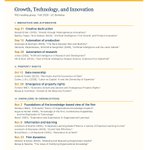
Today we kick off a PhD reading group at @UCBerkeley on Growth, Technology, and Innovation.
Sessions on innovation and automation, property rights, and knowledge in organizations — old classics and new work on AI, side by side, built around gaps where the next papers should be.
Here is the reading list for those who are interested.

Great presentations by Andrés Dávila-Ospina and @cmmnknowledge. Claude Summary of the session: dropbox.com/scl/fi/qjh3fl86w…

Martin Beraja retweeted

Tell your grad students: NBER Digital Economics and AI tutorial, deadline November 3: nber.org/calls-papers-and-pr…
Martin Beraja retweeted

RULFO: Maestro, soy yo, Rulfo. Qué bueno que ya llegó. Usted sabe cómo lo estimamos y lo admiramos.
BORGES: Finalmente, Rulfo. Ya no puedo ver a un país, pero lo puedo escuchar. Y escucho tanta amabilidad. Ya había olvidado la verdadera dimensión de esta gran costumbre. Pero no me llame Borges y menos «maestro», dígame Jorge Luis.
RULFO: Qué amable. Usted dígame entonces Juan.
BORGES: Le voy a ser sincero. Me gusta más Juan que Jorge Luis, con sus cuatro letras tan breves y tan definitivas. La brevedad ha sido siempre una de mis predilecciones.
RULFO: No, eso sí que no. Juan, cualquiera, pero Jorge Luis, sólo Borges.
BORGES: Usted tan atento como siempre. Dígame, ¿cómo ha estado últimamente?
RULFO: ¿Yo? Pues muriéndome, muriéndome por ahí.
BORGES: Entonces no le ha ido tan mal.
RULFO: ¿Cómo así?
BORGES: Imagínese, don Juan, lo desdichado que seríamos si fuéramos inmortales.
RULFO: Sí, verdad. Después anda uno por ahí muerto haciendo como si estuviera uno vivo.
BORGES: Le voy a confesar un secreto. Mi abuelo, el general, decía que no se llamaba Borges, que su nombre verdadero era otro, secreto. Sospecho que se llamaba Pedro Páramo. Yo entonces soy una reedición de lo que usted escribió sobre los de Comala.
RULFO: Así ya me puedo morir en serio.
--
Fragmento de una conversación real entre Jorge Luis Borges y Juan Rulfo.

And, sometimes, we pull a reverse Polanyi: we tell more than what we know.

Martin Beraja retweeted

Today's papers, on endogenous property rights at the technology frontier, bring to mind Harold Demsetz's work, especially this paper, a classic in @MasonEconomics circles.
Of course @MartinBeraja, a U Chicago Ph.D., discusses Demsetz at some length in his paper.

Today we kick off a PhD reading group at @UCBerkeley on Growth, Technology, and Innovation.
Sessions on innovation and automation, property rights, and knowledge in organizations — old classics and new work on AI, side by side, built around gaps where the next papers should be.
Here is the reading list for those who are interested.
Martin Beraja retweeted

Like every other econ reporter, I've spent much of the past couple years trying to understand what A.I. will mean for the economy and for workers. But it's been frustratingly hard to reach any firm conclusions, because so much is uncertain -- how the technology will evolve, how quickly it will be adopted, how policymakers will respond.
The Napster analogy misses a broader historical pattern.
Oil prospectors drawing from shared reservoirs, radio broadcasters occupying airwaves, advertising platforms collecting consumer data, and now AI companies training on creative works.
Time and again, innovators pushing the resource frontier moved first, appropriating resources before the rights governing their use were settled. Conflict followed. And more often than not, the taking that followed the making was legitimized after the fact.
Napster faced a different situation. Property rights in recorded music were relatively well established, and Napster was a small outsider confronting a powerful incumbent industry. In that respect, it was closer to DuPont's development of plastics, where the petrochemical inputs had identifiable owners and access had to be negotiated.
AI is different on both counts. Whether training on creative works constitutes fair use remains contested, and the leading AI companies have vastly greater economic and political clout than Napster ever did.
The broader historical lesson is that the prospect of appropriating resources can itself spur frontier innovation. Far from being merely an unfortunate consequence of it, appropriation and conflict are often part of the very process of economic growth.

Back in late 2023, when the New York Times first sued OpenAI, I went on a podcast and called it the Napster moment for AI.
Napster was the most popular thing on the internet in 1999, got sued almost immediately, and was gone by 2001. The lawsuit didn't really turn on the money. It turned on the precedent: a business built to take everything first and sort out the rights later got ruled flatly wrong, and that ruling is what let every rights holder line up behind it to collect.
Back then my read was that the AI companies would eventually license the material they'd been scraping, because fighting every rights holder one at a time is a worse business than just paying them. Since 2023 the licensing deals have stacked up, Axel Springer, the AP, News Corp, Reddit. The Times case itself is still grinding on with no ending.
I don't think the real lesson is about AI, though. Any business built on taking something it didn't get permission for eventually pays for it or gets rebuilt around not having it. That's the actual reason we went the opt-in route on our data years ago, back when opt-in just looked slow. I've watched which side of that fight usually wins.
Thanks @danielrock for bringing this one to my attention. For anyone else who is interested, I discuss these ideas in more detail here: nitter.cf/MartinBeraja/status/20…
Reading an old @Gladwell essay from 1999, I came across: “People like Mary Gay Shipley don’t merely predict sleeper hits; they create sleeper hits.”
A perfectly reasonable sentence. But I hated it... Funny how it now sounds unmistakably AI "it's not X, it's Y" rhetorical setups.
Martin Beraja retweeted

OpenAI just released hundreds of AI-generated results on open math problems.
If AI solves more problems with less human input, is human input worth less?
Short answer: not necessarily. It can be worth more—depending on which problems are left and how solvable they are for humans.
Thread, partly inspired by my paper with @EduardTalamas, “The Turing Valley” (accepted, JHC). (1/n)

Si quieren escuchar el camino de un argentino que fue a hacer su PhD en Economía a Chicago, y lo que vino después, acá hay una linda entrevista a @francisco_roch.
Lamentablemente, está un poco sanitizada... faltan historias divertidas en Chicago de las que doy fe. 😅

Recomendada entrevista con mi amigo @francisco_roch. ¡Rockstar! open.spotify.com/episode/6Pk…

What does it mean for labor to become capital? Human capital in Becker’s sense is inalienable. A model trained on your expertise is nonrival and can be copied. More so, what the model learns from any one lawyer (or economist?) is really the knowledge of the whole profession. Each expert sells individually something the profession produced jointly — a huge collective-action problem.
This question came from Session 4 of our @UCBerkeley PhD reading group on the macro of AI: data ownership. We discussed "Nonrivalry and the Economics of Data" by @ChadJonesEcon and @ChrisTonetti, and "Labor as Capital: AI and the Ownership of Expertise" by @zoebcullen, @Danielle__Li and @ShengwuLi.
Today we kick off a PhD reading group at @UCBerkeley on Growth, Technology, and Innovation.
Sessions on innovation and automation, property rights, and knowledge in organizations — old classics and new work on AI, side by side, built around gaps where the next papers should be.
Here is the reading list for those who are interested.
Excellent presentation by Sami Petersen and Alberto Undurraga-Flotts, and Claude session summary here: dropbox.com/scl/fi/vrzo60obp…

Martin Beraja retweeted

🚨 The NBER I3 Fellowship is now taking proposals!
**Outstanding oppty for PhD students in economics and adjacent fields working on innovation studies.**
Pros: Funds + networking, mentorship, opportunities to attend & present your work at NBER confs.
Cons: None!
Main expectations are that (i) you develop a new public data product and (ii) you join us at the December NBER meeting to share your progress.
Proposals must be submitted by Nov 1, 2026 using this Google form: docs.google.com/forms/d/e/1F…
Please share w/ students and colleagues!


i3 Open Data Fellows Program - 2027
The NBER Innovation Information Initiative (i3), a data collaborative for open innovation data and related analytics, tools, and metrics, will run the fourth cohort of Open Data Fellows.
The i3 will award five or more fellowships of $1500 each to graduate students in economics, innovation, entrepreneurship, or related fields. The fellowships aim to broaden the range of datasets, tools and documentation accessible to the research community, support a new generation of researchers in producing and sharing high-quality, reusable research data and code, and provide a network of support for these researchers, including through opportunities available to current and former fellows to attend and present this work at future NBER conferences.
Specifically, i3 fellowships will support students to contribute new datasets, tools, code, and/or metadata to the innovation research community. These contributions may come in the form either of a new project, or an existing project under development. We intend for this program to include a diversity of work. Our primary requirement is that your project is developed with the intention of public dissemination in mind.
The fellowships will run from January to December 2027. Fellows are expected to present their project at the end of the fellowship period at the annual i3 Technical Working Group meeting in December 2027. The program is intended to be supportive, collaborative, and not a major time commitment, with periodic one-on-one and group meetings to share progress and provide guidance.
This call is open to current graduate (Masters or PhD) students or those who graduated in the past six months. International applicants, including those on US student visas, may have specific considerations that could affect the payment process. We recommend consulting your international student office prior to applying to determine your eligibility to receive fellowship stipend payments and travel reimbursement from the NBER.
Please submit your proposal using this Google form (docs.google.com/forms/d/e/1F…) by November 1st, 2026.
We will announce the selected fellows in November, and fellows will be invited to attend this year’s i3 Technical Working Group meeting December 4-5, 2026.

Session 3 on AI and Innovation: “Artificial Intelligence in Research and Development” by @bfjo and “How Artificial Intelligence Shapes Science: Evidence from AlphaFold” by @RyanReedHill and @carolyn_sms.
One question we kept coming back to: should we think of AlphaFold mainly as automating research tasks?
AlphaFold gave us predictions for 200 million protein structures. That looks like AI producing new knowledge, which matters in ways that task automation does not. It can help scientists select which ideas are worth pursuing, rule out dead ends, and reveal new research directions.
Excellent slides by Eric Olav Chen and Kevin Yin (@_kevinyin), plus our (Claude-made) session summary, here: dropbox.com/scl/fi/jb7rom14v…
Today we kick off a PhD reading group at @UCBerkeley on Growth, Technology, and Innovation.
Sessions on innovation and automation, property rights, and knowledge in organizations — old classics and new work on AI, side by side, built around gaps where the next papers should be.
Here is the reading list for those who are interested.
Martin Beraja retweeted

We're hiring a Research Scientist in AI & Economics on the AI x Economy team @Google!
Come study how AI is changing the economy. Work with folks like James Manyika, Fabien Curto Millet, @alexolegimas, @AnuMadgavkar, Zanna Iscenko, @m_codreanu, @JMateosGarcia, @RMaria_drc, @andrewjkoh, @arthurturrell and an amazing slate of external collaborators. Publish what you find. Link below:
Martin Beraja retweeted
The 2026 NBER Economics of AI conference is available on YouTube. The theme was the economics of AI in China. Here are some of my takeaways.
Day 1: youtube.com/watch?v=pwODfPHl…
Day 2: youtube.com/watch?v=8cqRUc0W…

When @BrookingsInst asked us to speak to colleagues in policy and government, we thought: what better topic than the moral philosophy of AI?
Let's see how that goes.
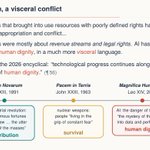
Talking about how innovation is intertwined with appropriation at the resource frontier. And why, with people's own creations and expertise taken, the concerns turned moral and the conflict visceral.
Thanks to Janice Eberly and @JonSteinsson for the invitation, and to @lugaricano and @SVNieuwerburgh for sharing the panel.
Watch live: brookings.edu/events/bpea-fa…
