
Economist working on animal welfare, as well as on environmental & ag economics, and public policy. All opinions are my own, not those of TSE or INRAE.
Toulouse, France
Joined June 2018
- Tweets6.1K
- Following1.8K
- Followers2.5K
- Likes18.3K






Au delà de la réglementation, c’est important de montrer la réalité. Il faut que les gens puissent se rendre compte de ce que subissent les animaux, même lorsque la réglementation est respectée

🔴La réglementation européenne exige que le temps entre l’accrochage et la mise à mort d’une dinde ne dépasse pas 2 minutes. Mais sur le terrain, le journaliste de #Complementdenquete a constaté que ce site d’abattage ne la respectait pas toujours.
Nicolas Treich retweeted

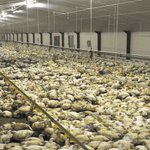
🐓L’association de protection animale L214 alerte sur les conséquences des élevages industriels de poulets à croissance express. Elle a récupéré clandestinement des cadavres de volailles dans un abattoir LDC afin de les faire autopsier.
Wow. I’m not sharing this because of Saez-Zucman, but for broader implications. We’re about to see a wave of AI scrutiny of published research. This period will be both hard and exciting. AI will lead us to reassess many existing works and change incentives for future research

Errors in the research of Emmanuel Saez and Gabriel Zucman marginalrevolution.com/margi…

Nicolas Treich retweeted

New working paper: Can AI forecast treatment effects in economics from pre-registration documents?
Answer: Yes. 1/

1/4 The Mbappé–Mao affair reminds me Timur Kuran's book Private Truths, Public Lies.
A simple joke triggered a major backlash in China, costing him sponsorship deals and prompting an apology.
Why can a seemingly minor joke provoke such a disproportionate reaction?

3/4 Here’s the trap: everyone sees others conforming and may assume the dominant belief enjoys widespread support.
The silence of sceptics then strengthens apparent consensus.
Power no longer has to do a lot. Self-censorship does most of the work.
Well done France!

🎉 The 2026 rankings are in! How competitive is your country’s tax code?
See how your country compares with our new interactive tool: hubs.ly/Q04C914t0
The structure of a country’s tax code is a determining factor of its economic performance. A well-structured tax code is easy for taxpayers to comply with and can promote economic development while raising sufficient revenue for a government’s priorities. In contrast, poorly structured tax systems can be costly, distort economic decision-making, and harm domestic economies.
The International Tax Competitiveness Index gives a comprehensive overview of how OECD countries’ tax codes compare, explains why certain tax codes stand out as good or bad models for reform, and provides important insight into how to think about tax policy.

Nicolas Treich retweeted

Bonjour @gerard_larcher, que dirait le Sénat si les médecins faisaient une saignée pour guérir tous leurs patients, comme au 17ème siècle, en se basant sur la théorie des humeurs ?
C’est pourtant ce que viennent de faire les Républicains, majoritaires au Sénat, en votant le maintien de l’encadrement des loyers proposé par le PS.
Non seulement votre groupe contribue ainsi à la diffusion des fausses solutions socialistes qui ont déjà fait tant de dégâts dans ce pays, mais il va pénaliser un peu plus l’offre locative.
Comme les médecins pratiquant la saignée, vous tournez le dos à plusieurs décennies de science économique solide, qui a documenté les effets de l’encadrement des loyers.
Tout est détaillé dans une méta-analyse de 112 études internationales parue en 2024.
Il suffisait de lire.👇
À court terme, et pour les locataires EN PLACE, l'encadrement parvient mathématiquement à freiner l'inflation des loyers et à protéger le pouvoir d'achat immédiat.
Mais à long terme, et pour l'ensemble du marché, la littérature internationale montre que la baisse de la rentabilité pour les bailleurs décourage l'investissement neuf et la rénovation, pousse vers des formes de contournement comme les meublés touristiques et la vente et contracte l'offre globale.
L’encadrement des loyers que vous avez voté va donc entraîner mécaniquement une dégradation de la quantité et la qualité de l'offre locative globale, et une aggravation de la crise du logement pour les nouveaux entrants.
C’était ça, l’objectif ?


Le vote par le Sénat de l’encadrement des loyers ne montre pas seulement que le socialisme a gangréné @lesRepublicains.
Il confirme que les élus de tous bords sont imperméables à toute rationalité, ignorants des réalités économiques et peu soucieux du bien-être général.
Car l’encadrement des loyers ne marche jamais, nulle part.
Nicolas Treich retweeted

Has this post-doc ad been circulating among political scientists? If not, please share! It is an amazing 2 year post doc in Toulouse at the IAST/TSE. I was a fellow and my life was changed forever (I even work in Toulouse now!).
tse-fr.eu/iast-research-fell…
Nicolas Treich retweeted

And we can do a better job of admitting when we're wrong.
Here's a good example from Andrew Gelman of how to do it. End/

Nicolas Treich retweeted

Job Market Alert: We're hiring and invite applications for the following positions:
1) Assistant/Associate Professor (tenure-track) in Microeconomics: econjobmarket.org/positions/…
2) Assistant/Associate Professor (tenure-track) in Behavioral Economics: econjobmarket.org/positions/…
1/2
Nicolas Treich retweeted

🚨 PhD Fellowship in Energy and Climate Economics – University of Barcelona School of Economics!
Join my research project on accelerating the energy transition at the Chair of Energy Sustainability and the PhD in Economics programme. Apply until 11/12/2026. Instructions below 👇 – at Plankstadt, Deutschland

Nicolas Treich retweeted

Normative Economics and Economic Policy webinar series.
Programme: sites.google.com/view/normat…
For joining details, email [email protected].

Nicolas Treich retweeted

De manière très factuelle :
– Les instances consultatives ministérielles (« comités Théodule » si l’on caricature…) représentaient un coût de ~30 millions d’euros en 2025
– Les pensions de retraite, première dépense publique, représentaient quant à elles 422 milliards d’euros la même année, soit 14 000x plus (!) que les dits « comités Théodule »

Le problème des retraites est dérisoire par rapport au montant des déficits et à l’intégralité des dépenses inutiles.
Il y a aujourd’hui, par exemple, de nombreuses agences et comités Théodule qui dévitalisent le pouvoir politique et qui, au passage, coûtent une fortune.
Readers added context they thought people might want to know
Les instances consultatives ministérielles (« comités Théodule ») représentaient un coût de ~30 millions d’euros en 2025, tandis que les retraites représentaient 422 milliards d’euros la même année, soit 14 000x plus.
vie-publique.fr/en-bref/303627…
drees.solidarites-sante.gouv.fr/sites/default/… (Page 99)
ifrap.org/fonction-publi…
Nicolas Treich retweeted

In just four years ChatGPT reached a billion weekly users. That's crazy fast! Facebook took 8.5 years to reach that milestone. Source: buff.ly/nqAiwM3


Nicolas Treich retweeted

Job market candidates in labor: we invite you to join the Labor Hub, create a profile and post your JM paper! You need the endorsement of your advisor, that’s all. laborhub.ilr.cornell.edu

Big announcement to the Labor Econ Community: We have created the "Labor Hub" - a platform to exchange relevant info (events, jobs, visits, SI, papers...) - Apply to become a member! Job market candidates especially encouraged to apply! Link: laborhub.ilr.cornell.edu/ Please share!
Nicolas Treich retweeted

The economist job market is up and running! Last year the economics job market was the toughest in recent memory, as JOE listings were down 20%. This was below even Covid levels.
A bit of good news for PhD economists this year in that I am noticing some green shoots in my discussions with employers! And, in the data, we have a bit of good news as well: JOE listings are up 5.5% over this time last year (see below).
Under the hood is where it gets interesting, however:
**Full-time US academic jobs: +14.4%. Liberal arts colleges +16.1%, universities with graduate programs +13.8%. The segment that took the biggest hit last year is leading the recovery.
**Full-time academic jobs outside the US: -12%. The rebound so far seems to be a domestic story.
**Nonacademic jobs: +7.5% overall. Yet, this hides a ton of heterogeneity. Consulting/research +21.6%, Banking/finance/industry -25%, US federal government: -44.4%. A side note is that for my entire career, the federal agencies were a stabilizer of this market, the last few years we have seen this buffer disappear.
At this point, a candidate might ask: how should I respond to all this news? Considering the data and my chats with people around several markets, I would still turn to the science. Back when I was on the market it was difficult too (at least for me…I had 1 interview from 150 applications!). The next year we studied the search market (paper downloadable here: ideas.repec.org/p/feb/natura…).
We compared a boom market to a bust market through the lens of optimal search across multiple markets. Candidates adjust on two margins: which markets they enter, and how many applications they send into each. In busts, we found graduates of elite programs broadened their search down the academic ladder, graduates of lower-ranked programs shifted toward the business sector, and employers everywhere raised their hiring standards.
So far the data in 2026-27 is neither a boom nor the bust in our paper, it is both at once. Today academia is loosening while government has effectively closed and finance has tightened. Even with those changes, my advice is no different than it was back then: adjust both margins. This means that you should re-enter markets you may have written off. This is because the academic window is wider than many feared, especially at liberal arts colleges. In addition, perhaps redirect applications from DC toward consulting.
In the end, the deepest lesson for me remains: there is no “the market,” we live in the world of “many markets.” Treat this like a portfolio problem, and thus the key question of the day is “how are YOUR markets doing?”
