

@WindwardAI
Account based inIsrael
About this account
- Account based in
- Israel
- Connected via
- Israel App Store
Account-level information from X, not a live location or the device used for a specific post.
Windward is the leading Maritime AI™ company, delivering mission-grade all-source operational intelligence across the maritime domain.
Washington, D.C.
Joined October 2014
- Tweets5K
- Following921
- Followers11.5K
- Likes1.5K



Vessel attacks around the Strait of Hormuz just hit a wartime high.
12 commercial vessels were attacked between October 5 and 11, the highest weekly count since the war began, edging past the 11 hit in its opening week. Six were struck on October 11 alone: five tankers and a container ship, hit in the strait and off Oman’s Sohar anchorage.
The surge comes as Gulf wet-cargo exports rise to near pre-war levels, with strikes no longer confined to the strait. Tankers were also hit off Qatar, east of Fujairah, and at anchor off the UAE this past week.
More laden tankers moving means more targets, and waiting at anchor is no longer safe either.
Live tracking: okt.to/j8D5LX


Windward is heading to EURONAVAL 2026, and we’re looking forward to meeting the industry leaders, decision-makers and visionaries shaping the future of naval defense.
Tell us your mission and we’ll show you how our all-source approach and remote-sensing operational intelligence helps you get ahead of risk and safeguard your waters, with a live walkthrough of the platform.
Meet our team at Hall 6, Booth J128
@SalonEuronaval #EURONAVAL


For the third consecutive month, no cargo was loaded on falsely flagged tankers moving Russian crude. Instead, record numbers of vessels shifted to the Russian flag in Q3 in one of the most significant developments for the shadow fleet since early 2023.
Russian-flagged tankers now make up 46 of the 101 sanctioned vessels Windward tracks, carrying 43% of all sanctioned volume moved in September.
Read the full analysis: okt.to/UXHCYe

Windward retweeted

The @WindwardAI Q3 Risk Report is out. Since then Iran has attacked another 15 ships across the Middle East Gulf widening its range beyond Hormuz to Qatar and Sohar.
among the highlights:
* 87% of ships attacked were tankers (Q2: 28%).
* 47% belonged to Gulf energy companies’ national shipping fleets (Q2: 12%).
* 93% of attacks occurred in the Strait of Hormuz (Q2: 52%).
* Most attacks hit vessels transiting the southern corridor with AIS off.
The dark fleet went through its largest structural change since 2023 in Q3: tankers reflagged to Russia in record numbers.
Windward’s dark fleet (over 20,000 dwt) now contains 223 Russia-flagged tankers. Of those, 84 changed MMSI numbers between July and September, indicating a change of flag during the quarter. That is more than four times the reflaggings of Q2 and nearly equals the total tracked since the start of 2025.
Russia is now the largest flag in the dark fleet, with 18% of vessels by number and 14% by deadweight.
The number of falsely flagged ships listed by the International Maritime Organization reached 613 by the end of Q3, up 39% since the start of the year. Together they total 24.8 million gross tonnes.
A falsely flagged ship does one of two things: it registers with a fraudulent registry that has no authority to flag ships, or it broadcasts the flag of a legitimate registry whose maritime administration says it never authorized the vessel. Both appear in the IMO list.
Guyana is the most used false flag by tonnage, at 15% of the total. Comoros is the most used by ship count, with 81 vessels; Comoros is a legitimate registry whose flag these ships broadcast without authorization. Malawi and Nicaragua follow.
sign up for the Risk Report here: windward.ai/top-8-maritime-r…


Between July and August 2026, six state-linked vessels operated above 11 subsea cable systems across the Pacific, Atlantic, and a Baltic corridor. None of the cases involved spoofing, identity changes, or AIS manipulation.
For infrastructure owners and agencies, screening based on a single data source has nothing to flag when nothing is being hidden. Spotting vessels like these requires multi-source fusion and behavioral intelligence, assembled from satellite, AIS, and vessel history, to reveal one clear operational picture.
See how: okt.to/JUq0Qe

8 maritime risks defined Q3 2026. Each one changes how you should be operating, insuring or securing ships heading into Q4.
Iran's attacks in the Gulf doubled. Dark fleet tankers reflagged to Russia more than quadrupled. Red Sea tanker transits dropped 26%.
Windward's MIOC analysts break down the data behind these shifts and why they matter now.
Get the full report: okt.to/aDjcI7

An unnamed tanker was hit by multiple projectiles 51nm off Madinat ash Shami, Qatar on Oct 7, per UKMTO. 16 attacks on Gulf shipping in 10 days; the first outside Hormuz since Sept 9.
Windward has confirmed 12 of the vessels: all on the U.S.-assisted southern corridor, transiting dark, 11 tankers.
Freight is now 25-30% of the cost of Middle East Gulf crude (normally 1-3%). VLCC Saudi-China rates have passed $1.3m/day. NOCs are paying $50m/transit and discounting up to $35/barrel off OSP to move cargo.
okt.to/TX1UIq

Q3 marked the most dangerous quarter for global shipping in recent history.
Iranian attacks on shipping doubled to 45 vessels and dark convoy passages through Hormuz surged from zero in early July to 52% of all traffic by September.
This month's MariTIMES reveals the risks that defined the quarter.
okt.to/Ssj3Do

The Port of NEOM recorded a single bulk carrier call between October 2025 and April 2026. Between May and September it recorded 25, many staying for weeks, parking cargo while route decisions get made further downstream.
When bulk calls at NEOM fall, confidence is returning to Gulf transits. When they climb, it's the opposite. okt.to/1lm9Or

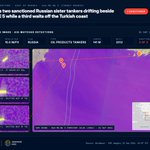
Three Russian-flagged sister tankers, two sanctioned, have loitered for up to two months east of Rhodes, crossing the SEA-ME-WE 5 cable corridor again and again. Built in 2012, same ownership network, destinations all "for order."
No cargo transfers. Two went dark together for ~19 hours. A fourth sister tanker ran the same pattern for 6 weeks before sailing off. Windward assesses this as consistent with mapping or positioning over critical infrastructure, not routine transit.
Surface patterns like this with Windward's Maritime Intelligence Operations Center: okt.to/YgIjO1


There's no official register of the shadow fleet. Estimates range from a few hundred vessels to over a thousand, because every organization scopes the count differently.
A vessel can behave exactly like a designated tanker and still not be on any list.
Windward tracks what it does, not what it declares. okt.to/x6nsD3

Windward's MIOC: satellite imagery as of 2 Oct shows three tankers, two likely VLCCs, alongside Yanbu's Northern Crude Terminal, the morning after an alleged Houthi projectile reportedly struck the port area on 1 Oct, sparking a fire near a tank farm.
The three tankers that arrived at the northern terminal on 28 Sep have since departed. The turnover points to continued activity, consistent with reports that loading resumed after a brief suspension, though occupancy alone doesn't confirm loading has resumed.
Separately, three tankers alongside Yanbu's Southern Crude Terminal since 27–28 Sep also departed, heading north toward the Suez with a combined 3.76M barrels of Arab Light crude (per @Vortexa) — 1.71M bbl bound for Rotterdam, the rest due at Sidi Kerir on 06 Oct.
A shift from mid-Sept, when several European fixtures fell through. Neither Aramco nor Saudi authorities have confirmed the 01 Oct incident.
Live Hormuz & Red Sea tracking: insights.windward.ai
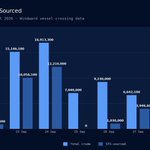
STS-sourced crude out of Hormuz more than doubled on 1 Oct, 2.02M to 4.82M bbl, across 4 of 10 crossings even as total crude outbound eased to 12.4M bbl (from 13.1M on 30 Sep).
Terminal loading fell to 7.58M bbl, from 11.1M on 30 Sep.
Emirati grades led at 5.65M bbl, overtaking Saudi Arabia, which led on 30 Sep. Oman: 2.68M bbl, 3 cargoes. (According to @Vortexa).
Live Hormuz & Red Sea tracking: insights.windward.ai


Windward retweeted

Marseille is the 6th largest undersea cable connection point globally.

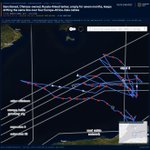
A sanctioned, Chinese-owned tanker has been loitering north of Algiers for 19 days. In ballast for 7 months, no cargo, no reason to be there.
Since Sep 29 it's run the same drift 3 times: 60–68nm at under 1kn, across 4 Europe–Africa–Asia cables, crossing EIG ~8 times (closest 0.24nm).
Windward assesses this as a possible cover case for seabed cable survey.

A sanctioned, Chinese-owned tanker has been loitering north of Algiers for 19 days. In ballast for 7 months, no cargo, no reason to be there.
Since Sep 29 it's run the same drift 3 times: 60–68nm at under 1kn, across 4 Europe–Africa–Asia cables, crossing EIG ~8 times (closest 0.24nm).
Windward assesses this as a possible cover case for seabed cable survey.
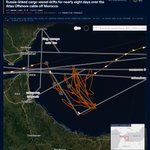
A Russian-linked cargo vessel tracked by Windward drifted for nearly eight days over the Atlas Offshore cable off northern Morocco: 10 loops across the route, 22 hours within 1nm, closing to 0.34nm, with a 2.5-hour near-stop directly on it. No cargo work, no STS, AIS on throughout.
The vessel carries a high compliance risk tied to Russia and called at Novorossiysk in April before unloading at Alexandria. Its AIS went dark for 65 hours leaving Russia, yet it reported position every few minutes while sitting over the cable.
Windward assesses eight days of unproductive drifting with no commercial rationale as consistent with deliberate loitering rather than transit.

Michelle Wiese Bockmann (@Michellewb_), Windward's Senior Maritime Intelligence Analyst, is in Fujairah, UAE for the 14th Energy Markets Forum 2026, hosted by Gulf Intelligence (@gulf_intel), October 6–7.
She'll share her expertise across multiple sessions, discussing topics such as untying the Strait of Hormuz, the market and capital shifts reshaping trade and energy security through 2027, and market transparency as a first line of energy resilience.

Near-peer threats and transnational crime look nothing alike, but both demand the same high-fidelity targeting information.
Windward's Zach Schwatka explains why raw positional data and dots on a map fall short, and how our multi-sensor, multi-intelligence fusion brings every relevant source to bear at once.