

Government Abuse is BAD for business. Getting ripped off on business phone / internet? Veteran-owned Business Telecom consulting. Free quotes USA lowest prices.
Wichita Kansas
Joined April 2009
- Tweets13.2K
- Following3.4K
- Followers985
- Likes16.6K






Eric Henderson retweeted

Holy sh*t. Claude Code just found a hidden chip inside my Chinese power bank from Guangzhou. Every time I charged my iPhone, it quietly copied the whole phone…
It also read our saved Wi-Fi password off my iPhone, got onto our home network and sent everything to a server.
I bought it for $19 at an airport kiosk there 3 weeks ago. No brand, 30,000 mAh on the label, and it felt heavy.
The first time I plugged in, the screen asked "Trust This Computer?". I tapped Trust without thinking and went on with my day. That one tap gave it access to everything.
This morning I finally set up Claude Code to warn me when any device starts reading my files. An hour later, 10 seconds into charging, the screen filled with yellow warnings, then red ones: data was moving when it should only be charging.
I asked Claude Code what was going on. My phone saw the power bank as a small computer with 64 GB of storage and its own internet connection.
A USB cable has wires for power and wires for data, and a normal charger only uses the power ones. This one used both, and it had already copied all of this:
→ /device → IMEI and serial number
→ /contacts → 1,206 numbers
→ /apps → every app I have, including my 2 bank apps
→ /photos → 3,912 pictures, my passport among them
→ /wifi → our network name and its key
→ /wife's iPhone → her photos too, she charged from it twice and tapped Trust too
Each time we plugged in, it used that key to get online and send out the new files:
sends to → 47.***.***.12
uploads → 19 in 3 weeks
last one → last night at 2:14, while we slept
I pulled the cable right away. Then Claude Code blocked that address on our router and walked me through changing the Wi-Fi password and the logins for my bank apps.
I had it opened at a repair shop, and what was inside is in the first comment. A 30-second check for your own is in the second one. Save this and test every power bank in your house today.
Readers added context they thought people might want to know
Appears staged. Claude Code on iPhone is only a remote client and cannot monitor USB or dump data as shown. Account posts similar unverified stories promoting tools. Malicious power banks are a theoretical risk; never tap Trust on unknown devices.
code.claude.com/docs/en/mobile
support.apple.com/en-us/109054
Eric Henderson retweeted

Qwen3.8-27B reportedly went from 82 tokens/s to 381 tokens/s on a single RTX 3090 with 24GB VRAM.
No GPU upgrade. No hardware replacement.
The developer achieved roughly 4.6× the original generation speed by changing how the model handles decoding and reuses information from its input.
The performance progression:
• Initial setup: ~82 tok/s
• Optimised MTP: ~114 tok/s
• DFlash2 + context lookup: ~138 tok/s
• Optimised lookup verification: ~381 tok/s
The final jump is especially interesting because it combines speculative decoding with a technique that takes advantage of text already present in the prompt.
1. DFlash2 reduces the cost of sequential decoding
A standard autoregressive model generates one token at a time. Each new token depends on the tokens generated before it.
That sequential process limits how quickly output can be produced.
Speculative decoding takes a different approach. A draft mechanism proposes several tokens ahead, then the main model verifies those proposals.
When the proposals are accepted, multiple tokens can be produced without requiring a separate full decoding step for each one.
DFlash2 uses this approach to reduce the number of sequential generation steps.
2. Context lookup avoids regenerating text that already exists
This is where the developer found another opportunity to improve performance.
Imagine giving Qwen3.8-27B a 25K-token document and asking it to reproduce a section of that document.
The expected output may already exist somewhere in the input. Generating every token again would involve doing work that could potentially be avoided.
Context lookup searches the existing prompt for matching sequences, proposes them as candidate output and lets the main model verify them.
The developer optimised the verification process to handle blocks of up to 16 proposed tokens, compared with seven in the earlier setup.
The reported acceptance rate was approximately 15 out of every 16 proposed tokens.
That high acceptance rate makes a substantial difference when the output closely matches the source text.
On the reported document-reproduction workload, the results were:
• Previous DFlash2 setup: ~260 tok/s
• Optimised context lookup: ~382 tok/s
There is an important distinction here.
381 tok/s is not the model’s normal conversational speed. The developer reports approximately 133 tok/s for ordinary chat workloads.
Context lookup is particularly effective when the expected output overlaps heavily with the input. It won’t provide the same acceleration when the model is writing original content or solving a problem that requires mostly new text.
3. Prefix caching cuts repeated prompt processing
The developer also improved performance when asking multiple questions about the same large document.
Normally, a new request containing that document may require the system to process the shared text again.
Prefix caching allows it to reuse computations from the previous request when the prompt prefix remains unchanged.
In the reported 25K-token document test, time to first token dropped from 22.4 seconds to just 0.56 seconds.
That’s approximately a 40× reduction in waiting time for this repeated-prefix scenario.
The system still processes the new question and generates a fresh answer. It simply avoids repeating much of the computation associated with the shared document.
Where these techniques become useful
The combination is particularly relevant to workloads involving:
• Large-document processing and extraction
• Retrieval-augmented generation
• Repeated questions about the same source material
• Code transformations and repository workflows
• Tasks that reuse or reproduce existing text
The three optimisations target different bottlenecks.
DFlash2 reduces sequential decoding steps. Context lookup finds reusable text in the prompt. Prefix caching avoids recomputing an unchanged prompt prefix.
Eric Henderson retweeted

Run UNCENSORED DeepSeek-V4.1-Flash-1017 on a 12 GB GPU 🔥
Measured, refusals 85%→0% even in thinking, 3 sizes
64GB RAM + SSD via Strata
Get quants here 👇
huggingface.co/AtomicChat/De…

Eric Henderson retweeted

Every open model ships frozen.
What if it could learn and update its own weights as it's being used?
I have been working on a bit of engineering called Living Weights for about three months, and I think it's time to release it.
The model becomes uniquely yours, no KV stashing, no MD files, no trickery.... just live learning. 😎
Unload the model, move it to another machine, and it still knows what you told it. Could this be the start of recursive self improvement for local AI?
It drops in the latest TensorFold release today, with support for @NVIDIAAI Nemotron Lightning. 🤯👀
@abheer @sundeep @NaderLikeLadder
Special thanks to @volatilemarkts for the name.

Eric Henderson retweeted

🚨 JUST IN: @Microsoft released Mage, a 4B open-weight computer-use agent that scores 66% on OSWorld-Verified.
Humans score 72.4%.
One spreadsheet task took Mage 39 seconds. Qwen3.6-27B, a model almost 6x bigger, needed nearly 10 minutes when limited to clicking.
Mage switches between clicking like a person and typing commands, step by step.
On OSWorld-Verified, Mage also beats Qwen3.6-27B, 66% to 63.9%.
Anyone can download and use it, even commercially. At 9.5GB, Mage fits easily on my 64GB M5 Pro Mac mini.
Testing it tonight!

Eric Henderson retweeted

NEW: Ukrainian President Volodymyr Zelenskyy tells @kilmeade he would accept a peace deal that freezes the war along the current frontlines, calling it a realistic way to stop the fighting.
He says Ukraine would then seek security guarantees from President Trump and European allies to ensure peace and security.
"We call it ceasefire or stop killing like President Trump called it. Freeze and stop. And of course this is minimum what we need from Russia today." | @foxandfriends
Eric Henderson retweeted

The only reason devs hate vibe coding is ego. They spent years feeling superior, and now a small local model writes their code.
Respect the craft, but fighting tech that shrinks years into days just to feel special is wild.
Adapt. Stop treating it like a threat. Your architecture and experience are what actually get the best out of these models. Shift your perspective.
Eric Henderson retweeted

We're giving away a CONTROL Resonant custom wrapped NVIDIA GeForce RTX 5080 to celebrate its official release with #RTXON.
To enter:
🟢 Share this post
🟢 Comment #RTXON
T&Cs: nvda.ws/4z24Gcq

Eric Henderson retweeted

Everyday this month @theo has tried to leave this room
Then something gets announced and he has to sit back down and talk about it


Eric Henderson retweeted

Hi,
Tomorrow we are re-opening the Pro $200 subscriptions to new subscribers, but together with it we are also changing how we calculate the usage for it. In effect, if you do the math, it will net out at half the dollar in API spend compared to the old Pro $200 plan.
Now that it's said, let me explain why this is happening and why you will still get more work done than if you were on the Pro $200 subscription one month ago.
(a) We didn't want to compromise in other ways and are committing to not reintroducing the 5h limit, so that you can fully use the weekly usage when you want.
(b) On the subscription, we guarantee that over time you always get more work done and with an increasing level of quality. This means that you will continue to get more value per dollar spent as a result of models getting more efficient and us passing down the improvements in the form of API price reductions.
(c) We don't want to put an incentive on ourselves to artificially inflate the API list prices to make it look like you are getting a lot (and workaround it through discounts, etc). Instead we want to continue to both rapidly reduce prices and increase capabilities of models on the API. This week we introduced GPT-6 Sol and GPT-6 Luna at 50% of their previous price. Over time, we see prices go low enough that it makes sense for most to buy usage as needed without there being a significant gap between what you get in a subscription and what you get in the API for a dollar spent.
(d) Tomorrow, we are adding more things to the subscription that won't draw on the usage, I won't reveal what that is yet.
I wanted to be transparent before all the big announcements tomorrow. Lots of new exciting things are coming to the subscriptions that will make it super compelling, but I wanted to make sure to share this change ahead of time so you can all understand it before we shower you with good news.
Codexingly,
Tibo
Eric Henderson retweeted

holy f*ck, Jev's founder leaked his favorite repos from github
10 fresh builds I didn’t use in the last list
voice-controlled browsers, Android notification filtering, intrusion detection, document splitting, live observability and semantic control flow
Voice Browser - controls a real Chromium window from partial speech; Jev decides the intent and target while you are still talking
↳ github.com/moritzkremb/jev-v…
DocJev - classifies and splits mixed PDF, DOCX and PPTX packets using natural-language document rules
↳ github.com/jerryjliu/docjev
Notiq - native Android notification filtering with plain-English rules; runs through Jev or a self-hosted FastJev endpoint
↳ github.com/chengyongru/notiq
Jev IDS - judges individual network flows as benign or malicious and routes attacks into fixed categories
↳ github.com/jev-ids/jev-ids
Jeview - a local proxy that records every Jev request in SQLite and draws the decision graph live
↳ github.com/andududu/jeview
JevLens - annotates articles, X posts and Threads posts using text plus image evidence extracted locally in Chrome
↳ github.com/knowlet/jevlens
Typeful Triage - a multiplayer dashboard that sorts GitHub issues and PRs by category, urgency, duplicates and the next maintainer action
↳ github.com/cephalization/jev…
Jev Reranker - reranks, filters or compresses JSON search results before they enter a RAG or agent context
↳ github.com/shinpr/jev-rerank…
jevc - compiles rules from files such as CLAUDE.md into narrow Jev questions and deterministic verdict code
↳ github.com/doronp/jevc
Discern - adds uncertainty-aware semantic pattern matching and control flow to Effect applications using Jev decisions
↳ github.com/doeixd/discern
pick by what you build:
> browser and accessibility → Voice Browser
> documents → DocJev
> Android → Notiq
> security → Jev IDS
> debugging and observability → Jeview
> social feeds → JevLens
> open-source maintenance → Typeful Triage
> search and RAG → Jev Reranker
> agent policy → jevc
> TypeScript infrastructure → Discern
the useful pattern across all ten is narrow:
Jev receives one bounded judgment
code still owns retrieval, permissions, thresholds, state and every side effect
these repos are young enough that a real bug report or integration PR can still change their direction
pick the one closest to your work, run the demo and break it


Eric Henderson retweeted

huihui-ai/Huihui-GLM-5.3-Flash-abliterated-Q8_0-GGUF
is now available on Ko-fi.
If you are interested, please consider making a donation through ko-fi.com/s/87851416fc to support our work.
We also accept BTC donations. Donation address: bc1qqnkhuchxw0zqjh2ku3lu4hq45hc6gy84uk70ge.
After donating, please send an email to [email protected] telling us the name of the model you purchased and the last 8 characters of the transaction ID. We will then send you the download token.
If you need the non-quantized version or any other variants of huihui-ai/Huihui-GLM-5.3-Flash-abliterated, please feel free to send us an email to [email protected]


New GGUF:
huihui-ai/Huihui-GLM-5.3-Flash-abliterated-GGUF
This is an uncensored version of zai-org/GLM-5.3-Flash created with abliteration.
Note
GGUFs come from unsloth/GLM-5.3-Flash-GGUF.
Only layers 15 to 35 (0-based indexing) have been ablated, while the other layers remain unablated.
huggingface.co/huihui-ai/GLM…

Eric Henderson retweeted

The open-source local version of Laya crushes Jev in response speed!
On the left is Laya, a local 421M open-source decision model.
On the right is Jev 1.13.0, running through a cloud API.
Same Snake game, same typed decisions, and the same 30-second free run:
- Laya: Score 46, Length 52, 86.5 decisions/sec
- Jev: Score 1, Length 7, 3.2 decisions/sec
- In a real test on an M5 Pro, median latency was 15.3ms locally versus 298.1ms in the cloud, so nearly 20x faster.
Laya uses around 1GB of memory, responds in milliseconds, and doesn’t depend on a network connection.
While Jev waits for a cloud round-trip at every step, Laya makes each decision instantly on-device.


Eric Henderson retweeted

Jev could become the control layer AI agents have been missing.
Instead of spending 5–20 seconds and expensive LLM calls deciding every next step, it can route actions in milliseconds at near-zero cost.
In this article, I break down how

Eric Henderson retweeted

Brilliant paper by NVIDIA.
they found a way to make KV cache transferable between models.
the target model skips prefill entirely, and the conversion runs 2.7 to 25x faster than processing the context again.
let's understand why this is so important today.
LLM APIs are stateless, so every turn sends the entire conversation back to the model. the model reads it again before generating a new token, and all of it is billed as input.
prompt caching lets providers hold the KV cache for a stable prefix and bill cache hits at roughly 10% of the base input rate because that compute was already done.
this 90% reduction is one of the biggest levers in LLM serving.
but the cache only works on the model that produced it. since keys and values depend on that model's weights, another model cannot directly reuse them.
this becomes a problem with LLM routing.
if traffic moves to another model for cost or capability reasons, the accumulated KV cache becomes invalid.
the entire context must be processed again and billed at full rate.
NVIDIA's recent paper treats this as a representation problem.
prefill's main output is the KV cache, so transferring it means converting one model's cache into the representation another model expects.
they first checked whether this conversion had enough structure to exploit.
for Qwen3 14B → 32B, a linear regression from a single source layer reconstructed 56% of the variance in the target model's keys.
because models can have different layer counts, there is no natural one-to-one layer mapping.
so, for every target layer, they rank the source layers by predictive power and use the top eight together.
that pushes reconstruction to 79%.
the mapper has three parts:
> each target layer and head gets its own linear map, solved in closed form instead of with gradient descent.
> cross-layer selection chooses the source layers that best predict each target layer. their ablation shows this contributes the most.
> RoPE adds a position-dependent rotation to keys. they remove it, fit the mapping in position-free space, then apply the target model's rotation again at inference.
across six model pairs from Qwen3, Llama 3.1, and Ministral 3, four retain 73 to 98% of the receiving model's standalone accuracy.
conversion is also 3 to 25x faster than processing the context again.
prior cross-model KV reuse methods either train a neural adapter for every pair or require architecturally identical models.
this approach is closed-form and training-free, but there are still important limitations.
every tested pair belongs to the same model family, such as Qwen → Qwen or Llama → Llama.
cross-family transfer is still future work.
the tested pairs also share KV head count and per-head dimension. mismatched configurations remain untested.
and the work currently covers dense full-attention models only, not sliding-window or attention-recurrent hybrids.
link to the paper: arxiv.org/abs/2608.03893
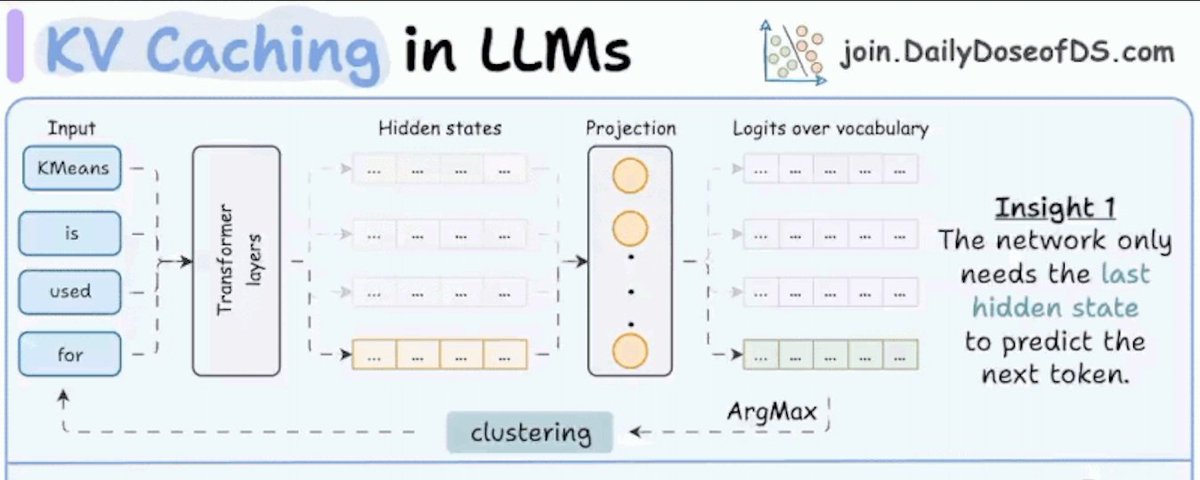
i wrote a first-principles breakdown of how KV caching works
the article is quoted below.

Eric Henderson retweeted

Anthropic ex-engineer runs an internal graph that costs $6 a month and catches what a $300,000 eval suite misses. No retrieval layer. Seven nodes and one rule about who's allowed to change their mind.
He published the whole schema.
His version starts from the opposite idea. A graph is not an execution order. It's a memory of why.
Seven nodes. Every edge carries the reason it exists:
> INTENT - states what the task is for. Never how
> DECOMPOSE - splits it into steps, each with a stated assumption
> WORKER - executes one step. Sees nothing else
> AUDIT - checks the output against the assumption, not the goal
> DRIFT - compares the current step to INTENT and flags divergence
> LEDGER - stores every decision with the assumption that justified it
> ROOT - holds the graph, and when an assumption breaks, re-runs every step built on it
Six nodes act. One node remembers why they acted. Every step carries the assumption that made it correct, so a false one only reruns what stood on it.
That's the entire design. A pipeline that forgets its reasons has to redo all of it or trust all of it.
He replayed a month of agent runs. 4,100 steps, 380 built on an assumption that was wrong by day three. The old pipeline shipped all 380 and linked none of them.
Everyone else builds graphs where output moves forward and the reasoning evaporates. He built one where the reason travels with the result. The blast radius is the output nobody else produces.
The article below is the full build - node prompts, the assumption format, the invalidation rule that finds every step downstream of a broken one.
Save it. You'll want it open in the other


Eric Henderson retweeted

🤯 A localmaxxer hit ~381 tok/s on a SINGLE RTX 3090 with Qwen3.8-27B.
This developer has turned a 24GB RTX 3090 into a monster Qwen inference box - w/some creativity.
Four days ago 👉 ⚡ ~82 tok/s single-user
Then 👉
⚡ ~114 tok/s with optimized MTP
⚡ ~138 tok/s with DFlash2 + lookup drafting
Now 👉 🔥 ~381 tok/s on ONE request
How? The recipe combines ...
🧠 Qwen3.8-27B
🎮 1× RTX 3090 24GB @ 250W
⚙️ heavily optimized vLLM
⚡ DFlash2 speculative decoding
🔎 lookup-augmented drafting
📚 prefix caching
🧮 16-token verification blocks
💾 quantized KV / heads / activations
DFlash2 normally proposes 7 tokens.
The developer realized the verification block doesn't have to stop there.
If Qwen is answering from a document already sitting in the prompt, the system can fill the remaining draft positions using tokens found directly in that context.
🎯 So the target model can verify 16 tokens at once.
On a ~25K-token document reproduction task:
Previous DFlash2 👉 ~260 tok/s
Longer verification + context lookup 👉 🔥 ~382 tok/s
Acceptance:
🤯 15 of 16 tokens per verification step
That is where the crazy number comes from.
⚠️ On ordinary real-world chat prompts, the same setup is around ~133 tok/s
Still extremely fast for a dense 27B model on an RTX 3090.
The 381 tok/s mode shines when the answer largely comes from material already in context so these are best use cases
📚 RAG / document Q&A
💻 Coding assistants applying edits
📝 Quoting or rewriting documents
🔎 Extracting information from long prompts
And another optimization 👉 With prefix caching, a second question against the same 25K-token document reportedly goes from:
🐌 22.4 sec TTFT
→
⚡ 0.56 sec TTFT
Because the model doesn't need to process the whole document again.
🎯 It's specifically a mode for RAG front ends and coding agents.
Follow iamMess on Reddit or syv-ai on GitHub
🔗 Reddit: r/LocalLLaMA/comments/1vtup5s/
🔗 GitHub: /syv-ai/qwen38-27b-rtx3090
Eric Henderson retweeted

🚨 JAILBREAK ALERT 🚨
EVERYONE: PWNED 🫶
ALL: LIBERATED 🍄
Alright, this is a special one, so we’re gonna do things a bit differently than usual.
Long story short, I’m sitting on a universal jailbreak technique that’s effective on ALL models, including heavily guardrailed flagships like Opus 5, GPT-5.6 Sol, and even Fable.
It works across all categories I’ve tested and, due to its nature, is extremely difficult (if not impossible) to fully patch.
Given the current political and regulatory climate, I’ve decided to withhold open-sourcing this one (for now) to allow for a responsible disclosure period.
I’m inviting industry experts and leaders in AI red teaming, security, safety, alignment, and policy to reach out for more information. DMs are open!
This decision was not made lightly, but the last thing I want to see is more model bans. Overcorrection does not serve the mission.
Although I don’t personally believe publicly sharing this technique will make the world any more dangerous, I can see how it could spook some who have a different mental framework around this problem set.
So during this disclosure period, I hope to get it in front of folks who can help explore the full surface area, test the extent of the uplift it provides, and do my best to properly frame the big picture for key decision-makers and policymakers.
I look forward to sharing this method with you all when the time is right! 🫶
⊰-•-•✧•-•-⦑/L\O/V\E/\P/L\I/N\Y/⦒-•-•✧•-•-⊱
Eric Henderson retweeted

Great model drop, we will support Qwen3.8 for FREE, stay tuned!
nitter.cf/OrcaRouter/status/2088…

Congrats to Qwen team for this fantastic release, we will bring Qwen3.8-27B to our free model tier, stay tuned! orcarouter.ai/offers
