

Post-doc @slavovlab Interests: Non-canonical protein sequences Protein degradation Single cell analysis
Boston, MA
Joined February 2020
- Tweets2K
- Following320
- Followers851
- Likes5.6K






Andrew Leduc retweeted

Parallel Squared Technology Institute aims to scale the throughput of sensitive proteomics without compromising quantitative accuracy, depth or specificity.
Today, we share a step in this direction:
🔹 A workflow supporting the analysis of 1,130 single-cell samples per day (SPD) while preserving depth and quantitative accuracy.
1/
biorxiv.org/content/10.1101/…

Andrew Leduc retweeted
This gets particularly interesting in single cells from the same cell type.
Working at the cell type level misses much of the action.
2/
biorxiv.org/content/10.1101/…

Andrew Leduc retweeted
It’s indeed time to transition from mRNA and protein levels do not correlate.

Don't correlate is a weak statement, especially in the absence of independent measurements & reliability accounting.
What's compelling for me are direct measurements of what regulates protein abundance.
doi.org/10.1101/2025.02.10.6…
1/

Andrew Leduc retweeted

Come join!

The Molecular Biosciences Department at Northwestern is excited to announce a faculty search for a Tenure-Track Assistant Professor position!
Learn more and apply at: molbiosci.northwestern.edu/f…
#BiologyJobs #AcademicJobs #FacultySearch #FacultyJobs

Andrew Leduc retweeted
The piece revisits the early days, our lab's initial work alongside other groups pioneering complementary approaches, together showing that mass-spec-based single-cell proteomics was feasible & promising. The proof-of-concept set the field in motion.
2/
nature.com/articles/d41586-0…

Andrew Leduc retweeted

Cells mitigate damage to DNA in surprising ways. Using a series of CRISPRi chemogenomics screens, we identified a PRDX1-dependent iron–damage axis in the DNA damage response.
Congratulations to Tom, Abe, Shaheen, Josep and all co-authors!
doi.org/10.1038/s41589-026-0…

Andrew Leduc retweeted

Claude Science when it becomes a wrapper on existing tools


Many drugs work by binding to a specific target in the body and blocking or changing what it does. An important first step in the drug development process is designing a molecule that can bind tightly to its target. Traditionally, that's meant weeks or months of expert work per target, sifting through a large number of candidates to identify the few that work.
We wanted to test if Claude could successfully design novel protein binders from scratch (also called de novo design). With a protein design prompt written by a human expert, Claude autonomously designed protein binders against 14 out of 15 targets.
We then worked with Adaptyv Bio and Twist Bioscience, who independently built and tested the proteins Claude designed.
Andrew Leduc retweeted

This is a very poor one line summary of the article by @DaphneKoller IMO.
The point is not just data volume. The right kind of data scaled in the right axis with the right experimental designs for well defined tasks + using the models to discover biology (not eval maxxing)

The data we need to understand human biology is about 1000x the quantity we've collected
Full piece from @insitro founder and CEO @DaphneKoller: a16z.news/p/drug-discovery-h…

Andrew Leduc retweeted
Very excited to announce ENCODE GRAMMAR (Genomic Regulatory Atlas of sequence Models, Motifs, Annotations & Rules): 3,865 experiment-specific deep learning model sets and sequence annotations for decoding human regulatory DNA. 1/

Andrew Leduc retweeted

The space of all possible hypotheses is still far greater than the space of all data collected. Moreover, the data has all been collected through the lens of our current paradigms for understanding biology (largely based on what we can measure easily). For these reasons, I think most verification is still hard, especially for interesting ideas. But maybe I’m wrong. Planning to explore that alternative possibility :).
Andrew Leduc retweeted

Does every enhancer work with every promoter?
With @jengreitz and @WJGreenleaf, we revisit this long-debated question and resolve an outstanding contradiction in the field.
A tour 🧵👇
biorxiv.org/content/10.64898…

Andrew Leduc retweeted
The preprint was available, and the peer review was rigorous and constructive even if very time consuming.
Thanks to @biorxivpreprint enabled by @cshperspectives and colleagues, the long peer review times do not delay sharing new results as much as before preprinting.
Andrew Leduc retweeted
Since the 1960s, the genetic code has been used to predict protein sequences from DNA and mRNA sequences. Our @Nature article demonstrates that these predictions miss thousands of protein sequences present in human tissues.
Across >1,000 human samples, we identified numerous abundant proteins whose amino acid sequences differ from those predicted by the genetic code.
These proteins are not rare translation byproducts. They accumulate to thousands of copies per cell. Some are more abundant than the proteins predicted by the genetic code from the same transcripts.
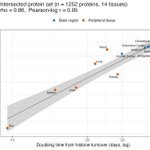
Their abundance reflects a combination of alternate RNA decoding mechanisms — including codon-anticodon mismatches, tRNA abundance, and RNA modifications — and selective stabilization of the resulting proteins. The last factor – protein stability – emerges as a major determinant of protein abundance across proteins, proteoforms and cell types: slavovlab.net/research.htm#P…
Alternate RNA decoding is pervasive across functional groups of proteins, healthy and diseased tissues. It affects proteins playing key roles in neurodegeneration, and some alternately decoded proteins show strong enrichment in tumors compared to their surrounding tissues.
This discovery has been a long and exhilarating journey with Shira Tsour and the @slavovLab team. It started in 2019 and proceeded through many challenges and thrilling highs. A journey that has opened new perspectives that we long to explore!
1/


We report many proteins not predicted by the genetic code.
They are stable & abundant O( 10³ ) copies / cell.
Generative mechanisms include codon-anticodon mismatches & RNA modifications.
Their abundance depends on codon frequency & protein stability.
biorxiv.org/content/10.1101/…

Andrew Leduc retweeted

The bitterist lesson

No scaling laws for single-cell foundation models: when bigger atlases stop teaching the model anything
In language and vision, the recipe has been simple: more data, bigger models, better performance. Single-cell biology borrowed that playbook. Foundation models for transcriptomics jumped from 1 million cells to atlases of over 100 million, on the assumption that scale would unlock the same gains. Alan DenAdel and coauthors put that assumption to the test, and the result is sobering.
Working from a 22.2-million-cell corpus, they pretrained 400 models across five architectures (from PCA and a variational autoencoder up to the Geneformer transformer) and ran 6,400 evaluation experiments. They varied not just dataset size (1% to 75%) but also diversity, using cell-type re-weighting and geometric sketching to deliberately enrich rare cell types and transcriptional states.
The finding: performance saturates almost immediately. On cell-type classification, batch integration, and perturbation prediction, most models hit their ceiling at roughly 1% of the corpus, about 200,000 cells. Beyond that, adding millions more cells changed essentially nothing. More diversity didn't help. Even spiking in genome-scale Perturb-seq data, to give the models perturbed phenotypes rather than just healthy ones, failed to move the needle. Larger models did score better overall, but they too plateaued early on data.
Two points stood out. Simple baselines (PCA, logistic regression) often matched or beat the transformers. And the strongest model, SCimilarity, won not because of size but because its contrastive training objective is aligned with the downstream task. For single-cell data, what you train on and how you frame the objective matters far more than how much you collect.
This reframes a quiet but expensive habit. In drug discovery, biotech, and any pipeline leaning on cell atlases, the instinct to keep scaling pretraining corpora may be burning compute for no return. The real leverage sits elsewhere: curating high-quality, task-relevant data and matching the training objective to the actual question you're trying to answer.
Paper: DenAdel et al., journal license | doi.org/10.1038/s41592-026-0…

Andrew Leduc retweeted
I feel deeply honored by this recognition of research from @slavovLab, @ParallelSqTech and many collaborators and colleagues. It is very fitting to celebrate the advances in this field with the community that has contributed the most to developing these methodologies. This is recognition of just the first steps of an amazingly promising research endeavor poised to widen, deepen, and reshape our scientific understanding.


Andrew Leduc retweeted
Longer thread later, but if you are designing small proteins or want to building a stability predictor using 1.8 million highly diverse experimental measurements… credit to @ChoYehlin and @KotaroTsuboyama !
biorxiv.org/content/10.64898…
Andrew Leduc retweeted

Broke: all vertebrates evolved from fish.
Woke: fish evolved from amphibi-birds.
Bespoke: Viruses evolved from nematodes.
Galaxy-brain-oke: Drosophila is a plant.
Andrew Leduc retweeted
Happy to share this in its published form! More than any project I've worked on, this was a huge team effort, so thank you so much to that team! Especially @ajrferrari nature.com/articles/s41586-0…

Small proteins can be more complex than they look!
We know proteins fluctuate between different conformations- but how much? How does it vary protein to protein? Can highly stable domains have low stability segments? @ajrferrari experimentally tested >5,000 domains to find out!

Andrew Leduc retweeted

It is our pleasure to announce that @slavov_n (Northeastern University, Boston) will be giving a talk at @CNIC_CARDIO this coming Monday, May 11th, at 12:00 pm in the Auditorium. We look forward to an engaging presentation on the field of single-cell proteomics.
#singlecell

Andrew Leduc retweeted
Biological functions arise from protein interactions, which are reflected in the natural variation of proteome configurations across individual cells. Emerging single-cell proteomics methods may decode this variation and empower inference of biological mechanisms with minimal assumptions.
This presentation summarizes research projects aiming to infer protein regulatory interactions from protein covariation across single cells. Examples include the regulation of protein transport to the nucleus and cell fate determination during early development.
youtu.be/ggr3NWzP-yM?si=KjnJ…