
https://nitter.cf/t.co/vlD2sAhx3c
localhost
Joined September 2023
- Tweets921
- Following19
- Followers964
- Likes2.1K



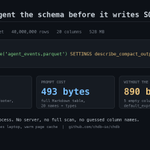



If your production SQL leans on arrayJoin, uniqCombined or quantileTiming, chDB runs the exact same string in CI or a notebook, no dialect rewrite. Starting fresh from Parquet + pandas, that edge matters less. digoal on chDB vs DuckDB (in Chinese):
zhuanlan.zhihu.com/p/2099110…
Agent sandboxes often run with the network off. Does your data layer still work there?
chDB, macOS sandbox-exec, all network denied:
Parquet, ORC, Avro, Arrow, JSONL and CSV, 1M rows each, one query: 0.11s
Fresh process incl. import: 0.18s
Every reader is built in.
SQLFrame 4.9 adds a ClickHouse engine: PySpark code compiled with SQLGlot's ClickHouse dialect and run over a DB-API connection. Its tests hand it a chDB connection, so the same Spark code runs on in-process ClickHouse, no server.
github.com/eakmanrq/sqlframe…
@eakmanrq

chDB retweeted

A fintech cut its analytics bill from $13,000 to $4,000 a month: AWS Glue and Athena to self-hosted ClickHouse, one layer at a time. p95 query latency 4.2 s, on par with Athena.
When you leave managed services, you own the monitoring. OpenTelemetry and Last9 went in on day one.
one2n.io/case-studies/migrat…

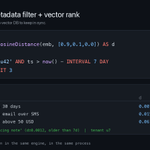
Agent memory needs forgetting. Skip the cron job; in chDB it's two lines of DDL:
emb Array(Float32) TTL ts + INTERVAL 30 DAY
TTL ts + INTERVAL 90 DAY DELETE WHERE importance < 0.5
1M memories, 6 months: 1.45 GiB -> 305 MiB after merge. Old turns keep text, drop vectors.
p90 of the same 10 orders ranged from 3900 to 12500 depending on which "quantile" you called. Solid walkthrough across pandas, Polars, DuckDB, Postgres and ClickHouse (run embedded via chDB), plus why to merge t-digest states, not average daily p95s.
habr.com/ru/articles/1096468…

chDB retweeted

A bit late to the Jev party, but we brought a benchmark 🎉
We used TypeSafe's Jev to label every failure on our agentic analytics benchmark and rank the tables each question needs: 0.951 nDCG@10 in 0.4 seconds.
clickhou.se/4BAEZSK

Agent facts change. Append every version, then ask what it believed at any point:
SELECT key, argMax(val, ts) FROM facts
WHERE user = 42 AND ts <= '2026-05-01'
GROUP BY key
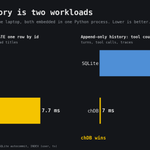
2M versions, SQLite vs chDB:
1 user: 0.2 vs 2 ms
churn, all users: 78 vs 4 ms
disk: 144 vs 29 MB

No agent on the nodes: this Korean PoC embeds chDB in a FastAPI app, where refreshable materialized views pull system.query_log and system.metrics from multiple ClickHouse clusters via remoteSecure(), and ReplacingMergeTree FINAL drops re-read rows.
github.com/CYRok90/mini-logh…

Agent used .apply(lambda)? chdb.datastore keeps the rest in SQL:
e = c[c.status == "error"]
e["slow"] = e["ms"].apply(lambda x: x > 4000)
e.groupby("tool").agg({"slow": "mean"}).explain()
[chDB] WHERE
[pandas] apply
[chDB] GROUP BY
The lambda runs on 1M rows, not 20M.
chDB retweeted

We capture every single api key verification, http request or ratelimit decision in clickhouse. Maybe that's overkill...
but it comes in really handy when making any larger change to these systems cause I can just synthetically replay the exact production traffic patterns to compare their latency, accuracy to give us more confidence in shipping
chDB retweeted

How we improved bloom filters in parquet-rs [1], now adopted by ClickHouse [2]: pydantic.dev/articles/bloom-…
[1]: github.com/apache/arrow-rs/p…
[2]: github.com/ClickHouse/ClickH…
A Velib bike-network monitor with a neat dev setup: a 113-line shim serves ClickHouse's HTTP interface from chDB and replays clickhouse-connect's binary Native inserts through file(), so the real dbt-clickhouse adapter runs the full dbt build, no server.
github.com/ooFaycaloo/velib-…

Agent memory: top-10 by cosine can return one conversation 8 times.
Cap hits per session in the same query:
ORDER BY cosineDistance(emb, {q:Array(Float32)})
LIMIT 2 BY session LIMIT 10
chDB, 1M synthetic 384-d memories: 3 sessions -> 5 in the top 10, 12 ms both. No MMR loop.
chDB retweeted
ClickHouse’s core database remains open source, Apache 2.0 licensed.
As AI agents change how software gets built, open ecosystems matter more, not less. In conversation with Aaron Katz (@ceo_clickhouse), @vercel CEO Guillermo Rauch (@rauchg) explains why: developers can build businesses on shared technology, and even competitors can contribute to its growth.
Interested in seeing how ClickHouse works on your data? Get started with the link in the comments. ⬇️
Data MCP servers: don't spawn a process per tool call. Each re-pays the remote schema cost.
Same chDB query, 105-column Parquet on public S3:
new process per call: 3.7s
2nd call, same process: 1.0s
Import + init: 0.08s. Most of the gap is schema inference, cached per process.
chDB retweeted

Since Maple has grown into having such a big product service, and a lot of people are searching for an easy way to add instrumentation to their sideprojects I'm starting to work on making Maple Local (basically a speced down OTEL only version of Maple), easy to self host.
One docker container, attach a volume and you are done. Runs on 1GB of ram, includes ingest, dashboard and query api.
This is one the easiest and cheapest ways to self host your own small observability platform.
Love to hear any use cases or wishes to extend the self hosted option here, will add one click deploys for various platforms soon.
maple.dev/docs/self-hosting/


Maple has naturally been transforming into more than just an OTel-based observability platform, which honestly makes it harder for me to pitch and describe.
It's not just a warehouse with a query engine and an MCP server. Maple deeply integrates with all your providers, works amazing for product analytics, web errors and session replays, and also lets you build alerts on literally anything. User signups down, memory usage in your pods too high, latency of a specific endpoint too high, or even alerts on slow queries or database load. The possibilities are endless.
Maple also helps you improve your CI, does AI code review with all the context of your production data, and soon will include security monitoring across all your connected services, be it AWS, OpenRouter usage, Cloudflare, your email sending service etc. On top of that, full-on deep AI security scans across your codebase and your infra.
With agents now, the value of having all your monitoring, analytics and observability in one place is so high. They can deeply understand how your entire stack works to improve performance, debug issues and find security issues.
Still not sure how to really describe this too well and showcase the value you get from this commitment into using Maple and embracing the platform.