


Pinned Tweet
Feed your mitochondria every day - happy mitochondria make happy cells and a healthy body & mind - you’ll feel better for it
With regular activity
And nutrient-rich real food
The high prevalence of poor health in society is from falling into today’s default toxic environment
D Laws 💙 retweeted

This is an extraordinary amount of economic confusion to pack into one graphic.
First, Britain does not need another 3.4 million taxpayers to provide the government with sterling. The British state is the sole issuer of sterling. It cannot involuntarily run out of its own currency in the way a household or a business can.
Second, debt interest is not money lost to the British economy. Every pound paid by the Government is a pound received by someone else. Government interest expenditure is income to the holders of government liabilities. The IEA is presenting one side of the accounting while conveniently ignoring the other.
Third, the recent increase in debt interest is substantially a consequence of higher interest rates and inflation indexation. The Bank of England as a matter of policy has increased the remuneration on reserves, consequently maturing government debt is being refinanced at higher yields. To describe all this as the inevitable price of excessive public spending is economically illiterate.
Finally, the comparison with the income tax liabilities of 18 million workers is designed to evoke the household-budget fallacy: the idea that government must first collect sufficient money from taxpayers before it can spend on public services.
It is a powerful political narrative, but a profoundly misleading description of how the monetary system operates.
If debt interest is genuinely your concern, discuss the interest-rate policies that determine much of its cost, who receives the payments, and their economic consequences.
But please stop pretending that Britain is running out of pounds.
D Laws 💙 retweeted

If people are wondering why the BoE is raising interest rates, even though there is nothing they can do about the Iran war.
Well, it's because they fear workers will start asking for higher wages as a result. So they are trying to slow down the economy to prevent that.
D Laws 💙 retweeted

Just remember:
1. Spending creates income.
2. Loans create deposits.
3. Taxes do not fund spending.
4. Government deficits create non-government financial surpluses.
5. Real resources, not money, constrain sovereign government spending.


D Laws 💙 retweeted

You’d think that between them, the two authors of this article might mention that if anything raising rates now will increase inflation. The data is available, the evidence is there.
Crickets. They have been trained to repeat Treasury lies. And they do.
bbc.co.uk/news/articles/ck5y…

Only a week or so ago, the Budget increased taxes on our banks, prompting many protests from them.
According to the budget, that time-limited tax increase will raise £1.475 billion.
Yesterday (thanks to the BoE) they collected £1.6 billion from the UK state to cover those costs

UK banks were given £1.6 billion yesterday. When will this bank robbery end?
taxresearch.org.uk/Blog/2026…

D Laws 💙 retweeted

The Bank of England has just raised interest rates to 4%. But higher rates won’t make oil any cheaper, and households are paying the price for a shock we can’t control. My piece for @LBC 🧵1/9
lbc.co.uk/article/higher-int…

D Laws 💙 retweeted

Yes indeed, explained in a nutshell - hiking up interest rates can't cure supply-side inflation and can make it worse. So why raise interest rates? To protect the value of the hoarders' and lenders' money and debt repayments while workers, businesses and borrowers suffer.
The Bank of England has raised interest rates to 4%, supposedly to tackle inflation.
There is just one problem with this decision. The Bank knows that much of the inflation we are suffering is being driven by rising oil and energy prices, largely resulting from conflict in the Middle East.
It also knows that raising interest rates cannot reduce those prices.
So why is it doing this?
The answer is that the Bank believes it must suppress demand elsewhere in the economy to compensate for rising energy costs.
In other words, it is deliberately making mortgages more expensive, increasing business borrowing costs, discouraging investment and reducing household spending power.
And all this when people are already struggling with higher energy bills. That is problem number one.
There is, however, another problem. Higher interest rates increase costs for businesses, which can then feed through into higher prices. They can, in that case, add to inflation rather than reduce it.
The Bank is imposing economic pain to address a problem its chosen policy cannot directly solve.
That is not sound economic management. It is the consequence of an economic dogma that refuses to recognise the difference between inflation caused by excessive demand and inflation caused by supply shocks.
When will we learn?
D Laws 💙 retweeted
Whatever we can actually do we can afford
All it takes is the political decision to approve the budget required to deliver what is needed. The money is then created as it is spent by Govt.
There’s truly no need for the NHS to rely upon charitable giving to function as desired
D Laws 💙 retweeted

The Bank of England has raised interest rates to 4%, supposedly to tackle inflation.
There is just one problem with this decision. The Bank knows that much of the inflation we are suffering is being driven by rising oil and energy prices, largely resulting from conflict in the Middle East.
It also knows that raising interest rates cannot reduce those prices.
So why is it doing this?
The answer is that the Bank believes it must suppress demand elsewhere in the economy to compensate for rising energy costs.
In other words, it is deliberately making mortgages more expensive, increasing business borrowing costs, discouraging investment and reducing household spending power.
And all this when people are already struggling with higher energy bills. That is problem number one.
There is, however, another problem. Higher interest rates increase costs for businesses, which can then feed through into higher prices. They can, in that case, add to inflation rather than reduce it.
The Bank is imposing economic pain to address a problem its chosen policy cannot directly solve.
That is not sound economic management. It is the consequence of an economic dogma that refuses to recognise the difference between inflation caused by excessive demand and inflation caused by supply shocks.
When will we learn?
D Laws 💙 retweeted
Whatever we can actually do, we can afford
We have UK doctors who want to train
We have the capacity for significant expansion in specialist training posts
And yet this @andyburnham Govt continues to make the purely political choice not to do so
UK can never be short of £s!👇🏻

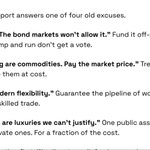
The Bond Market Bluff vincegomez.com/articles/the-…
D Laws 💙 retweeted

some people dont understand that retirement and pensions are real resources issues. The finances involved with pensions are just a tool to help distribute those real resources from workers to retirees
If we all save more, it doesn't necessarily mean there will be more resources

Pensions are ultimately a real resource problem, not a financial one. The real question is (pun intended): How will fewer productive workers produce enough real goods and services for a growing number of retirees?
To free up real resources for retirees, the working demographic must obviously abstain from spending their entire income. Taxes (PAYG) is one way to achieve this. Forced private savings is another.
But PAYG is vastly more efficient. Growing the FIRE sector to manage forced savings for future pensions actively worsens the real resource shortage by tying up productive capacity and labor.
Ultimately, how much of current production should be redistributed to pensioners should be a democratic decision, and whatever level is decided it is always “financially affordable”.
D Laws 💙 retweeted

"How will we pay for it?" isn't a question about money. It's a question about resources: workers, materials, energy, time. Get that distinction right and most of what you've been told about government budgets stops making sense.
D Laws 💙 retweeted

The UK desperately needs to escape the learned helplessness trap. Get @PatriciaNPino on your programs ASAP.

"Painful" years ahead, think tanks warn, as living standards set to fall
bbc.in/4k5Vgsz
D Laws 💙 retweeted

Average salaries of £150k plus extra for out of hours is wrong. The £150k is the full time average and includes all hours over 40, all the overtime, on call and additional lists within the NHS. Base salaries are £114k to £151k max compared with Irish figures of £215k to £275k for the same number of hours at base pay.
The expansion of medical school places policy actually said that medical school places should only increase as jobs increase at least in part due to the expense of training doctors who might not have jobs to go to. We have repeatedly called for proper workforce planning, there is still no NHS workforce plan.
About 15% of UK registered drs have taken hard steps to leave UK medicine according to the GMC, the most efficient Drs are typically the ones already here and the loss of talented UK graduates and IMGs is a great detriment to patients. Roughly 84% of potential immigrant Drs chose not to come to the UK due to poor pay, working conditions and quality of life theguardian.com/society/2025…
The DDRB admitted that medical pay had fallen behind comparators and needed correcting but rather than fixing this it left it to ’negotiations’. The talks have been ongoing for 18 months fruitlessly and this action represents the failure of the DDRB to correct pay and government to take the situations seriously.
Even within the UK there are great disparities with the most senior consultants in Wales effectively earning £27k more per year for the same hours and roughly £1m more during the course of their lifetimes.
A large part of the dispute is about out of hours parts of the contract, the very fact that so much work is now done by consultants at the weekend and that is not properly recognised by the contract in terms of pay or recovery time, this work represents the very hardest work we do. The author seems to be taking about the NHS of the 1980s not the 2020s.
What isn't even mentioned is the erosion of SPA time, the very time used to fix and improve our departments and the efficiency of our services. This will never be done by people with spreadsheets in Whitehall but by the highly educated professionals actually doing the job.

D Laws 💙 retweeted
Average salaries of £150k plus extra for out of hours is wrong. The £150k is the full time average and includes all hours over 40, all the overtime, on call and additional lists within the NHS. Base salaries are £114k to £151k max compared with Irish figures of £215k to £275k for the same number of hours at base pay.
The expansion of medical school places policy actually said that medical school places should only increase as jobs increase at least in part due to the expense of training doctors who might not have jobs to go to. We have repeatedly called for proper workforce planning, there is still no NHS workforce plan.
About 15% of UK registered drs have taken hard steps to leave UK medicine according to the GMC, the most efficient Drs are typically the ones already here and the loss of talented UK graduates and IMGs is a great detriment to patients. Roughly 84% of potential immigrant Drs chose not to come to the UK due to poor pay, working conditions and quality of life theguardian.com/society/2025…
The DDRB admitted that medical pay had fallen behind comparators and needed correcting but rather than fixing this it left it to ’negotiations’. The talks have been ongoing for 18 months fruitlessly and this action represents the failure of the DDRB to correct pay and government to take the situations seriously.
Even within the UK there are great disparities with the most senior consultants in Wales effectively earning £27k more per year for the same hours and roughly £1m more during the course of their lifetimes.
A large part of the dispute is about out of hours parts of the contract, the very fact that so much work is now done by consultants at the weekend and that is not properly recognised by the contract in terms of pay or recovery time, this work represents the very hardest work we do. The author seems to be taking about the NHS of the 1980s not the 2020s.
What isn't even mentioned is the erosion of SPA time, the very time used to fix and improve our departments and the efficiency of our services. This will never be done by people with spreadsheets in Whitehall but by the highly educated professionals actually doing the job.

Who would have thought it? Two years and a bit after junior, sorry, resident, doctors staged strikes in successful pursuit of a mammoth pay rise, NHS consultants have decided they would like a bit of the action.
They claim, as they would, that it's only about restoring the value of pay as it was 17 years ago – 17 years, no doubt, carefully chosen to maximise the claim, otherwise, why not ten years, or even five?
In the media, their representatives also refer to lawyers and bankers as equivalent professionals whose pay now substantially exceeds theirs.Not unsurprisingly, the general public response, as per social media, has essentially boiled down to 'greedy sods'. And it is hard not to agree.
✍️ Mary Dejevsky
Article | spectator.com/article/the-pr…

D Laws 💙 retweeted
If the government balanced its books, it would make people in the country poorer and in deeper debt. So why do so many politicians want to do that? youtu.be/th3N-Otscgo?si=JNHW…

D Laws 💙 retweeted

Your regular reminder 👇
🏥 81% want publicly owned NHS
🏫 78% want publicly owned schools
💧 73% want publicly owned water
🚂 70% want publicly owned rail
✉️ 70% want publicly owned mail
🚍 67% want publicly owned buses
💡 65% want publicly owned energy
leftfootforward.org/2023/11/…

D Laws 💙 retweeted
If anyone thinks @andyburnham is the answer to the worsening cost of living crisis and the UK economy doldrums then please watch this👇🏻
@uklabour & @Conservatives follow the same nonsense economic models
Burnham is clueless as to what to do, so he tinkers
youtu.be/-p2_Wut74Ys
D Laws 💙 retweeted
Everything Burnham says in this interview aligns with the thinking of most progressive heterodox economists until… you put them next to his commitments to balanced budgets and giving confidence to the City traders.
He hasn’t got a clue.

'I don't want to see anyone in their 20s on benefits'
Andy Burnham insists he does want to cut the welfare bill, in an interview with @DanielHewittITV
Watch our ITV Tonight Special, 'Burnham: Inside The First 100 Days' at 1915 on Tuesday 3rd November, ITV 1, ITVX and STV