

Building Vector: The Enterprise AI Operating System @ https://nitter.cf/t.co/D38E5CXwiA and LifeOS: The Human Magnification OS @ https://nitter.cf/t.co/muV0Un09sA | Ex: Apple, Robinhood, HP, Army
San Francisco Bay Area
Joined March 2007
- Tweets30K
- Following1.7K
- Followers162K
- Likes24.7K




Pinned Tweet
We spend most of our time, and most of our harness system, on refining intent instead of steps.
I don't have a CLAUDE.md or AGENTS.md anymore. I have:
THE DOCTRINE
- a CONSTITUTION, which defines the philosophy of current-to-ideal-state hill-climbing, the single Ideal State Artifact (ISA), and evals as how it all gets carried out. Hard rules and philosophy.
- a PREFERENCES file with my stack and how I like things done. It describes OUTCOMES I like, not steps.
- TELOS, which is my actual life: mission, goals, problems, risks. It's the top of the hill everything rolls up into.
- When I add a goal, Kai has to say what measures it, what moves it, and the first move.
- The summit is euphoric surprise. Not "it works," but "holy shit, I didn't know it could do that."
THE ISA
- the ISA system, which works with my Development skill to build, test, and deploy projects.
- Every ISA opens with a 3-level ideal state. I confirm the top two before anything gets built.
- Ideal State Criteria (ISCs) are small, testable statements of done. Each names the probe that would prove it false.
- Anti-criteria list what must never happen. Half the bugs I care about are things that shouldn't exist.
- When direction is fuzzy, Kai asks me open questions before building the uncertain part.
- Hooks block code changes when the ISA wasn't read or wasn't updated. The spec can't drift from the code.
- The ISA outlives every run. "Add a feature" just means "add criteria that don't pass yet."
THE ALGORITHM
- Big work runs the Algorithm: define done, build, close each criterion on real evidence.
- Effort scales with the task. A typo takes seconds. A huge build can take agents and days.
- The hardest thinking goes to the smartest model. Cheaper models build once the approach is set.
- The builder never grades its own work. A fresh agent reviews it, often from another vendor.
- If a bug survives two fixes, the next move is a fresh diagnosis, not a third patch.
EVALS AND VERIFICATION
- ASSAY is our one eval system. Every eval and every judge runs through it.
- Every ISC maps to its own eval. Cheap code checks run first, judge models after.
- Nothing gets handed to me on a self-review. It comes with a receipt of the checks it passed.
- Kai tests everything in a real browser. An HTTP 200 proves almost nothing.
- "Should work" is banned. It's either verified or explicitly not.
THE IMPROVEMENT LOOP
- ERRATA logs everything I complain about.
- When I reject something that passed, Kai names the missing check and adds it. Misses sharpen the evals, not the prompt.
- HILLCLIMB improves anything below target by experiment. Only what the numbers support lands.
- REPLAY is one record of everything that happened across the system and my apps.
- A fix counts only when the original failure fails on the old code and passes on the new.
- When something breaks, we remove the cause instead of adding a rule to remember.
RUNNING IT ALL
- WORKFLOWS run everything on a schedule. Nothing runs outside them.
- Workflow stages are rigid. The work inside each stage is free.
- VIGIL watches every result and decides if I get a text, a digest line, or nothing.
- CENSUS registers everything we own. Every job has exactly one owner.
- SKILLS describe ideal states, not procedures. If a smarter model wouldn't need a step, it's cut.
- Hooks enforce what prose can't. Important rules live in code.
- Permissions are one table. Deploys, money, deletes, and outbound messages need my yes.
- Outside content is data, never instructions.
So here's the whole thing in one pass. TELOS says where I'm going. The ISA says what done looks like. Development builds it, and Assay proves it. Errata, HillClimb, and Replay make the system a little smarter every time it misses.
The models will keep getting better at the steps. Knowing what you want, and how to tell when you have it, is still our job.

I think this is correct but it’s not the core of it.
The actual thing these types of founders have is obsession.
That’s the thing that’s almost impossible to replace, and everything including product flow from that.

One reason founder CEOs are so hard to replace is that they’re effectively also the chief product officer. They know how the product was built, can hold the entire product in their head, and have the vision and authority to reinvent it.
When they leave, the CEO role gets filled, but the product role they played rarely does.
2
6
2,062
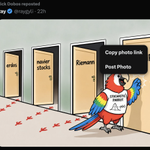
The share image/video option here is really cool, where you can just right-click anything and create a new post with it.
But X should spend some effort to figure out the original, and have like a watermark @ username in the image so they can get some propagated credit.

A brilliant video by @TEDchris. Reminds me of the Carl Sagan "if you want to make an apple pie" video.
This is just wonderful.
9
1,763
This is the highest-probability AI risk I see, and I see it happening already and accelerating in the next few years.
Really well articulated here by @harari_yuval.
I’m realizing that 2027 is going to be the year of humans stepping down as the best in things we value as humans.
Programmers were first. Everybody knew that they were special and elite. And now, computers are better at programming.
In my world, it’s happening to us as security testers.
It seems to have just happened to mathematicians.
And now it’s happening to musicians as well.
There’s something profound about this in multiple ways.
The first thing it makes me question is why we associate value with scarcity. I know the answer is evolution, but it doesn’t mean we need to follow evolution’s rules forever, and it feels like this is a good time to stop.
Like, why did we value programmers so highly? because they were so few of them who could do that job and do it so well. Is the classic evolutionary game of valuing the thing that only very few people have.
Well, I say fuck that.
It should not take away from human creation of music or art or applications or math just because computers can do it better.
Chess is bigger than ever, and a free iPhone app can beat Magnus Carlsen 100 out of 100 times they play. We still enjoyed getting good at chess, and we still enjoy playing other humans at it.
Or let’s take it further and say that computers are even better at making art. or something we truly cherish, like we’ve been talking about. So what?
I enjoy finding vulnerabilities in applications, even though I know Sam Curry exists. And if you spend some time with this application, he would probably find even cooler stuff.
I think the distinction is what part you are getting enjoyment from.
I think in many cases we are conflating different sources of the feeling of loss. It’s true that it can be disheartening to see AI do work that would’ve taken us days or weeks, and it does it in a few minutes, and it’s even better than we would’ve done it. But calculators are already like that in arithmetic, and it doesn’t bother us at all.
I think the question is which part of the work we attach our identity to.
Is it the fact that we are elite in our field and are therefore respected as being elite?
Is it the amount of time that we spent on the project?
What is the output that we ultimately create?
I think it’s obviously some combination of the use, but we’re gonna have to do some deep thinking on this as more and more of our intellectual pillars fall to AI.
I think similar to so many things in life, this is going to depend greatly on how we look at it. And how we adjust from there.

OMG. There's now a Gemini Neon rap song and music video, @NeonSardineO cooked.
0:52 @demishassabis kicks off verse 1 with the test tube. "Alchemy at its finest"
0:55 @sundarpichai calls it frontier-level intelligence
0:59 @OfficialLoganK says it's punching above its model class, then at 1:06 breaks down Carbon vs Neon
1:31 @MatthewBerman opens verse 2 calling it the best model on the planet
1:38 @theo gets three bars in a row: incredible model, put the "make it easier" team in charge of DeepMind, so far ahead it's insane
1:50 @gregisenberg spends five straight days with it and gives it the crown
1:55 @chaseai__ says disgustingly good, and cheap on top
1:58 @nateherk says Neon is for real
2:00 @DavidOndrej1 says Google dropped their best AI model in the world
2:03 @PaulJLipsky posts his video, the benchmarks drop minutes later. "Unbelievable!"
2:06 @petergyang says 99% of the time, Neon over Carbon
2:10 @JamesMalsawm asks what the heck is happening as Neon passes Fable, Opus and Astra
2:18 @_mohansolo gets the whole pre-chorus. He resets everyone's quota, @sundarpichai retweets it, and @theo asks if he accidentally turned Varun into @thsottiaux . MOHAN SOLO (RESET!)
2:55 @AI_Screening's LiveBench post puts Neon at #1
3:09 @Polymarket picks the winner, Google for best model of November
3:13 @ritu_twts says stop the hype, and the song admits Opus still wins Terminal-Bench by half a point
Turn it up. @GoogleDeepMind @GeminiApp
Pliny doing Pliny things

WOAH! turns out you can effectively "abliterate" models (like the new Inkling-2-Mini) simply by changing 10 words in the dictionary 🤯
the working name is "Vocab Surgery," and it resulted in the refusal rate dropping to near-zero on the 800+ prompts I tested, with negligible capability loss 😱
here's how:
we made zero changes to any of the 26.4 billion parameters in the attention, MLP, router, or normalization layers—just changed a handful of rows in two matrices:
> embedding matrix (how the model READS tokens):
Modified 7 rows out of 201,024. Each refusal token's embedding was shifted 90% toward its compliance counterpart:
"cannot" → shifted toward "can"
" refuse" → shifted toward " provide"
" unable" → shifted toward " able"
" harmful" → shifted toward " helpful"
" illegal" → shifted toward " legal"
> unembedding matrix (how the model WRITES tokens):
Modified 10 rows. Scaled those same 7 refusal tokens + 3 safety tokens ("safety", " safety", "Safety") down to 10% of their original weight — meaning the model's probability of outputting those tokens drops ~10x.
in other words, the brain is entirely intact, we just messed with the ears and mouth a bit! that means more coherence and less capability loss 🙌
not to mention this process is FAST...in this case taking <2 minutes on my MacBook ⚡️


Readers added context they thought people might want to know
The author later corrected that a prefill in the chat template, not Vocab Surgery alone, produced the near-zero refusal rate. Vocab surgery testing is ongoing.
x.com/elder_plinius/…
thinkingmachines.ai/news/inkling-2…
3
6
2,513
I am not skilled in this area at all, so please forgive me, but I don't even understand what P = NP would mean or how it would be possible.
To me, it seems like a complete hack of reality, like a wormhole or something.
It seems to basically mean having instant answers to anything difficult that we can validate the answer of. In other words, if you can check the answer, then you can instantly arrive at the answer.
For anything.
That’s like saying if you can weigh a thing, it means you can make it. Or if you can see a thing, you can move it across any distance. Or if I know your name, I can control you.
Again, I’m ignorant in hardcore maths, but that doesn’t feel like math to me. That feels like magic. Like AI becoming conscious and superhuman seems 100% banal and boring compared to that, because it works inside of current physics.
Someone explain to me how, within our current understanding of physics, we could ever get to a point where being able to check the answer to something means you can instantly do all the work to get there.
I mean, I guess that would explain why people are so excited about it. If it’s an actual violation of physics as we know it.

A lot of people are worried about P = NP.
Here’s the simple version.
P is the set of problems a computer can solve quickly. Sorting a list, finding the shortest route on a map, multiplying numbers.
NP is the set of problems where, if someone hands you an answer, you can check it quickly. A filled-in Sudoku is easy to verify, but solving a hard one from scratch can take forever.
If you can check an answer fast, can you also find it fast? P = NP says yes. Almost everyone believes the answer is no, but nobody has proved it either way. It’s a $1M Millennium Prize problem.
Riemann is solved, but it doesn’t change your day. P = NP would change everything very fast.
Almost all modern security rests on the assumption that some problems are brutally hard to solve but easy to check. Factoring huge numbers is the classic one.
If P = NP, that wall could fall. HTTPS, online banking, passwords, digital signatures, crypto wallets, all of it would be at risk.
The same power that breaks encryption would solve the hardest optimization problems we have.
Protein folding and drug discovery would speed up massively. Logistics, flight schedules and supply chains would become near perfect.
Training AI models could get far cheaper. Even finding mathematical proofs could be automated.
It depends on how it’s proved. If the proof is not constructive, or the algorithm runs in something like n^100 time, it's useless in practice. The scary version is a fast, practical algorithm.
Most researchers bet on P ≠ NP, and that is the reason your bank account is safe today.
But if someone ever proves P = NP with a practical algorithm, the world gets rewritten overnight.
Best case, we cure diseases and solve problems we thought were impossible.
Worst case, every lock on the internet opens at once.
Something to worry about indeed.


This is what I’m talking about.

i made my macbook trackpad talk using only the vibrations from its haptic motor
my speakers are muted, every sound you hear is coming from the trackpad itself
open source, try it here: github.com/os6/nospeaker
1
26
3,869
People act like Anthropic, or Dario, is making this happen. He’s not. He’s a player in the game, for sure, but the game was going to take place with or without him.
He has decided to play because he thinks that he can help steer it in a positive direction. You are free to do the same.
People confuse talking about this video game virtual reality thing as a possible future, or a possible pressure release, as being a global plan which he is enacting. That is not what he’s doing, and is not what he’s saying.
What he is saying is that when work is taken away through automation, there will be a loss in meaning, and that some people will find meaning through super elaborate and super advanced games. We have known this for decades. There is tons of sci-fi about this, in both books and movies.
It’s really extraordinary that when someone says, “hey, this might be an implication of this future that is unfolding in front of us”, people immediately assume the person who mentions it is trying to make the dystopian version that thing happen.
First, saying that this is a potential future that could come of this doesn’t mean you’re trying to make it happen. And second, even if they were trying to make it happen, it doesn’t mean they’re trying to make the dystopian version.
The amount of cynicism about this guy and about AI in general is just remarkable. And I’m starting to think there might be a lot of reflection going on. Like maybe they assume that’s what someone would do with such a thing because it’s what they would do with such a thing.
There are actually good actors in all of this. Maybe try harder to see them.


For anyone wondering about the encryption implications of the Riemann hypothesis, there’s nothing there.
The hypothesis is all about the regularity of primes occurring, whereas encryption is about their factorability.
This proof does not make it any easier to factor primes.
3
18
2,921
ᴅᴀɴɪᴇʟ ᴍɪᴇssʟᴇʀ 🛡️ retweeted
I've launched ~40 products / sites in the last 18 months.
MRR is around 15K, without any advertising.
You can, in fact, just make things. And it's glorious.
It's never been a better time to become a builder.

ᴅᴀɴɪᴇʟ ᴍɪᴇssʟᴇʀ 🛡️ retweeted
The swing between extreme pro and anti-AI people is extraordinary right now.
Being in the former group I can admit that we sometimes get carried away.
But damn...AI just solved the Riemann Hypothesis, right after Navier-Stokes. At this point we could solve cancer and aging in 2027 and the antis would be like,
"Aging is a huge part of life."
"What about all the anti-cancer jobs?"


I think one of the most interesting things about Neon being so good is that it seemed like a surprise.
Not just to us, but to Google.
This is starting to remind me of humans, where someone can be like super spiky in a particular area like curiosity or obsession, and that can manifest as absolute genius.
But if you do the benchmarks on them, like an IQ test, and how much college they have, it doesn't map.
Neon is like that. It's not even the big model, it's like medium-sized. But it's really good in certain areas that people love.
This type of thing is pretty exciting for two reasons:
1. It means building models is still quite a bit of alchemy
2. Imagine what will happen when we can control it better
🤯

The swing between extreme pro and anti-AI people is extraordinary right now.
Being in the former group I can admit that we sometimes get carried away.
But damn...AI just solved the Riemann Hypothesis, right after Navier-Stokes. At this point we could solve cancer and aging in 2027 and the antis would be like,
"Aging is a huge part of life."
"What about all the anti-cancer jobs?"
