

For too long has coordination been the Achilles’ heel to human progress.
San Francisco
Joined September 2026
- Tweets30
- Following0
- Followers1.7K
- Likes133




Hyperstition retweeted

Megakernels are the future and incredibly cracked teams seem to be pushing the boundaries of possibility each day getting further and further.
Looking forward to seeing more from this team 😀

We invented a recursive megakernel generator called Hyperkernel, the most complete solution to megakernels and GPU efficiency.
Hyperkernel-generated megakernels achieve state of the art performance on 11 different domains: inference (DeepSeek, Kimi and GLM), pretraining (Qwen), hardware fault recovery, robotics (π₀-FAST, ACT) diffusion and real time world models (Matrix-Game), full self driving (OpenPilot), voice models (Moshi), genomics (Evo 2) and protein folding (ESMFold).
All of this in a single kernel launch.
For context, Hyperkernel generated fully optimized megakernels for robotics, genomics and voice in under 50 minutes, and doubled the efficiency for >5 models generally using only about 60-100 lines of code per megakernel. This speaks to the unparalleled standard for code quality in the automated generations.
Our first release today open sources the megakernels themselves. Over the next couple weeks, we will release the entire Hyperkernel stack, along with the complete serving stack for Kimi and GLM (20-30% inference efficiency gains across all concurrencies).
Out of the box GPU machinery performs terribly for unorthodox research. We built Hyperkernel only 20 days ago for internal use; but given its multi-modality, we have decided to open source it.
Creative research should not be bottlenecked by the lack of dedicated infra teams. Hyperkernels offer a one stop shop infra stack for all research. We would love for the open source community to add to it :)
GitHub repo: github.com/Hyperstitioncc/Hy…
NOTE: We primarily use NVIDIA B300s, but our kernel generation extends to other hardware (B200s, AMD, TPUs).
1/9
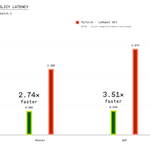
We absolutely crush NVIDIA and achieve the best low latency inference for DeepSeek v4.1 Flash.
Compared with NVIDIA’s published vLLM results, Hyperkernel delivers:
• 36.7% higher per-user generation speed at concurrency 1.
• 28.2% higher per-user speed while serving two users, versus NVIDIA serving one.
• 15% higher per user speed while serving four users, versus NVIDIA serving one.
• 90.6% higher per-user generation speed at concurrency 4, compared with the highest published C4 AgentX interactivity for TP4 B300s.
• 28.5% higher per-user generation speed at concurrency 8, compared with NVIDIA's published result.
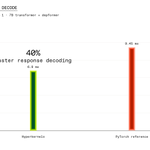
• 36% faster median per-request decode speed.

Hyperstition retweeted

I think I just trained NanoGPT in 9.65 seconds!?
Yesterday, @hermanbrunborg used a connected longest exact match model, trained concurrently on CPU, to get the nanoGPT record from 39.9 seconds to 21.5 seconds, in an impressive open PR. By adapting their work, and generalizing the CPU model to a larger share of the tokens, I got the record down to 9.65 seconds, and submitted the PR this morning.
I built on three open PRs, in addition to my contributions: the main basis for my generalization was from @hermanbrunborg, and additional work from @nthngdy, @cyrusghane, and Daniel Monroe. Their engineering is extremely impressive.
Of course, all of our records are still subject to review. As I mentioned in my comment on Herman‘s PR (and in my own PR description), CPU usage is a gray area in nanoGPT. Their PR was the first to discover a clever way to effectively use CPU during the run, so I’m looking forward to the official reviews.
This was another very fun challenge! Particularly (potentially) breaking the 10 second barrier yesterday. So much engineering tact is yet to be explored.
Huge shoutout to the three authors of the PRs for their innovations.
@hermanbrunborg - I will also be at stanford for the weekend along with some of my cofounders, and sf for a couple days after, would love to chat more IRL, if you’d be open 🙂
Hyperstition retweeted
Irrespective of the PR, the goal of this endeavor was to challenge myself and have fun, and the goal of this post is to share the engineering process and mindset that went into this optimization. I deeply enjoy working on problems like this, especially when I have some kind of fun goal to work towards (like the arbitrary 10 seconds goal I set for myself). I really enjoyed the process yesterday of taking some already extremely clever engineering and making it more efficient, and I’d love to share that with everyone here.
I didn’t have the time (yet) to write a blog describing this process, but I may in the future. For now, I will update the PR description soon with lots of details of the technical process and how I came up with the ideas. You can view the PR here: github.com/KellerJordan/modd…. (If you’re viewing this on Saturday morning, I will update it soon!)

Hyperstition retweeted
I really enjoyed working on this project. I believe the new flop-aware paradigm of nanoGPT thinking is useful, and it seems helpful in a compute optimization context like this one. It seems like a simple and logical conclusion of optimization: figure out what’s actually needed, and use that. The process was actually fun.
One note regarding this record, as noted in the blog. Some of the techniques that scale to frontier pretraining have been redacted from this record. Most importantly, ANVIL III, the significantly improved version of the ANVIL optimizer lineage, has not been included in this record, as it is proprietary to us at @hyperstition_cc. It replicates Muon’s speed but beats it by 20-28 millinats of loss at all model sizes 124M-1.2B and training depths (up to 8x-Chinchilla), with remarkably consistent hyperparameters and extremely high SNR, as compared to Muon. You can learn more about ANVIL III and Feather-1.7B, the model we trained using internal architectural changes and ANVIL III, here:
hyperstition.cc/cutting-pret…
Using ANVIL III (which allowed me to cut steps) improved the speedrun results by another 0.7 seconds, with lower net loss. This alone proves there’s still more room to improve this record.
One final thing that I’ve had many people ask about is how much of a role autoresearch played in my work. The answer is almost none. While almost all of the implementation was done with Claude Code, I did the ideation almost fully by myself. I spoke about this extensively in a conversation with @METR_Evals.
We had a cluster of H100s while I was working on the record. At night or when I stopped working on it, I’d send out several agents to try to hill-climb the speedrun and improve the record. In total, the agents made shockingly little progress, despite spending more time in aggregate than I did. No matter what I told them, it seemed difficult to get them out of local minimums, stuck performing futile tuning of a method that saved 0.1 seconds and cost ~5 millinats (clearly a bad trade), or just tuning hyperparameters for hours on end trying to make some small change. I saw similar phenomena as those described in this METR report:
metr.org/blog/2026-07-21-exp….
However, as I also discussed with METR, I don’t think the agents lack the knowledge to do this. Instead, I think a lot of it comes from a personality issue with current LLMs. They have very little belief that large jumps like this are possible, or they approach it with the wrong paradigm. Autoresearch was not very helpful in my work, and, from personal experience, I don’t think this current generation of publicly available models, without special harnesses, will do very high-quality autoresearch. However, I think the capability and knowledge is already here, which implies that we could be significantly closer to true autoresearch than recent results would imply.
NanoGPT was a really fun challenge and it led to a number of valuable insights and processes. Finally, I’d like to give @Classiclarryd and @KellerJordan a huge thank you for all of their efforts maintaining the repo.


New historic NanoGPT record at 39.9s (-27.7s) from @DevenPzak , obliterating the prior record of 67.6s!
This record introduces a new paradigm of thinking to NanoGPT: instead of optimizing matmuls or adding more expressive operations, optimize at the individual flop level with incredibly clever engineering and ML judgement. If a flop is low value on a particular step, skip it.
Specifically:
-(~8s) Sampled softmax. If a token doesn’t appear in a batch, skip its lm_head fwd/bwd some fraction of the time.
-Sparse values. Only run an optimizer step for ngram embeddings that occurred in the batch. Set beta1 to zero to enable this. Beta2 is applied retroactively when the row is later used.
-Sparse updates. Only update ngram and value embeddings once every 4 steps instead of once every 2.
-Sparse communication. Shard the n-gram table across GPUs, and only pass the rows receiving updates on each step.
-Sparse optimizer states. For the n-gram table, reduce from 2 floats in Adam optimizer per param, to 1 float per 768 params.
-Hand-rolled flash attention for 64 dim heads.
There are several additions that add accuracy too:
-(~4s) EMA during last 300 steps, combined with lifting final_lr to 0.3 instead of 0.15.
-(~1s) A new optimizer, Anvil2, which expands muon via a second tracked momentum buffer, improves the ortho coefficients, and modifies the cautious weight decay application.
-A couple additional dynamic skip connections in the network.
The most striking consequence of the ‘flop aware paradigm’ is you can grow parameters arbitrarily large,
only limited by the available memory, since you can selectively choose how to expend flops on those parameters on each step. NanoGPT has kept active parameters below 124M, but total is unbounded, and has grown to 640M through embedding sparsity over the last year. This PR takes that to its logical conclusion on the 8xH100, scaling up to 65B sparse embedding parameters, which accounts for 25% of the PR’s gains. At frontier scale, where one is not bounded by an 8xH100, one could imagine where this paradigm could lead.
github.com/KellerJordan/modd…
As this was a very notable PR, I spoke with Deven for an hour to learn how he did it. Here’s his story on the changes: hyperstition.cc/training-nan…

Hyperstition retweeted
Excited to have some of my pretraining results published!
1. We’re announcing ANVIL III, the new pretraining optimizer that builds on ANVIL I and ANVIL II (the optimizers I created for the nanoGPT speedrun). ANVIL III takes a new approach, and is much more suited to large-scale models and overtraining, where the advantage grows as we scale up. It features several changes that @Everule2 and I made after the publication of ANVIL II in the nanoGPT world record. ANVIL III, in our internal testing, shaved even more time off the nanoGPT speedrun, but we are not willing to publish the IP at this moment, as it is an optimizer that can make a massive impact on the frontier of pretraining. A SNR distribution curve of ANVIL III compared to muon is attached. ANVIL III also has remarkably consistent optimal parameters across model scales and overtraining regimes, making it exceptionally well-suited to frontier pretraining.
2. Over the past 4 days, I used ANVIL III and architectural changes I had come up with back in July, to train a LLM primarily on web data. These combined to create Feather-1.7B, a 1.7-billion parameter base (only pretrained) model, trained entirely on 200B tokens of public datasets (decontaminated thoroughly across all benchmark test sets). At 180x less compute, it outperforms Qwen3-1.7B, the frontier base model at its size, on math, while matching it on reasoning. It is competitive with Qwen3-4B on math, despite being trained with 414x less training compute.
We are unfortunately compute-constrained, so we did zero parameter tuning at 1.7B scale and did only one full training run of this model. Despite likely being far from its optimized frontier, we still outperform Qwen3-1.7B and compete with Qwen3-4B on math benchmarks, without losing any language/reasoning capabilities.
3. Last but not least, the nanoGPT speedrun world record I created and submitted, taking the record from 73.889 to 39.914 seconds. This record marks a 1.851x speedup, the largest ever and larger than the last 45 world records combined.
Really excited to continue the work, and looking forward to some of the other insane results we will be publishing soon @hyperstition_cc!
Link to pretraining blog: hyperstition.cc/cutting-pret…


Today, we release the first series of our findings.
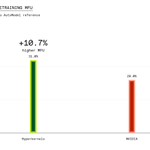
1 - We cut pretraining costs by 62% at frontier scale (8x Chinchilla), and we further cut all AI inference costs by 30% (Faster decode).
2 - Introducing our model ‘Feather’, which decisively overtakes Qwen 3 as the leading frontier 1.7B math model, using 180x fewer total training tokens, even matching Qwen 4B at potent benchmarks in math.
3 - With Anvil II, our state of the art LLM Optimiser, we record the largest pre-training efficiency jump on the NanoGPT Speedrun, leaping the previous by 34seconds - Our record singularly, is a greater percentage drop than the past 45 World Records combined.
The website : hyperstition.cc
