

Worked as a government librarian, teacher, cricket & rugby coach/writer, and in local government. Dedicated but slow parkrunner. Puzzled why anyone follows me!
Lloegr
Joined January 2009
- Tweets26.7K
- Following553
- Followers1K
- Likes17K




John Birch retweeted

I must know 79 people here on this platform who can sign and share this today and get us to the first milestone of 10,000 signatures!! "Women should not have to see the words woman, girl, mother, and pregnant woman disappear or become secondary." #XX
petition.parliament.uk/petit…



John Birch retweeted

At the core of every socialist revolution is a group of failed middle-class intellectuals and artists with a grudge against a world that won’t acknowledge their greatness.


John Birch retweeted

“England: we're going to have to opt out of that one.”
This has aged magnificently.
It speaks to astounding talent that they could make 17th-century geopolitics hilarious to a 21st-century audience.
John Birch retweeted

Hey everyone! 👋
Over the last few hours, an awesome trend has picked up. People are clearly and firmly sharing where they’re from, stating:
'I do not support Pallywood or Hamas as I have a functioning brain.'
Quote this post and drop your declaration! 👇🔥
🤖 Made with AI

Just added this - it's brilliant! I can now see at a glance where each post comes from and do things like block posters that appear to be using a VPN!
Why is this not a available in Twitter/X as standard???

There's a decent plugin I use that blocks countries and regions based of what you select. It can take a slight delay to block newly added countries, but works well enough.
Plugin Link: chromewebstore.google.com/de…
Has made browsing X magnitudes more enjoyable


John Birch retweeted

Tio miljoner svenskar får inte rösta i det israeliska valet.
Tänk på det. Tio miljoner.
Och israelerna påstår att de inte har ett apartheidsystem.
John Birch retweeted

There's a decent plugin I use that blocks countries and regions based of what you select. It can take a slight delay to block newly added countries, but works well enough.
Plugin Link: chromewebstore.google.com/de…
Has made browsing X magnitudes more enjoyable
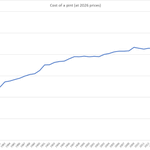
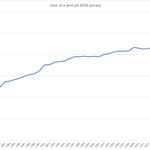
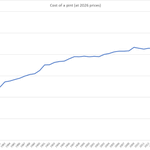
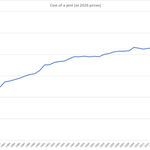
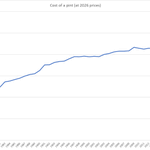
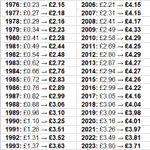
Do you enjoy visiting a pub, having a pint? Do you wonder why so many pubs have been closing recently?
This is the price of a pint, adjusted for inflation, since 1970. Note how prices were stable most of this century... until 2024.
What happened in 2024?


John Birch retweeted

I redid this chart, splitting the fake "South Asia" into Pakistan and India, to give Pakistan its "rightful place" in the chart.


The Economist's estimate of Britain's age- and sex-standardised conviction rates for sexual offences by the offender's nationality
economist.com/britain/2026/1…


John Birch retweeted

Parkinson's Laws, Part Two – Triviality, Expenditure and the Committee.
Everyone knows Parkinson's first law: work expands to fill the time available. Fewer people know he wrote more – and that his other laws describe Brussels with uncomfortable precision.
1. The Law of Triviality. Parkinson's example: a finance committee approves a £10 million atomic reactor in two and a half minutes, because nobody in the room understands reactors. Then it spends forty-five minutes on a £350 bicycle shed, because everybody understands bicycle sheds. The time spent on any item is in inverse proportion to its importance. Brussels spent years making sure your bottle cap can't come off – while the big questions, energy, defense and the empty cradle, waited.
2. The Second Law: expenditure rises to meet income. Give an institution more money, and it will always find ways to spend it – never to give it back. Brussels has proposed nearly two trillion euros for its next seven-year budget, with new taxes of its own to fund it. And Parkinson was an optimist. France spends more than it earns, and hasn't balanced a budget since 1974.
3. The Coefficient of Inefficiency. Parkinson studied cabinets through the centuries and found that beyond about twenty members, a committee stops deciding anything. Power quietly moves to a small inner circle, and the full committee becomes a ceremony. With a straight face, he even calculated the breaking point: somewhere between 19.9 and 22.4 members.
The European Commission has 27.
One commissioner per country – not because the work needs twenty-seven, but because twenty-seven countries each need a seat. Politics decides the size of the committee. Parkinson decides what it will accomplish.
He wrote it as satire. Brussels turned it into a system.


Parkinson’s Law – Why the State Bureaucracy Grows When the Work Shrinks
In 1955, a British naval historian wrote a joke for The Economist. Seventy years later, it remains one of the most accurate descriptions of the modern state ever written. Everyone knows the slogan: work expands to fill the time available. Almost no one knows the mechanism underneath it. That mechanism explains Europe.
1. The evidence. Between 1914 and 1928, the Royal Navy lost two thirds of its largest warships. Over the same years the Admiralty – the office that ran the ships – grew by three quarters. There were fewer ships and more men behind desks. Then there was the Colonial Office, which kept growing while the colonies left one by one. It was hiring while the empire was shrinking.
2. The first mechanism. An official who feels overworked has three choices. He can resign, he can share the work with a colleague, or he can ask for two subordinates. He never chooses the colleague, because a colleague is a rival. Two subordinates are a rank. So one tired man becomes three. Then each of the two subordinates feels tired.
3. The second mechanism. Seven people now do what one did, and they keep each other busy with drafts, approvals, and comments on the approvals. Everyone works hard, and nothing is produced. You have been in this meeting. You have been copied on this email. You have watched three people sign the form that one person filled in.
4. The law of triviality. Parkinson noticed that a committee will approve a nuclear reactor in minutes, because nobody understands it. The same committee will debate the bicycle shed for an hour, because everybody does. Bureaucracy does not avoid the important question by accident. It avoids it by design – the small question carries no risk, and on the big one, someone’s name goes on the decision.
5. The ratchet. A business that fails closes. A department that fails gets a bigger budget, because the problem is now bigger. Failure is the bureaucracy’s best argument for itself. This is why the state never shrinks on its own: every problem it does not solve becomes a new office for solving it.
6. The civilizational lesson. Burnham described the managers taking over. Parkinson showed how they breed. Put the two together and you get Brussels. You get France, where the state spends more than half of everything the country produces and still cannot fix a hospital. This is not because the people inside are wicked. It is because the machine works exactly as Parkinson said it would.
7. The vindication. Parkinson was dismissed as a humorist. Then Milei cut Argentina’s ministries in half – and the country did not collapse. It barely noticed, except on the bill. The lesson is simple: you cannot reform a bureaucracy by asking it what to cut. It will always propose to cut the ships – and hire someone to manage the cut.


John Birch retweeted

Can someone explain this to me?
Europeans settled the Cape of Good Hope in 1652.
Their descendants have been born there for more than 350 years, built a distinct language and culture on African soil, and know no other home.
They are still routinely called colonisers and told they are not African.
Move from Lahore, Lagos or Kingston to Britain, acquire a passport, and the same voices insist you are British at once and, increasingly, that your children may claim to be English.
Either continuous presence, birth and cultural formation create a legitimate claim to a place, or they do not.
The standard cannot be inverted solely according to the ancestry of the people involved.
Jews maintained a continuous presence in the Land of Israel for over 3,000 years.
The Romans renamed the province of Judea “Syria Palaestina” after crushing the Bar Kokhba revolt in 135 CE specifically to erase the Jewish connection to the land.
Arab forces conquered the region in the 7th century. Significant Arab migration continued into the late Ottoman period and under the British Mandate, drawn by economic opportunities created in part by Jewish development.
A distinct “Palestinian” national identity among local Arabs is a 20th-century development, solidifying mainly in the 1920s in opposition to Zionism and later consolidated by the PLO and the Soviet KGB.
Afrikaners after 350+ years in South Africa: still colonisers, not African.
Jews returning to (or remaining in) their ancestral homeland after millennia: colonisers and settlers.
Arabs whose ancestors arrived via 7th-century conquest or later migration: indigenous Palestinians with an ancient claim.
Someone who arrived in Britain from the Subcontinent or Africa in recent decades: British, and now eligible to be English.
The standard for belonging keeps changing depending on who is making the claim.
#DoubleStandardIdentity #350YearsStillColoniser #JewsNeverLeft, #BelongingIsSelective
#WhoseHomeCounts
#IndigeneityWhenConvenient
#StopTheBoats #NetMigrationCrisis #EnglishIsAncestry #IntegrationFailed #BelongingIsSelective.