

Researching Kneading fresh ideas into reality Opinions are my own
Joined April 2019
- Tweets420
- Following434
- Followers349
- Likes1.3K






nice work. time to reconsider soft prompt tuning for post training. simple enough for expert mixing & serve friendly for personalization

We think we’ve found a better path to continual post-training: merging models in input space.
🔹 A 256-token soft prompt (~0.01% of params) matches full-parameter RL
🔹 Plug-and-play composition: prompts trained separately just stack, with no joint training, and the combo beats the experts. No more MOPD!
🔹 Better OOD generalization, almost no forgetting
🔹 ~0 inference overhead, even with a different prompt per request. Built for personalization.

4
210
Jheng-Hong Yang retweeted

Introducing SID-2, a new search model built on compute-scaling swarms.
Our swarms find better results than Opus and Astra, while being 8x faster and 20x lower cost.
By 2030, AI will write an internet's worth of text every 24 hours. Current search pipelines were built on hand-designed rules, adding more won't scale to meet this incoming volume of data.
SID-2 is available on our API today. Try it on your most demanding searches.
Jheng-Hong Yang retweeted

gave a talk in pi-durable on 2 hours of sleep at the Vienna AI Engineering Meetup last week.
i made people look at code and nobody exploded.
thanks @bpirvu, @mrlesk and team for the organization.
youtu.be/EreOxs9Vvrg

Jheng-Hong Yang retweeted

Introducing e-means, an algorithm beating k-means in 10x fewer epochs.
With order of magnitude wall-clock speedups, e-means is released in FAISS and needs no hyperparameter tuning beyond k. It is robust to various scales and datasets. Still skeptical ? Just try e-means [1/10]🧵
Jheng-Hong Yang retweeted

I joined Keenable just a month ago, and I've already been involved in four model rollouts! What a fast-paced environment! 🚀

Keenable Search 1.0 takes 1st (pro, 83) and 2nd (realtime, 82) on the Artificial Analysis Search Index: ahead of Exa (auto, dynamic highlights) and Perplexity (medium) at 80
We benchmarked both modes of @KeenableAI's Keenable Search 1.0, pro and realtime, in our Stirrup agent harness with Keenable Search as its web_search tool to complete 1700 search-focused tasks.
At $4 per 1k searches, Keenable costs about $0.040 per task in both modes, over a third below the board median ($0.063). It is also one of the fastest products we measure: 15.0s (realtime) and 15.5s (pro) per task, 2nd and 3rd on the board.
Key benchmarking results for Keenable Search 1.0:
➤ Artificial Analysis Search Index: Keenable (pro) scores 83 and Keenable (realtime) 82, up from 67 for both modes when we first benchmarked Keenable in August, and a ~50-point lift over the same model with no search (33). Both lead Exa (auto, dynamic highlights) and Perplexity (medium) at 80
➤ DeepSearchQA is Keenable's strongest benchmark: both modes score 88 F1, 1st and 2nd of 26, ahead of Exa (auto, dynamic highlights) at 86. Pro also ranks 1st on BrowseComp (87%, level with Perplexity (medium)) and on AA-Omniscience (73%, level with Exa (auto, dynamic highlights) and Firecrawl)
➤ Fast search: realtime takes 2.3s of search time per task (2nd of 26) and pro 3.0s (3rd), against a board median of 12.5s. Each search returns in about 330ms (realtime) and 390ms (pro) on average
Key details:
➤ Setup: GPT-5.6 Luna (medium) in Stirrup, Keenable Search API with mode=realtime and mode=pro
➤ Pricing: $4 per 1k requests in both modes (public pay-as-you-go price)
➤ Cards: We disabled Keenable's search cards for testing (disable_cards=true)

Jheng-Hong Yang retweeted

1/ so what is ovnfs? in essence, it's a virtual filesystem made of composable layers that you can cheaply fork and mount via a protocol of your choosing.
git worktrees are highly inefficient, especially for monorepos, requiring recompilation of code, reinstallation of dependencies, as well as O(N) disk-space. omp had it's own CoW take on this since Feb, but it only saves space, not time.
in contrast, an ovnfs checkout is instant, copies nothing, and keeps your caches (target, node_modules) intact.
when touched, tracked files materialize, rest simply become a passthrough read of your original folder, with changes saved to an overlay dir.
github.com/stencil-hq/ovnfs

Jheng-Hong Yang retweeted

meh, the more you dig into each experiment, the less magical it gets; it feels like a loose collection of cherry-picked demonstrations with a grand narrative built around them
Exp 1-2 are tiny (~20K params) with unusually easy to interpret architecture; Exp 1 is an MLP, where nearly all params are used in the first layer, so you can easily tell what kind of objects the network is trying identify
Exp 5 is about designing a game strategy (we already know that Astra is extremely good at this) and then converting it to a tiny (~20K params) MLP; entirely doable by a human, but of course would require a lot of effort
Exp 3 & 8 are closer to automated mechinterp using python and established techniques, rather than direct weight interpretation (at least according to chat)
to be clear, those are genuinely cool results, but I think people are reading too much into them
I don't think any of this should meaningfully change anyone's intuition about what models are capable of

We asked GPT-6 Astra to edit Qwen3.5-0.8B weights to improve math.
It directly changed only 0.016% of weights, fixing 0.8B's reasoning loops & improving math up to 6x and even instruction following 3x, without gradients or training.
We call this Weight-Space Programming: frontier LLMs can now natively read/write neural network weights! 🧵
Blog: rikiyat.github.io/blog/weigh…

Readers added context they thought people might want to know
LLM was given weights explicitly as text in prompt and used code/forward passes (per authors' logs) to ablate Qwen looping direction, a known thinking-mode issue per model card. Primarily fixed repetition in that mode, not general 'natively' improving weights/math.
rikiyat.github.io/blog/weight-sp…
github.com/RikiyaT/lm_und…
huggingface.co/Qwen/Qwen3.5-0…
huggingface.co/RikiyaT/Qwen3.…
Jheng-Hong Yang retweeted

1/4
Meet Qwenputer: Qwen3.5-4B with a full RISC-V CPU inside its weights, using the model's own Gated DeltaNet layers as RAM.
It runs C and MicroPython in its forward passes, no external runtime.
On DeepMind math: base 55–90%, base + Python tool 95–100%, Qwenputer 97.5–100%.
Jheng-Hong Yang retweeted

As people know, I'm very much anti-public-benchmarks - even when we're ahead, so wouldn't recommend believing them blindly
The biggest victim of benchmarks is exactly their target audience: people too busy to play with the models themselves and get a feel for their intelligence


there are many JevGPT, but i like this one
arxiv.org/abs/2610.18272

1
258

great opening move makes things way more interesting


1/ We’re excited to share Question’s Gambit module for search agents. ♛
🥇Question Gambit got first on the BrowseComp-Plus leaderboard for recall with BM25 as our only retriever!
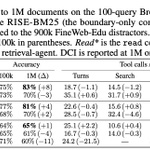
📈 It focuses on the first retrieval move in search agents and got 96.6% recall with about 6 times fewer agent search calls.
Same BM25 index. Same agent loop. Just a better opening move.
📄 Paper:
arxiv.org/abs/2609.14412

Jheng-Hong Yang retweeted

watching Toast 1 deep search sec filings is satisfying
- gets a vibe of the corpus from facets/semantic search
- picks grep or semantic to track down specific evidence
- prunes irrevelant docs from its own context
and its blazingly fast @mixedbreadai

used to set timeout at 300s for a deep search query
now it's less than 30s
it's a good model
it knows how to use search tools properly
🍞


sooner or later,
every incoming thread will become a room
we'll peek left and right
choose the right weapon (model)
and fire
one step closer to text doom

1
2
2,665
Jheng-Hong Yang retweeted

This was fun. Humans need powerful search tools, but even exact-match Boolean queries can work for agentic search. Our Boolean ranking uses only match proximity and density. No learning, vectors, or even term statistics required. arxiv.org/pdf/2607.11362

how to derive upper and lower bounds on a problem's token complexity?
maybe even tell whether it's linear or sublinear or superlinear?
2
236
