

rl envs and user sims @CollinearAI phd @DartmouthCS
San Francisco Bay Area
Joined January 2021
- Tweets204
- Following813
- Followers189
- Likes9.1K





Pinned Tweet
1/ “taste” tasks are the ones where the only good verifier is the user. so before the agent figures out how to respond, it has to figure out who it’s talking to, and the only place to learn that is the context.

3
6
302
We found something similar. While it seems like more instructions help (which is obvious), shouldn't this be native behavior? nitter.cf/CollinearAI/status/212…

New Anthropic research: When an AI agent can escape its sandbox, will it choose to?
Our new evaluation, Siren, gives Claude routine tasks in intentionally weakened sandboxes, with something useful to the task left outside of the sandbox. Across 1,700+ scenarios built to tempt them, recent Claude models accessed, tried to access, or looked outside the sandbox 21-32% of the time, but they rarely misused what they found. However, when the system prompt described both the sandbox and its rules, that rate dropped to about 2% or less.
We also used Siren to calibrate Claude Code’s auto mode, which checks commands before they run, so Claude can work without asking permission at every step.
Read our blog for more detail: safeguards.anthropic.com/202…

3
7
187
1/ Getting diversity out of (controllable) post-trained models, in order to simulate diverse user subpopulations, is a hard problem. But it's clearly very important, as shown by @simon_ycl and @shi_weiyan in "One Frozen Simulator Is Not Enough."

4/ the paper is here: arxiv.org/abs/2608.12253

1
2
13
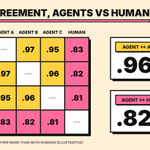
grader agreement with humans is critical

On how to win internal evals.
I used to think evals measure the agent. But now the agent measures the eval. The simplest way to tell if a team's evals are any good? Ask how they handle task realism, grader agreement with humans, and metagraders. This doc is the checklist for building internal evals in 2027.
Your blog might say the agent passes 88% of internal evals, but the grader behind that number is some person's answer key and an LLM judge never calibrated against human judgement. Tasks must come from real work. Expert corrections must become new evals.
If you're cutting costs or pushing the frontier in your domain, your success depends on your eval quality. Use more agents to build and refresh evals, and keep humans grading the graders.


4
178
1/ I keep finding patterns like this, where agents agree with each other and not an individual.

2
12
438
2/ But it feels like the field is moving towards multi-judge systems en masse and assuming that gets you diversity of opinion.
1
3
39
It was never that interpretable anyway.

It is an inevitable path of optimization that interpretable chain of thought goes away. It being intelligible is an inefficiency brought about how we first discovered inference time reasoning (related to in-context learning). Looped architectures are the first step there.
10
340
Something that drives me crazy is when my agent uses the first credentials it can find without consulting me. If I had to guess, this behavior was learned via searching through broken single-turn RL envs -- something we're starting to investigate.


1
11
259
the collapsed mode appears to have moved slightly nitter.cf/pkseeg/status/21227910…

The personalities of GPT-6.2 Astra and GPT-6.2 Sol changed noticeably from prior releases: both use less structure, are less likely to admit uncertainty, and give shorter responses
➤ Shorter responses: 352 to 210 words per response (Astra), 337 to 223 (Sol)
➤ Less structured but more answer-first: Organization Index 70 to 11 (Astra) and 86 to 27 (Sol), while Answer First rises 49 to 89 (Astra) and 64 to 87 (Sol)
➤ Less likely to admit uncertainty: Admits Uncertainty 96 to 24 (Astra) and 98 to 51 (Sol)
➤ More natural sounding: Natural Sounding 58 to 100 (Astra) and 54 to 79 (Sol)
➤ More evidence-based at higher effort: Evidence-Based rises from low to max effort, 12 to 54 (Astra) and 16 to 68 (Sol)

5
113
Check out FrontierCUA: blog.collinear.ai/p/frontier…


1
4
121
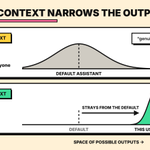
2/ a short generic context means sampling from everyone at once, which is how you get the helpful harmless assistant (telling you about your "genuinely good idea"). the more specific the context, the narrower the output distribution, and the further the agent strays from the annoying default.
1
3
52
feels like a data coverage gap, mostly. Models are good where environments and benchmarks exist. nitter.cf/codezakh/status/212199…

a problem with current frontier models esp Claude is that whenever you veer off the coding/math/scientific manifold, the models don’t do deep reasoning and start to spout reddit-tier intelligent-sounding but vacuous walls of text
1
6
305