
Graduate student in PKU, working on single cell omics.
Beijing, China
Joined February 2020
- Tweets84
- Following227
- Followers133
- Likes61



Pinned Tweet
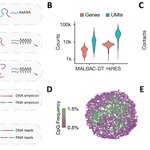
Curious about the 3D genome’s relationship with gene expression? With @ychen48184593 and team at @xingdong816‘s lab, we’ve developed a method to simultaneously capture 3D genome and RNA in single cells. Find our study in the latest @ScienceMagazine! doi.org/10.1126/science.adg3… (1/8)

Zhiyuan Liu retweeted

Our cells carry the same DNA, but how this DNA is interpreted differs wildly from cell to cell. In a new preprint, Science Fellow @zhou_jingtian and team introduce Bolero, a model conditioned on cell state that predicts chromatin accessibility and expression from DNA alone.

Zhiyuan Liu retweeted

3D genome architecture underlies health & disease, but its biochemical basis is hard to study at scale. We present Plate-C: a screening platform that profiles thousands of whole-genome 3D maps in a day ($4 each), discovering many pathways that rewire DNA: biorxiv.org/content/10.64898…

ALT Plate-C measures whole-genome architecture at scale
Excited to share our latest work, CHARM,build on HiRES by bringing in single-cell chromatin state information, to study how cis-regulatory elements relate to genes in 3D space.
Big thanks to @xingdong816 , @YujieChen1209 , and all our great lab mates.
nature.com/articles/s41586-0…

Zhiyuan Liu retweeted

scDIAGRAM: Detecting Chromatin Compartments from Individual Single-Cell Hi-C Matrix without Imputation or Reference Features biorxiv.org/content/10.1101/… #biorxiv_bioinfo

Zhiyuan Liu retweeted

🚨 New to single-cell analysis? Still stuck in a trial-and-error loop?
🚨 Already experienced? Your “optimal” preprocessing pipeline might not actually be optimal.
🚨 Relying on a BioAgent? It likely runs standard procedures that are broadly accepted — but not truly optimal for your dataset or downstream task.
No matter where you are — 💡DANCE 2.0 is here for you. We turn single-cell preprocessing from a trial-and-error guessing game into a systematic, data-driven, and interpretable workflow.
🔍 Highlights of DANCE 2.0:
1. Overview
DANCE 2.0 automatically searches for optimal preprocessing pipelines tailored to your new methods and datasets.
It’s not just a recommendation engine — we open the black box of preprocessing and reveal which patterns hurt or help your downstream task performance. (See Figure 1)
2. Method-Aware Preprocessing (MAP)
Have a new downstream task method? Just plug it into DANCE 2.0.
We’ll run a systematic pipeline search to find what preprocessing works best for it.
Our large-scale experiments show DANCE 2.0 significantly outperforms original study pipelines across tasks like annotation, clustering, imputation, joint embedding, and cell type deconvolution. (See Figure 2)
3. Dataset-Aware Preprocessing (DAP)
Need to preprocess a new dataset?
DANCE 2.0 uses similarity-based atlas matching to recommend optimal pipelines on the fly.
We built a preprocessing atlas where each dataset is paired with its optimal pipeline (pre-computed via DANCE 2.0).
Your query dataset is matched to similar ones, and inherits the best preprocessing accordingly. (See Figure 4)
4. Interpretable Insights: Unlocking the Preprocessing Black Box
Through extensive experiments, we found that even within the same task, the optimal preprocessing varies across datasets and methods — depending on dataset characteristics like tissue type, sparsity, or technical noise.
DANCE 2.0 exposes and explains these hidden dependencies. (See Figure 5)
5. A Scientific Asset
We executed over 325,000 pipeline searches across 6 major downstream tasks.
Each run is labeled with task-specific performance, offering an unparalleled resource for benchmarking and insight discovery.
🔗 Paper: biorxiv.org/content/10.1101/…
💻 Github: github.com/OmicsML/dance (will be open-sourced very soon!)
🌐 Web platform coming soon! You'll be able to upload your new dataset and get on-the-fly recommendations for optimal preprocessing — powered by DANCE 2.0.
DANCE 2.0 will remain an open-source initiative — and we warmly invite the community to contribute, extend, and build upon it.
With amazing collaborators @Stanford @CMUCompBio @StanfordMed
Zhongyu Xing, @YixinxinWang @RemyLau3 @ShengLiu_ @ZhiHuangPhD @WenzhuoTang @Yuyingxie @james_y_zou @Xiaojie_Qiu @jmuiuc Guoxian Yu @tangjiliang

Zhiyuan Liu retweeted

Excited to share that scPRS is now out @NatureBiotech! We developed a new single-cell-resolved #PRS using deep learning.
nature.com/articles/s41587-0…

Zhiyuan Liu retweeted

Our new review paper is out @ JMB! 🧬
@katsu_s_minami @semeigazin @a_mond_future discuss DNA accessibility in euchromatin and heterochromatin in living cells.
📘 Free access: authors.elsevier.com/a/1lHgb…
🔗 Also, check our previous paper on nucleosome motion: science.org/doi/10.1126/scia…

Zhiyuan Liu retweeted

How does heart failure rewire gene regulation? 🔍 Excited to share our single-cell, multimodal epigenomic resource on human heart failure🫀: doi.org/10.1101/2025.05.08.2….
Zhiyuan Liu retweeted

We developed an imaging-free spatial genomics technology where DNA barcodes diffuse to connect locally. Using UMAP, we reconstructed the physical locations of these barcodes, transforming spatial transcriptomics into purely molecular biology.
biorxiv.org/content/10.1101/…

Zhiyuan Liu retweeted

Check out our latest large-scale Perturb-seq on biorxiv! biorxiv.org/content/10.1101/…
A new stat gen/GWAS-inspired analytic framework + large-scale screens in an expanded range of cell types
Thanks @NadigAjay and @Luke0connor for involving us!

Zhiyuan Liu retweeted

Tired of searching for first-author publications on Google Scholar?
Here's a Chome extension that highlights them for you: chromewebstore.google.com/de…

Zhiyuan Liu retweeted

Who's ready for $MNT ◤Phase 01◢ drops?
To be eligible for juicy social points that automatically drop every week - Register now to gain more points:
🔗 mantle-xyz.net/
All current users who whitelist their wallets will be eligible for x3.5 points multiplier! 🎲

Zhiyuan Liu retweeted
Who's ready for $MNT ◤Phase 01◢ drops?
To be eligible for juicy social points that automatically drop every week - Register now to gain more points:
🔗mantle-xyz.net/
All current users who whitelist their wallets will be eligible for x3.5 points multiplier! 🎲

Zhiyuan Liu retweeted

Our multi-year effort on putting together a comprehensive database of loop calls from 1000+ HiChIP samples plus enabling visualization, download and other analysis modalities is out #biorxiv now. @JoaquinReyna8 and Kyra Fetter did a phenomenal job in making this happen. #3dgenome

Loop Catalog: a comprehensive HiChIP database of human and mouse samples biorxiv.org/cgi/content/shor… #bioRxiv
Zhiyuan Liu retweeted

Our LiMCA paper has been published in Nature Methods! Congratulations to my co-authors @JiankunZhang21, @jianfcpku, and @tanlongzhi. Thanks to all the reviewers for their invaluable suggestions, which greatly enhanced the quality and clarity of our work. nature.com/articles/s41592-0…


I'm thrilled to introduce our latest technique—LiMCA (Linking mRNA to Chromatin Architecture (LiMCA)), from Sunney's lab @XieSunney, which simultaneously profiles 3D genome and transcriptome with the same cell. Preprint: researchsquare.com/article/r…

Zhiyuan Liu retweeted

Excited to share scGHOST, now published @NatureMethods, graph-based #ML identifying #3Dgenome subcompartments in single cells. Kudos to @KyleXiongCMU & @RuochiZhang, who worked so closely on this. Exciting time for single-cell epigenomics & multiomics! nature.com/articles/s41592-0…
Zhiyuan Liu retweeted

Very excited to share our review on genetic variation across and within individuals led by @ZhiYu_ACGT @TimCoorens! nature.com/articles/s41576-0… @NatureRevGenet


Genetic variation across and within individuals go.nature.com/3PFrsTf #Review by @ZhiYu_ACGT, @TimCoorens, Md Mesbah Uddin, Kristin G. Ardlie, @nialljlennon & @pnatarajanmd

Zhiyuan Liu retweeted

Thrilled to announce our paper in @Nature introducing MUSIC! For the first time, MUSIC enables simultaneous mapping of multiplexed chromatin interactions, RNA-chromatin interactions, RNA-RNA interactions & gene transcription at single-cell resolution. doi.org/10.1038/s41586-024-0…
Zhiyuan Liu retweeted

A benchmarking study from Zhiyuan Yuan, Yi Zhao and colleagues at @FudanUniv and @UCAS1978 compares spatial clustering methods for spatial transcriptomics data.
nature.com/articles/s41592-0…
