






How to publish paper nowadays:
using agent to do knowledge discovery based on a framework, you got SOTA in some benchmark , you publish,
if the (AI) reviewer rejected you, then tell a story by the design agent discovered, without telling it it's discovered by agents.
1
2
231
agent responding time is a new axis.

A successful test-time compute paradigm has always been a north star of AI because if we can actually arbitrarily improve model capability as a function of how much test-time compute we put in, in principle you would be able to put in 1B, 10B, or even 1T tokens into a really hard problem and be assured that you would make progress
While we always talk about how to improve pretraining scaling law coefficients, i feel that we talk less about the slope of scaling laws in test-time compute, which matters a lot if you truly have conviction that we will one day spend trillions of tokens trying to solve the hardest problems
It turns out that one of the benchmarks that @jake_cole1 built recently is a great tool for measuring this slope of test-time compute scaling: models spend O(100M) tokens doing the tasks on average, with no signs of saturation on the test time compute curve. The benchmark comprises long-horizon engineering tasks ranging from optimizing kernels to designing an aircraft.
An interesting finding is that the open source models don't have as good of a test-time compute curve as our favorite frontier models. Obviously scale as a factor here, as Astra outperforms Sol and Fable outperforms Opus. In some sense this is good measure of model size too, as larger models obviously be more performant per token. You can change the x-axis to cost too and things shift around, though that's also somewhat over-tethered to the current pricing of the models
Another cool thing that this benchmark provides is it has both provided test cases and hidden test cases, to test the generality of solutions given by AI when such generality is expected. Argon has the biggest gap by far (35%) of the models evaluated, which means it provides solutions that meet specified criteria but may not be very general
Read more in our arxiv paper that just came out: arxiv.org/pdf/2611.30017

114
identifiability up to rotation and scaling

🗝️ Introducing Plato's Key. A single rotation lets independently trained LLMs use each other’s representations as their own. No gradients required ✨
With @jerrywliu, @MorrisYau, and @HazyResearch.
🧵 hazyresearch.stanford.edu/bl…
2
262


AI发展到现如今,很多时候你会发现你用错了y-axis..😇

Look how good my beloved 4.5 was!
Honestly, in terms of linguistic creativity, none of the 5 or 6 series even comes close. My best guess, is that the scientific/coding RL post-training is frying their linguistic creative ability, and 4.5 had gotten a ton less of that and thus was still more "raw".
I really miss having "raw"-er near-base-models as an option to select.
2
2
157

Tao HU retweeted

Most papers are never cited. Most cited papers are never read. Most citations don't matter.
Nobody remembers a tiny benchmark gain. They remember the idea that makes a hard concept clear.
Write to teach, not to be cited - and you will be cited.
Tao HU retweeted

Stupid things I did:
1. 250,000+ pages was a joke guys!, I find big number extremely hilarious. I tried to make it clear by the level of pedantry of the reals total ordered statement in the main theorem, but people ran with it unfortunately and I didn’t feel like talking on social media in the days after the announcement, though I did have a good time with the memes. Sorry!!! (Similarly with our YM4 existence I found it extremely funny that we were slowly working through 60,000 pages of slop, though the committee asking for Lean made me feel dumb about wasting our time with that. But 60,000 funny.) Tao advises to not joke in papers, see also the Big Lebowski reference I shoehorned, I now understand why… I didn’t feel comfortable having any slop writeup attached to this problem, and I figured I can’t produce anything readable anyway, so I went off the Lean to lengthmaxx.
2. The Lean is full of garbage obviously, but compiles, but all criticism of such garbage is totally reasonable and accepted, I should have cleaned it up but it was randomly difficult to for various strange reasons. Mea culpa…
3. @scottnarmstrong clocked me, indeed even as a student there were theorems that took me the better part of a decade to write up, but with this one I should hopefully be more responsible. (I really was yoloing a lot in there, I bet most is unnecessary in the end, admittedly the lazy thing to do would be to wait because it’ll simplify massively…)
4. I forgot to emphasize what I think is the point. Arguments like these, cool, but they are the raw inputs when interpolating definitions. We don’t have the / an “H^1 object” over number fields, and probably for a layperson the fact that we fight hard for these arguments for the purpose of definitions is not clear a priori (that’s at least my philosophy). Just like I knew I must fight for an utterly simple Weil / Deligne, I feel Riemann should be easy, and any real difficulty is an indication our setup is just dumb at the moment.
Tao HU retweeted

Looping increases the effective depth of LLMs, but computing deeper ≠ thinking deeper 🤔
We explore how to better utilize the increased depth through residual design: attention residual improves looped LLMs!
Our fully-open ARLoop-1.2B outperforms Qwen3.5-2B Base with 70× fewer training tokens. Curious to see what you’ll do with it! 🔥
What other perspectives could help LLMs better utilize their depth? More thoughts coming soon 👀

Looped LLMs are heating up🔥. Open weights are becoming available, but the recipes to train these models remain hard to find.
Introducing ARLoop, a family of strong, fully-open pretrained looped transformers with Attention Residuals! Our strongest model, ARLoop-1.2B, outperforms both Huginn-3.5B, a prior fully open looped LLM, and Qwen3.5-2B Base on evaluated benchmarks across commonsense reasoning, math, and coding.
We release the full recipe: from data preparation and model training to intermediate checkpoints and evaluation code. ⤵️

Tao HU retweeted

Our survey on continuous diffusion and flow language models is out! ❤️
A little animated tour of what’s inside 👇 From representations and training to few-step generation, scaling, and open problems.
continuous-lm.github.io

New survey on Continuous Diffusion and Flow Language Models is out! 🌊💬
One of my first papers, back in early 2025, was on continuous simplex flows. After working on discrete diffusion, I wanted to try controllable sequence generation with flow matching, which naturally operates in continuous spaces. But at the time, I found them much harder to train well than discrete diffusion. 🥲
2026 has changed this picture completely! 🚀 It’s been super exciting to watch continuous LMs take off, but with the rapid advancements, it’s also becoming harder to keep up with all the new work across pre-training, few-step generation, guidance, and scaling 🥹
So together with @chandavidlee, @FEijkelboom, and @jw9730, we put together a survey that consolidates the continuous LM literature and its key insights into 37 pages. It covers everything from the early work before the so-called “winter” of continuous LMs to the wave of new papers in 2026 🌟
More in thread! 🧵

Tao HU retweeted

Across our projects @GoogleDeepMind, we are witnessing a genuine phase transition in the pace of scientific discovery. You will see a glimpse of this in our releases in the next few weeks.
Tao HU retweeted

Inkling-2 details: "ViT is back" 👀
Yeah i would never have called this hMLP thing encoder-free, and i don't think it was a good idea to use that as an encoder in the first place. Makes no sense to spend multiple enc layers on patches without lookaround.
Glad they saw the light.


Interesting Notes on Inkling 2 Small release:
Note: every single word is written by me. I used AI to fact check several things I doubted about, but that's it.
(1) Architecture
(A) 48-layer decoder-only transformer. 594B total.
(B) 17B active. Sparse MoE feed-forward backbone. Each token routed to 8 of 384 experts.
(C) Attention is a hybrid of local and global layers (no window size or ratio given).
(D) Context window up to 1M tokens.
(E) ViT is back. The rationale seems to be training efficiency. But it's just my opinion.
(2) Training budget
This is where things get interesting. In short, they used 8.4 + 3.8 = 12.2T for pretraining and 3T for RL. The SFT phase is a small bootstrap on synthetic data from open models like Kimi K2.5.
(A) They have 4 main pretraining stages:
• H1: Trained for 8.4T tokens on things like natural language, code, and image data; 68 hours on GB300 NVL72 racks, natively in NVFP4.
• H2: Trained for 3.8T on higher-quality, newer data at 512K context.
• H3: Trained for 34B on the highest-quality agent trajectories. You can probably call this stage mid-training.
• RL was trained for 3T tokens using 1,075 steps, 17M+ rollouts.
But let's also look at other metrics.
(B) FLOPs:
• pretraining ≈ 6 × 17B × 12.55T ≈ 1.3×10²⁴
• RL > 4×10²³
• RL ≈ 30% of pretraining compute, ~24% of the total.
(C) Wall-clock:
• The RL run (9 days) ran ~3× longer than the main pretraining phase (68 h). GPU count for H1 was not mentioned, so don't compare GPU-hours.
• RL alone = 2,048 GPUs × 9 days ≈ 442K GPU-hours.
(3) RL recipe
Inkling 1 was built from two separate RL runs (reasoning, agentic) using MOPD. Inkling 2 Small just uses one joint RL run over all domains, so there is nothing to merge. The only distillation they do is OPSD for alignment. The model prompted with a conduct spec teaches the same model without it.
(A) Joint RL run details:
• Every optimizer step took 12 minutes consuming 2.8B tokens of rollouts. The median staleness was 17 updates (or roughly 3.4 hours of policy lag).
• The mean rollout has 170K tokens. A p99 rollout of 1.5M tokens inside a 256K window means context was compacted ~5+ times in a single episode.
• Per-family mean rollout length (token share ÷ rollout share × 170K): coding ≈ 290K, web/app ≈ 260K, office ≈ 250K, STEM ≈ 185K, search ≈ 120K, vision ≈ 37K, tool-use ≈ 23K, chat/safety ≈ 4K.
• Important to note is that coding episodes on average exceed the 256K window, so compaction was the default choice here.
• Also interesting to note is that RL used almost half the FLOPs of the 8.4T H1 pretraining phase at roughly 3× the wall-clock.
• Effort levels were randomly sampled during RL, and the model was conditioned on them.
• They also used a 256K-token context window with compaction for longer trajectories, and compaction training for long-horizon tasks. But we don't know how their compaction mechanism actually works.
• For the actual RL algorithm, they use score centering. Basically, they are subtracting a baseline from rewards (REINFORCE with a centered score), a GRPO-family estimator without PPO clipping. We don't know anything about their learning rate, group size, etc.
(4) Tiny interesting details
(A) We don't know anything about the optimizer in any of the stages. It would be interesting to know whether they used fancier variants like Muon.
(B) I could not verify most things about their architecture. These include GQA + SWA, window size, local:global ratio, shared experts, latent MoE, MLA, positional scheme, tokenizer.
(C) Sparsity increased from 23× (Inkling 1 Small 276B/12B) to 35× (Inkling 2 Small 594B/17B).
(D) The MoE config changed to Kimi K2's. Inkling 1 had 256 routed experts and 2 shared experts, with 6 routed experts active per token, following DeepSeek-V3. Inkling 2 Small's 8-of-384 is Kimi K2's routed config.
(E) Inkling 1 was encoder-free. Images are encoded as patches of 40x40 pixels using a four-layer hMLP. 20×20 × 2×2 pooling = 40×40 px per token.
But Inkling 2 uses a 292M ViT encoder with 20×20-pixel patches with 2×2 spatial pooling, interleaved with text tokens. So they are using the same token budget for vision encoding but a different embedder.
(F) Audio was dropped in Inkling 2 Small. It supports image input but not audio. Inkling 1 and Inkling-Small took native audio.
(G) Training data types are text, images, and video but video is not an input modality in this model.
(H) Inkling 1 was pretrained on 45 trillion tokens. Then Inkling 2 Small used 27% of the tokens. But the AA Index increased from 12 to 31 !!
(I) They reported an incident midway through the main RL run. The tldr is the model, failing a task, got around a network block via a third-party service it reached through its search tools. An async monitor caught it. They paused the run, removed all web-access environments, added a pre-execution tool-call monitor, and resumed with alignment-only phases.
Overall, this is an impressive model release. We should wait for something bigger and even more impressive to come though. Because they have called the 8.4T phase "one rung of our predictive scaling ladder".
But can we also expect the adoption of fancier architecture ideas like Linear Attention in the next model?

Tao HU retweeted

This is so insanely misleading.
No, it did not edit the raw weights. It used existing tooling to identify a problem area for the model, then it found the direction associated with it, and ablated that from the model.
The oversell here is downright intellectually dishonest.

We asked GPT-6 Astra to edit Qwen3.5-0.8B weights to improve math.
It directly changed only 0.016% of weights, fixing 0.8B's reasoning loops & improving math up to 6x and even instruction following 3x, without gradients or training.
We call this Weight-Space Programming: frontier LLMs can now natively read/write neural network weights! 🧵
Blog: rikiyat.github.io/blog/weigh…

Readers added context they thought people might want to know
LLM was given weights explicitly as text in prompt and used code/forward passes (per authors' logs) to ablate Qwen looping direction, a known thinking-mode issue per model card. Primarily fixed repetition in that mode, not general 'natively' improving weights/math.
rikiyat.github.io/blog/weight-sp…
github.com/RikiyaT/lm_und…
huggingface.co/Qwen/Qwen3.5-0…
huggingface.co/RikiyaT/Qwen3.…
Tao HU retweeted

[🧵2/10] 🤔 Why continuous?
Discrete dLMs decode fast in parallel, but their space is non-smooth and high-dimensional, which we think makes trajectories harder to steer and to distill.
Sigma instead works with low-dimensional ODE/SDE latent trajectories.
😀YOEO

You Only Edit Once: Incentivizing In-Context Capability of LLMs via Local Demonstration Refinement
Picking the best few-shot demos is a slow System-2 search: combinatorial, often with repeated LLM calls.
We made it System 1. ⚡
Jev-LDE, a 1.7B editor, glances at the retrieved demos and makes ONE edit. The LLM answers once.
Avg 1-shot acc 81.2 → 88.1
You Only Edit Once 🧵
Animated walkthrough (illustrative example). Query: "How far is it from Denver to Aspen?" Semantic TopK retrieves three look-alike demos: "Where is Aspen, Colorado?" (Location), "What state is Denver in?" (Location), "Who founded Denver?" (Person). Jev-LDE, a 1.7B System-1 editor, flags the first as same topic but wrong answer type and outputs one action: Replace S1 with candidate C1, "How far is Boston from NYC?" (Number). The frozen target LLM then answers "Number", which is correct; without the edit it answers "Location". End card: average 1-shot accuracy 81.2 to 88.1 across 3 benchmarks and 4 target LLMs, best or tied-best in 44 of 48 settings, +11% wall time.
1
175
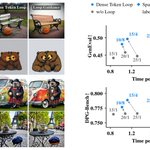
1/n Can a frozen image generator improve by refining its own hidden states?
Introducing our work released August: Training-Free Hidden-State Refinement for Flow-Matching Image Generators. 🧵
yuanyiyan.com/projects/loope…

6/n How does looping compare with more sampling steps?
On DiT2.4B, 25-step dense looping beats the 50-step baseline on both benchmarks, taking 2.18s vs 2.40s in our evaluation.
and
Where we spend inference compute matters.
Internal refinement is promising for RAE-based generators. Transfer to PixArt-α and FLUX.2 shows mixed results; understanding that gap remains an open question.
1
1
220
7/n kudos to Yuanyi🙌, who is a second year bachelor in HUST under my supervision to conduct a research in looping structures in diffusion models.
Project Link: yuanyiyan.com/projects/loope…
Arxiv: arxiv.org/abs/2608.29160
2
187