





Average Reward retweeted

The Kryashens(They were Muslim Kazan Tatars who converted to Orthodoxy Christianity)


Average Reward retweeted

Xiongnu Y-DNA, n=106
The Xiongnu were a nomadic confederation in Central Asia, one of the earliest powerful steppe empires. They fought China and likely relate to the European Huns.
Y-DNA: C2 - 23%, N - 13%, O - 5%, Q- 15%, R1a-30%, R1b-5%; minor J1, J2, G1, E1b, L.


Average Reward retweeted

Uncovering a Medieval Pogrom: Genetic History of a Jewish Community in Catalonia (Spain)
mdpi.com/2073-4425/17/3/358

Average Reward retweeted

What if you could trace a civilization's genetic legacy in a few clicks?
CasperHub is now live — ancient DNA, haplogroup assignments, and IBD analyses, all in one place.
Always free. No exceptions.
No noise. Just data. 🧬
🔗 casperhub.dev
🔗 caspershub.github.io

Average Reward retweeted

New website for the massive Akbari 2026 dataset that lets you access G25 coords, haplogroups, and admixture profiles to quickly find the closest ancient and modern matches for each individual.
Link: caspershub.github.io/


Average Reward retweeted
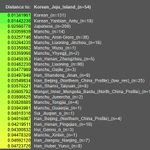
昨年報告があった韓国の林堂洞・造永洞古墳群出土の78個体のゲノムデータが一般公開され、論文未記載のY-SNPまで追えるようになりました。父系は母系に比べ多様性が低く、弥生系でお馴染みのO1b2a1a1が最多。
日本人の起源をより高い解像度で捉えるためにも、半島側のデータ蓄積には今後も期待したい


Average Reward retweeted

Roughly 10,000 new samples no available on G25
Thanks to Teepean
drive.google.com/drive/folde…
Average Reward retweeted
Ancient Egyptians, Dorian Greeks, Indus Valley Civ, Archaic - Classical Greeks, Neo-Assyrians
So much in this one release

The mother of all releases. 9,426 new ancient DNA samples
Absolute insanity
ebi.ac.uk/ena/browser/view/P…
Average Reward retweeted

The average of 4 Azerbaijani samples from Mianeh county in East Azerbaijan province Iran.

Average Reward retweeted
Ancient human genomes from Ladakh reveal Tibetan, South Asian, and Central Asian admixture over the last three millennia
biorxiv.org/content/10.64898…

Average Reward retweeted

(1/2)
Iron Age admixture table on Balts.
Model used (disregard the bit toward the end of the pastebin. I am using Kartal Thracian for paleo-Balkan admixture): pastebin.com/raw/RywT7VYyRaw
Raw ADMIXTOOLS2 outputs for each model:
imgur.com/a/vXlR9V2

RT @khlavkalashguy: Remnants of the Tsanars in Georgia
The Tsanars were a group inhabiting the mountains of northeast Georgia, first menti…

Average Reward retweeted

Deep genetic analysis of modern Icelanders using qpAdm.
~73.4% – Original West Eurasian (Kostenki-Sunghir cluster)
~10% – East Eurasian (IUP & EEC)
~16.6% – Basal Eurasian (ZlatyKun & Mota proxies)
Icelanders are genetically one of the most "White" / "European" nations.

ALT Mbuti.DG,Romania_UP_Muierri.SG,France_Gravettian.AG,Belgium_GoyetQ116_1_UP.AG,Bulgaria_BachoKiro_UP.AG.BY.AA,Romania_Oase1_IUP.AG.BY.AA,Bulgaria_BachoKiro_IUP.AG.BY.AA,China_Tianyuan.AG.BY.AA,China_AmurRiver_Paleolithic.AG,Germany_IUP_Ranis13.SG,Russia_UstIshim_IUP_snpAD.DG
Average Reward retweeted
6th-century Brahmin Li Dan’s genome is officially out. Ran the BAM through ybyra and he clocks in as R1a-Y934.
Plink files and GEDmatch-compatible raw data are linked in the thread below.

Li Dan's ancient Dna data has been made public, and he was a Brahmin from the country of Jibin (which is roughly located in today's Kashmir) who came to China to spread Buddhism. It's also the world's first Brahmin Dna sample.
ngdc.cncb.ac.cn/gsa-human/br…

Average Reward retweeted

🚨 Major Discovery from the Jewish Genetic Discovery Foundation (JGDF)
A Jewish man from Uzbekistan has turned out to be the closest known cousin of a large Ashkenazi paternal lineage. 🧬🌍
1. Who is he?
A Bukharian Jew (JGDF10, the 10th test we sponsored) whose paternal line migrated from Herat → Tashkent in the 1800s.
Before Herat, this line may have come from Mashhad, in nearby Iran.
He belongs to R2-FT1713 — the largest cluster of Mizrahi Jewish male lines.
2. What’s the breakthrough?
His Y-DNA places him as the nearest Mizrahi cousin to a branch found in over 1% of Ashkenazi Jews.
Until now, all Ashkenazi men in this group shared seven unique mutations — found in no one else.
JGDF10 shares two of those seven, meaning their lines split after ~500 CE.
3. Why it matters
This result shows:
• The direct ancestor of over 1% of Ashkenazi men likely had roots in historical Mizrahi populations, before the time of their split.
• How Jewish communities in Iraq, Iran, Central Asia, and the Caucasus share ancestors in a historical Jewish population that grew significantly between the 2nd–7th centuries CE.
4. A medieval mystery
This paternal line may have entered Eastern European Jewry through one of the old “Canaanite” Rabbinic communities, not the Rhineland. Canaanite here refers to medieval Jewish populations speaking Slavic languages in Czechia and western Poland (West Canaan) or those in eastern Poland, Belarus, and Ukraine (East Canaan).
5. What’s next?
We’re sponsoring 7 more Big Y tests in this lineage to clarify its structure and migration history.
Each result brings the global Jewish story into sharper focus. 🧬✨
This is an essential part of why the JGDF exists:
To illuminate how Jewish communities across time and geography are deeply interconnected.

Average Reward retweeted

Human Population Genetic History and Evolutionary Dynamics on the Eastern Tibetan Plateau academic.oup.com/mbe/article…

Average Reward retweeted
Patrilineages of ethnolinguistically diverse populations reveal multifactorial influences on Chinese paternal population stratification
link.springer.com/article/10…

Average Reward retweeted

Important upcoming unpublished sample from the Late Sasanian era has been identified in what was once Adurbādagān province (near the Hasanlu area, south of the Urmia Basin), dating to the Byzantine–Sasanian War period in AD 624. The sample exhibits negligible Iranian ancestry, mirroring the earlier Bronze and Iron Age Hasanlu individuals from the same region (with the exception of one outlier that shows signs of Iranian admixture). Interestingly, the Achaemenid-to-Sasanian-era Caspian samples published earlier this year by Amjadi et al., which likewise also show no Iranian ancestry in the pre Islamic Caspian samples.
Historical sources indicate that during this period, Adurbādagān had a notably heterogeneous population, comprising both Iranian and non-Iranian groups. This individual likely represents part of the local non-Iranian demographic, of whom were primarily composed of Armenians and Assyrians.
At present, only three (perhaps four) historical samples show clear traces of western Iranian ancestry. These include the Ganj Historic and Lorestan Kalmakareh Cave individuals, both dating to the medieval period, and one Sasanian-era Iranian from modern-day Azerbaijan, who likewise exhibits strong admixture with local populations. The outlier at Hasanlu is primarily BMAC derived with a small amount of Sintashta ancestry, alongside other traces. It is hard to say whether or not this sample was an Iranian speaker.
When comparing modern west Iranians to ancients, alongside linguistic research, there seems to have been a massive expansion of south Iran related ancestry during the Sassanian era, that continued well into the post Islamic era. For example modern Caspians (particularly eastern ones) show strong signs of south Iran related admix, that their ancient counterparts did not.


Average Reward retweeted
Preliminary Y-DNA until final publication:
G-F3484
I-FTG659
H-FT69004
R-FGC21027
R-FT212523
R-Z46
I-CTS2257
H-FT68618

New aDNA on Bronze Age Southern Italy.
"Archaeogenetics reconstructs demography and extreme parental consanguinity in a Bronze Age community from Southern Italy"
ebi.ac.uk/ena/browser/view/P…
