

Researching China. On here for news, analysis, and ideas to look into.
Joined October 2017
- Tweets5K
- Following801
- Followers2.8K
- Likes11.6K




Pinned Tweet
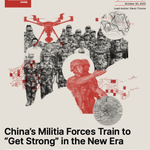
🚨 NEW RESEARCH — The ability of China’s militia forces to support the People’s Liberation Army (PLA) across all domains is likely improving. My latest explores war-oriented militia training reforms since 2018 1/x (link and key findings below)


Devin Thorne retweeted

This book by @ToshiYoshihara is going to be a masterpiece — and a masterclass on the Chinese Communist Party’s way of war. I cannot wait to see it in the hands of students @NavalWarCollege!

Why does the People’s Liberation Army continue to study campaigns fought more than 70 years ago? The victories that secured Communist triumph in the Chinese Civil War remain central to PLA doctrine, professional military education, and strategic thought.
In the forthcoming "Mao’s Finest Hour," Toshi Yoshihara examines the decisive campaigns of 1948–1949 (Liao-Shen, Huai-Hai, and Ping-Jin) and their enduring influence on how China’s military thinks about war.
Drawing on extensive Chinese-language military sources, doctrinal writings, campaign histories, memoirs, and Nationalist accounts, Dr. Yoshihara traces how these victories became foundational lessons within the PLA’s institutional memory and considers their relevance to military modernization, future warfare, and a potential Taiwan contingency.
Yet historical success can create blind spots as well as insights. The lessons the PLA draws from these campaigns may illuminate future conflict—or encourage dangerous analogies in a radically different strategic environment.
📚 Forthcoming from Cambria Press cambriapress.com/MaosFinestH…

Devin Thorne retweeted

The mood in China's AI industry is not great. A recent article by Bob Chen, a long-time contributor to Baiguan, has been privately circulated on the Chinese internet, even though it has been taken down by censors after it went viral.
Bob makes six points worth thinking about.
1. Chinese labs used to have a fallback when they couldn’t buy Nvidia chips. They could rent time on the same chips in Southeast Asia. Now that avenue is closing. Switching to Huawei brings up the next question. Can Chinese chipmakers get the equipment to make enough of them?
2. Distillation let Chinese labs learn from the answers of models that US labs had already spent billions training. As OpenAI and Anthropic make that harder, Chinese labs have to collect more of their own data and pay for more experiments, including the ones that go nowhere. Alibaba can fund that from other businesses. An independent lab has to go back to investors, who are already losing faith
3. A lot of money has gone into Chinese startups building specialized “robot brains.” What happens to those valuations if a general-purpose model learns to do the job? In one test, a system using GPT already beat several specialist models at grasping and moving objects. China could build excellent robots while much of the value goes to whoever supplies the intelligence.
4. Chinese AI is creating far less revenue, on a rapidly rising cost base. Epoch AI puts annualized AI revenue for six leading Chinese companies combined at about $11 bn. OpenAI and Anthropic together are at roughly $105 bn.
5. Even where China leads, it depends on American customers. Chinese firms supply roughly two-thirds of the world’s optical transceivers, the components that move data over fiber in AI clusters. Washington is reportedly considering restrictions on new Chinese models. This will be a stupid decision if true. There aren’t many buyers who can replace an order from Microsoft.
6. We’ve spent a lot of time debating whether Chinese models are three months or six months behind. Bob’s question is how much it will cost to close that gap next time. The bet on Chinese AI was that its labs could get close to the frontier on a fraction of the budget. What happens if they have to spend something close to US money while earning a tenth of the revenue?
Read the full article:
baiguan.news/p/chinas-ai-mod…

Devin Thorne retweeted
NEW: The PRC is conducting what it understands to be a “guerrilla” maritime strategy in the Pacific. It is “guerrilla” in PRC parlance because it blends overt military development with seemingly innocuous political and economic influence. The goal is to gradually create conditions to threaten key sea lines of communication and undermine US sea control ahead of a Taiwan contingency.
New from ISW and AEI’s Coalition Defense of Taiwan: Surveil, Project, Divide: China’s “Guerrilla” Framework to Reshape the Pacific, by Jackson Karas, Alison O’Neil, and Alexis Turek.

Devin Thorne retweeted

Glad to see this report released. Thanks go to my coauthors at RAND 🙏 rand.org/pubs/research_repor…

Devin Thorne retweeted

EXCLUSIVE @BreakingDefense: House China committee pushes Air Force on think tank cuts
breakingdefense.com/2026/11/…
“Under-resourcing” the China Aerospace Studies Institute (#CASI) “could risk undermining the ability of military leaders and civilian policymakers to understand” Beijing’s aerospace strategy and military prowess, according to a letter addressed to Air Force Secretary/@SecAFOfficial Troy Meink.
By @michaeldmarrow on November 04, 2026 11:28 am
WASHINGTON — Lawmakers on the House Select Committee on China/@ChinaSelect are pushing the Air Force/@usairforce for answers about a planned downsizing of its Beijing-focused think tank, warning that any reduction in the group’s output could impact America’s national security.
“Under-resourcing” the mission of the #China #Aerospace Studies Institute (@CASI_Research) “could risk undermining the ability of military leaders and civilian policymakers to understand” Beijing’s aerospace strategy and military prowess, according to a copy of the letter viewed exclusively by Breaking Defense.
Addressed to Air Force Secretary Troy Meink and signed by Republican Chairman John Moolenaar and Democratic Ranking Member Ro Khanna, the letter requests a briefing by Nov. 20 to provide “resourcing and personnel decisions” for CASI.
In their letter, House lawmakers say that “[a]ny potential loss” of CASI’s skills “is particularly worrisome” due to China’s burgeoning aerospace capabilities and “aggressive activities in the Indo-Pacific region.” Praising CASI’s work, the lawmakers say that alternatives to the institute’s “in-house expertise” would likely require the Air Force and other government entities “to expend considerable resources to purchase contracted expertise from external vendors.”
Given rapidly advancing air and space power by the Chinese People’s Liberation Army (PLA), the lawmakers say that diminishing relevant analysis is “particularly concerning” and could impact American deterrence, as fears mount over a potential battle for Taiwan.
“As the PLA continues to expand its aerospace capabilities, our need to understand these advancements will continue to grow,” the letter says. An Air Force spokesperson told Breaking Defense that the service “will respond directly to the committee.”
The letter comes after it was revealed in September that the Air Force planned to axe CASI’s 10-member civilian workforce. While the Air Force maintained its premier China-focused think tank would remain open and operate with military personnel, its director, Brendan Mulvaney/@B_Mulvaney, stressed in an interview with Breaking Defense that the elimination of its civilian staff would functionally shutter the institute.
Founded by Mulvaney roughly a decade ago, CASI regularly publishes on Beijing’s air and space forces, drawing on open-source information translated from Mandarin. The institute’s publications and training courses are seen as valuable resources for educating the broader military policy community on Chinese air and space power, prompting experts to denounce CASI’s expected downsizing.
“The idea that you could do research or the translations that we’re doing is not credible” without civilian experts, Mulvaney previously told Breaking Defense.
Mulvaney explained that the think tank’s civilian posts are being converted to an unfunded status, meaning that staffers will continue to work until being moved to a different role elsewhere in the Department of the Air Force — and once they leave, their positions cannot be backfilled. CASI’s current commitments stretch until around March and will largely function as usual until then, but after that the institute’s fate becomes more unclear, according to Mulvaney.
News of the CASI cuts raised questions about similar efforts run by the Army, Navy and Marine Corps, though spokespeople for each service previously told Breaking Defense that there are no planned changes for their respective Beijing-focused programs.

Devin Thorne retweeted
Vital warning by @PLMattis & @chrisnyeeee in @WarOnTheRocks!
“The #China #Aerospace Studies Institute @CASI_Research will linger in a kind of half-life and may yet recover. Hopefully, it will regain its budget and billets before its expertise scatters. 10 civilian billets are a rounding error in the Air Force @usairforce budget. Restoring them requires only that someone with the power of the purse decides the mission matters. We need more of these institutes, not fewer, and more institutional support to sustain #OpenSource analysis of America’s greatest rival. With one fewer, the role of places like the China Maritime Studies Institute @ChinaMaritime at the U.S. Naval War College @NavalWarCollege and publications like Jamestown’s @JamestownTweets China Brief @ChinaBriefJT become all the more important.”

Outside groups can't easily replace the China Aerospace Studies Institute’s work. The Air Force just cut the 10 civilians who did all of its research. warontherocks.com/2026/10/ch…

Devin Thorne retweeted

The PRC has set up several new institutions at military academies to train specialists in hi-tech and discipline inspection.
The College of Unmanned and Intelligent Engineering, the College of Combat Support NCOs & the College of Equipment Support NCOs were established within the PLA Army Engineering University on Wednesday.
The National Defense University, the PLA’s highest academy, formally inaugurated the College of Discipline Inspection, Law and Politics at its Xian campus in Shaanxi province.
Also on Wednesday, the PLA Joint Logistics Support Force Engineering University, which was launched last year, announced the addition of four colleges and one institute under its umbrella.
The PLA AEU, formed in 2017 during President Xi Jinping’s massive military reform, is tasked with training engineering and technical personnel as well as command officers for the PLA Ground Force.
The establishment of the College of Unmanned and Intelligent Engineering at the PLA Army Engineering University highlights the military’s growing emphasis on uncrewed systems and artificial intelligence.
Devin Thorne retweeted

UK: On 30 September 2026, MI5 issued a Security Service Espionage Alert stating that the primary purpose of the China General Technology Research Institute (CGTRI) 中国通用技术研究院 is to fund research that directly improves Chinese Ministry of State Security (MSS) technical capability for espionage. CGTRI funds academic research in China on topics including AI and cybersecurity. More than 100 UK-linked academics have contributed to research projects funded by MSS via CGTRI. In some cases, academics may not be aware that CGTRI is funding the Chinese research project they are contributing to.
mi5.gov.uk/mi5-issues-espion…

Devin Thorne retweeted

Proud to have been part of this important @ndupress project examining the Chinese PLA in a new era. Thanks to Phil Saunders and @jwuthnow for including me. My hope is these types of efforts continue, especially given the recent announcement that @CASI_Research will shut down. We need China military analysis now more than ever.
ndupress.ndu.edu/Media/News/…

Devin Thorne retweeted
Honored to support the @NavalWarCollege’s @ChinaMaritime Studies Institute (#CMSI) from the very beginning!
Two decades on, we are analyzing a very different array of PRC military maritime developments from when we started…
From CMSI Director CAPT @ChrisHSharman, @USNavy (Ret.):
#China #Military Maritime Watchers—
Twenty years ago, the Navy created a small institute at the Naval War College to focus on PRC military maritime issues. Its approach was distinctive: use China’s own scholarship and professional journals to better understand how the PLA thinks, plans, and operates in the military maritime domain.
Two decades later, that mission has never been more important.
Today, the China Maritime Studies Institute (CMSI) commemorates 20 years as an official Navy program and two decades of research, education, and engagement focused on China’s military maritime development.
CMSI traces its origins to a group of Naval War College faculty who recognized the need for a dedicated effort to better understand China’s growing military maritime power.
Established within the College in 2004 and formally launched as an official Navy program in 2006, CMSI became the Department of Defense’s first service-level Professional Military Education (PME) China center.
Over the past two decades, CMSI has sought to do something that remains central to our mission today: conduct rigorous research on China’s military maritime forces and provide penetrating insights that are relevant to the U.S. Navy, the @DeptofWar, and national security decision-makers.
We were honored to mark this milestone with a special lecture today at the Naval War College by former CNO Admiral Gary Roughead and former CMSI Director Dr. @peter_dutton, who shared their perspectives on CMSI and its development.
Twenty years is an important milestone, but the mission is even more pressing than ever.
We are proud of where CMSI has been and even more focused on where the next twenty years will take us.
>>> Click here to read my personal reflection on CMSI’s founding and subsequent evolution:
andrewerickson.com/2024/10/c…


Devin Thorne retweeted
PRC: "The Global Footprint of China's Defense Labs: Contacts and Collaborations with Foreign Institutions" airuniversity.af.edu/Portals…

Devin Thorne retweeted

1/ For anyone interested in a concise distillation of China's vision for the future of international political order and where they see history heading, I recommend this speech by Xi Jinping to the Shanghai Cooperation Organization this week (short 🧵):
english.scio.gov.cn/m/topnew…
Devin Thorne retweeted

Good @Reuters report highlighting two previously undisclosed Chinese and US-UK space operations.
"In June, a secretive unmanned Chinese spaceplane closely monitored by U.S. military analysts released a small satellite hundreds of miles above Earth, then looped around another Chinese satellite before returning towards the spaceplane. Chinese researchers linked to the military are developing technologies ranging from satellites designed to pursue and even capture other spacecraft to systems that could extend fuel supplies while doing so, according to a Reuters review of patent-related documents, procurement notices and academic papers. And in Sept last year, the U.S. and Britain conducted their first joint military operation in space in the path of a suspected Chinese spy satellite."
reuters.com/world/asia-pacif…

Devin Thorne retweeted

What drives China’s global strategy under Xi Jinping? Pei Minxin put five key questions to Steve Tsang and me. Read our interview in the China Leadership Monitor: prcleader.org/post/clm-insig…

Devin Thorne retweeted

🇨🇳 COSCO uses concealed equipment on board its ships to spy on military communications near the coastlines of target nations including the US.
COSCO has a decades-long intelligence-collection partnership with Beijing. The arrangement allows China to collect communication signals from vessels and aircraft operating across Europe, North America and Asia.
The advanced equipment aboard the ships is intended to enable China to gather information about military communications technologies and encryption developments.
The effort also allows Beijing to monitor key shipping lanes and maritime routes crucial for trade and military navigation.
COSCO ships are using "sophisticated signals intelligence collection" platforms, not routine communications hardware.
Beijing uses the information gleaned to bolster its position in territorial disputes and provide maritime reconnaissance and early-warning indications of foreign military targets.
A report published by the US Naval War College in April 2025 said it was likely that 🇨🇳 PLA was harnessing the country's fishing and commercial shipping fleets for intelligence and surveillance gathering.
The Pentagon put COSCO on its list of companies linked to China's military in Jan 2025, a designation that carries serious reputational costs for companies as well as US government procurement bans, but does not entail formal sanctions.
Chinese law requires the country's firms to support government intelligence work.
Nonetheless, COSCO remains one of the top global shipping companies calling at US ports and has several terminal service joint ventures for container ships at US ports.
The US government would likely have difficulty decisively addressing the security concerns given the degree to which COSCO is interwoven into US trade.
reuters.com/world/china/chin…

Devin Thorne retweeted
A record 244 PRC coast guard, scientific research and other ships were detected in waters around Taiwan last month, up from 55 in June and 30 in May, the Coast Guard Administration (CGA) said in an article published today by Radio France Internationale.
An average of almost eight PRC ships were detected per day last month, about 60 percent of which were coast guard ships, the article said.
The figures do not include PRC warships, which are deployed on a near-daily basis, the article added. taipeitimes.com/News/taiwan/…

Devin Thorne retweeted

A study concluded that even when fully mobilized, China’s industrial system would only be able to meet 60% of the military demand for drones in a conflict. “Under high-intensity demand shocks, the supply chain, although possessing certain mobilisation and recovery capabilities, still faces a significant supply-demand gap” scmp.com/news/china/science/…

Devin Thorne retweeted

Pleased to share that my books is now available for pre-order on @OUPAcademic website global.oup.com/academic/prod… and Amazon amazon.com/Simmering-Seas-Es…

Devin Thorne retweeted
#China’s #Navy in 2025: An Ocean of #OpenSource Documentation
bit.ly/PLAN_2025
Article Compilations by Ken Allen —
⚓ Overview File: China’s Navy in 2025
⚓ English-Language PRC Articles on China’s Navy in 2025
⚓ Chinese-Language PRC Articles on China’s Navy in 2025
[This summary was prepared with AI assistance & vetted by Ken Allen, who contributed key inputs. Unless otherwise specified, “Chinese” means “Chinese-language.”]
Longtime People’s Liberation Army (PLA) researcher Ken Allen has produced an extraordinary compilation of PRC sources detailing the PLA Navy (PLAN) & its activities in 2025. The information was compiled for a project sponsored by Exovera & the simplified data were published for January through July.[1]
Taken together, this corpus constitutes an unusually substantial, chronologically organized collection of official & quasi-official PRC open-source reporting on the PLA Navy during calendar year 2025. The set has 3 layers: a 209-page overview/index; a 277-page collection preserving the English-language articles themselves; and a 1,295-page collection preserving the Chinese-language articles, generally together with machine translations. The overview identifies the principal source streams as the English-language Ministry of National Defense (MND) & China Military Online sites & several Chinese-language PLA/MND channels. More importantly, it provides a chronological research map: 279 English-language items, followed by 377 Chinese-language items, for 656 indexed items in all. The English sequence ends with item 279 on 30 December, while the Chinese sequence begins with item 280 & ends with item 656. This makes the overview much more than a table of contents: its short descriptions, dates, source citations, hull numbers, exercise details, & notes on photographs & videos make it a searchable analytical index to the 2 much larger source collections.
What the corpus contains is strikingly broad. At the most visible operational level, it documents fleet training, carrier aviation, submarines, amphibious operations, replenishment & logistics, naval aviation, search and rescue, escort operations, overseas deployments, military diplomacy, hospital-ship missions, port visits, & multinational exercises. Even routine English-language reporting often supplies specific hull numbers, platform types, dates, locations, & activity descriptions—for example, the compilation records J-15 sorties lasting from 0800 to 2100 & identifies the Type 903A replenishment ship Kekexilihu by hull number, assignment, & previous Gulf of Aden & foreign-exercise experience. Other entries capture activities that are easy to overlook in more strategic reporting: emergency rescue, towing & salvage, medical evacuation, combat-support training, air-defense & antisubmarine drills, ammunition & damage-control activities, & Maritime Safety Administration exclusion notices. The English collection is particularly rich in visual evidence—photographs & links to short videos whose captions identify ships, aircraft, subordinate organizations, training evolutions, & occasionally otherwise obscure equipment. The overview systematically flags these materials rather than merely noting that an article existed; an example is its description of aviation, replenishment, & student-navigation material, including a 16-day, 3,000-nautical-mile training voyage with 24-hour watch rotations.
The Chinese-language collection is considerably more revealing at the organizational, institutional, & human level. Its articles routinely go beneath the platform-&-exercise layer to describe how units train, diagnose deficiencies, maintain equipment, educate personnel, restructure organizations, develop specialists, conduct political work, support families, & adapt training methods. One January example describes a destroyer formation integrating ships, shipborne helicopters, & shore-based antisubmarine patrol aircraft into a common antisubmarine training system & explicitly emphasizes “system support” & coordinated victory. Another describes the deliberately economical “one ship at sea, multiple ships strengthening capabilities” model, under which personnel from several ships train aboard one vessel & then link up with submarines & aircraft for air-defense, penetration, & joint-ASW training. Elsewhere, the collection describes integrated maintenance command centers using aircraft-status monitoring, resource management, data sharing, algorithms, & IoT devices to replace a maintenance model dependent on individual technicians’ experience. Still other articles expose persistent difficulties—skills bottlenecks, equipment failures that cannot initially be repaired at sea, gaps caused by personnel turnover, excessive reliance on scripted training, & problems integrating specialists—while explaining the unit-level solutions being attempted.
That contrast between the two language streams is one of the collection’s greatest analytical values. The English material is disproportionately useful for reconstructing what the PLAN wants foreign audiences to see: named platforms, deployments, bilateral & multilateral engagements, overseas presence, humanitarian activities, new equipment milestones, visually compelling training, and official statements about Chinese intentions. A representative English report identifies the warships Baotou and Gaoyouhu by name & hull number & specifies replenishment, anti-piracy, search-&-rescue, & air-defense subjects for AMAN-2025. By contrast, the Chinese material frequently tells researchers much more about how the force is attempting to generate combat effectiveness—through training pedagogy, command relationships, Party organization, personnel development, equipment support, troubleshooting, cross-specialty learning, implementing lessons learned, & recognizing shortcomings. For example, a submarine-training account describes the conscious breakdown of occupational barriers & cross-disciplinary training so that a radar operator could perform emergency damage-control work while the sonar operator remained on the tactical problem. This asymmetry itself is analytically significant: comparing Chinese- & English-language coverage can help distinguish external strategic messaging from internal professional discourse.
Taken longitudinally, the compilations reveal a PLAN that in 2025 was concerned not simply with acquiring more sophisticated hardware but also with making a larger, technologically more complicated fleet operationally coherent. Repeated themes include system-of-systems integration, jointness, realistic & adversarial training, transition from individual proficiency to crew & formation proficiency, cross-specialty competence, night & all-weather operations, logistics under combat conditions, autonomous maintenance & repair, & the identification of weaknesses through exercises. A late-year submarine-training account explicitly contrasts isolated skill proficiency with coordination across the entire boat & describes connecting formerly separate simulators so different specialties can train together against realistic offensive & defensive scenarios. Another Chinese article characterizes the underlying objective as moving professional training from mere “physical combination” toward “chemical integration,” with “jointness” & research as central concepts. Such material is particularly valuable because official propaganda normally emphasizes success, yet these articles often disclose the problem(s) that preceded the success story. Read critically, those acknowledged problems can be more informative than the asserted solution.
The collection also provides an unusually detailed contemporaneous record of major capability transitions during a consequential year for PLAN modernization. The aircraft carrier Fujian appears repeatedly across both language streams as it moved through testing, electromagnetic catapult operations, commissioning, & initial formation training. The English collection records the September announcement that the J-15T, J-35, & KJ-600 had completed their first electromagnetic catapult-assisted launches & arrested recoveries aboard Fujian. The Chinese collection subsequently documents Fujian’s 5 November commissioning & spells out the claimed operational significance of catapult launch for aircraft payload, fixed-wing airborne early warning, command & control, & a more diverse air wing. The overview then captures its first post-commissioning live-force training, including formation navigation, ship-air search and rescue, & launches & recoveries by J-35, J-15T, J-15DT, & KJ-600 aircraft. The virtue of the compilation is therefore not simply that it contains individual Fujian-related stories; it allows researchers to reconstruct the sequence & maturation of a capability across an entire year.
For researchers, the strongest way to exploit the set would be to treat the Overview as the discovery layer & the two article compilations as the evidentiary layer. Start by searching the overview for a platform, unit, fleet, exercise, mission type, geographic area, or operational concept—Fujian, Type 055, submarine, antisubmarine, replenishment, “system,” Gulf of Aden, South China Sea, amphibious, maintenance, political rectification, & so forth. Build a chronology from its numbered entries, then move to the corresponding full articles. For consequential propositions, researchers should return to the original Chinese text, using the included Google translation for discovery & triage rather than as an authoritative translation; the Chinese compilation explicitly places machine-translated English beneath the source text, as visible from its opening article. Technical vocabulary—especially terms such as zhidui, system-of-systems concepts, combat-readiness terminology, Party organizational terminology, & expressions concerning training & operational art—should be translated directly from the Chinese before publication.
A second, more powerful use would be to turn the corpus into a structured longitudinal dataset. Each of the 656 overview records could be coded for date, source, language, theater command, named unit, ship or aircraft type, hull number, geographic location, mission category, training subject, joint/foreign participant, readiness issue, personnel issue, logistics or maintenance issue, & whether the item includes imagery or video. Researchers could then identify patterns that disappear when articles are read individually: which fleets discuss particular training problems most frequently; whether certain readiness concepts rise or fall during the year; which ships can be associated with particular flotillas; how often overseas deployments are coupled with training; or how the publicity surrounding a new platform changes as it progresses from trials to operational employment. The corpus is especially well suited to entity resolution & order-of-battle research because apparently mundane captions repeatedly provide combinations of hull number, ship name, subordinate formation, theater command, date, & location. It could likewise support careful studies of training evolution, maintenance systems, personnel policy, political work, & combat-support architecture—subjects for which PRC reporting is often far richer than conventional Western reporting.
It is important to know not only what the articles say about the PLAN but also what they do not say. Specifically, there is not a single reference to any of the PLA’s 15 grades. The only reference to officer ranks is to various Naval spokespersons, and2 the focus is on units at the Theater Command Navy level, not at PLAN Headquarters level.d not occur, & claims of extraordinary performance require independent corroboration. At the same time, propaganda content should not be dismissed as analytically worthless. Recurring emphases, admitted shortcomings, changes in terminology, details embedded in captions, named organizations, equipment associations, training scenarios, & discrepancies between Chinese- and English-language presentation can all yield high-confidence findings when triangulated. The corpus’s distinctive value is precisely this combination of breadth, chronology, preservation of original Chinese text, parallel English publicity, detailed indexing, visual material, & thousands of granular observations about the PLAN at work. Used comparatively & longitudinally rather than as a stack of isolated articles, it is a genuinely unusual research resource for reconstructing both what China’s Navy was doing in 2025 & how the institution itself described the problems, processes, & priorities involved in becoming a more capable fighting force.
It is important to know not only what the articles say about the PLAN but also what they do not say. Specifically, there is not a single reference to any of the PLA’s 15 grades. The only reference to officer ranks is to various Naval spokespersons, & the focus is on units at the Theater Command Navy level, not at PLAN Headquarters level. There is also no information about the two-cycle conscription process, which clearly impacts the annual training cycle.
andrewerickson.com/2026/08/c…
[1] PLA Service Monthly Report
PLA Service and Theater Command Articles Published in January 2025, exovera.com/news-releases/pl….
PLA Service and Theater Command Articles Published in February 2025, exovera.com/reports/pla-serv….
PLA Service Articles Published in March 2025, exovera.com/reports/pla-serv…
PLA Service Articles Published in April 2025, exovera.com/reports/pla-serv…
PLA Service Articles Published in May 2025, exovera.com/reports/pla-serv…
PLA Service Articles Published in June 2025, exovera.com/reports/pla-serv…
PLA Service Articles Published in July 2025, exovera.com/reports/pla-serv…


Devin Thorne retweeted

Good new report on 'Spamouflage' anad how it increasingly goes after reporters and journalists who cover unflatterings stories about China around the world: graphika.com/reports/ore-els…
