

Chair of Urology, Imperial College London. ex-Chair, UK Prostate Cancer Research Strategy Group. Opinions my own. https://nitter.cf/t.co/39ogouXPu1 RT✖️E
London, England
Joined May 2016
- Tweets7K
- Following130
- Followers4.5K
- Likes38.9K





Pinned Tweet
✅ Focal therapy for prostate cancer is effective over the long term
🏆A win for all those eligible patients who want a treatment for their significant prostate cancer with fewer side effects
🇬🇧 Amazing ‘Team UK’ endeavour for the last two decades to get us to this point!

🚨 NEW IN @EUplatinum! 🚨
The largest analysis of focal therapy by Imperial Prostate and UK colleagues, reporting 1⃣0⃣-year outcomes after focal HIFU and cryotherapy in 3⃣4⃣7⃣7⃣ men 🔥🧊
Led by @AJWLight @LondonProstate1 @TaimurShah
Read for free: europeanurology.com/article/…

Nice study
We have used for a few years in @IP_London
Every little element with LA transperineal biopsy helps

The BURN trial 🔥
@alexzhuDO shows buffered local reduces pain during prostate biopsy
@auawest #WSAUA26
Should we all be using buffered local for our pts?
👏

Hashim U. Ahmed retweeted

PROTEUS substudy results at #ESMO26
Perioperative apalutamide + ADT vs surgery alone in high-risk localized #ProstateCancer
EFS HR 0.38
MFS HR 0.49
Subsequent treatment at 3 years: 35% vs 68%
Compelling evidence for perioperative intensification @OncoAlert

Hashim U. Ahmed retweeted

Among the big news from #ESMO2026: PROTEUS companion RCT (not a substudy ¯\_(ツ)_/¯ ) comparing neoadj apa/ADT to RP alone. Impressive early results, should put to rest at least some of the objections to PROTEUS main paper.

Hashim U. Ahmed retweeted

PROTEUS Substudy: Periop Apa + ADT with RP+PLND vs RP+PLND in HR PCa @urotoday #ESMO26
Periop APA + ADT (+ RP+PLND; n= 102) vs RP+PLND alone (n=306)
🚨EFS: HR 0.38, 95% CI 0.26–0.55
🚨MFS: HR 0.49, 95% CI 0.26–0.90
🚨TT 1st Sub Rx: HR 0.29, 95% CI 0.20–0.43
🚨All Gr Hot Flush: 64% vs 0.7%


What a lovely gesture from the organisers of the Panhellenic Urology Association on attending as a guest speaker for the 27th Panhellenic Urological Congress.
Speaking on focal therapy for prostate cancer.
@HellenicUrology

Hashim U. Ahmed retweeted

The TRANSFORM trial is the biggest ever trial into prostate cancer screening and hopefully there may be some output that the National Screening Committee acts on.
My webinar with @LondonProstate1 on it for @TackleProstate youtu.be/DmYRLsXgvVo?is=iO4z…

Hashim U. Ahmed retweeted

Conclusion of the 5th Blackpool FRCS Urol Course Thanks very much to the faculty members and delegates
best wishes to the candidates
@BlackpoolHosp
@LondonProstate1
@AnandUro
@Mehwash_Nadeem
@a_rauf82
@BAUSurology
@IBUSurology
@mzaslam77
@ijeoma_chibuzo


Hashim U. Ahmed retweeted

2026 Nobel Peace Prize laureate Navi Pillay’s commitment to universal legal principles and her firm moral compass are constants in a long career. Born into a family of Indian Tamil origin under apartheid in Durban, South Africa, Pillay became a lawyer and legal pioneer, confronting deep structural discrimination, segregation and exclusion. A common thread runs from her early work defending Nelson Mandela and others who stood up against apartheid to her service as a judge in some of the key international court cases of our time.
This year’s laureate has significantly enlarged the scope and impact of international law. She has served as a judge on the High Court in South Africa, the International Criminal Tribunal for Rwanda and the International Criminal Court. She was the United Nations High Commissioner for Human Rights and, until recently, she chaired the UN Independent International Commission of Inquiry on the Occupied Palestinian Territory. Today Navi Pillay is a judge on the International Court of Justice in the case where Myanmar stands accused of genocide.
In historic international court cases, she has shown that legal measures can help prevent acts of war and violence. Navi Pillay has also contributed to strengthen the institutions of international law. Her independence, expertise and steadfastness have made her one of the most respected international jurists of our time.
Learn more about the 2026 #NobelPeacePrize: bit.ly/4xjOJ03
#NobelPeacePrize #NobelPrize

Hashim U. Ahmed retweeted

Lithuania looked at PSAs in a pioneering national program and found prostate cancers in record numbers: Now it wants to screen smarter.
Facing a boom in PCa overdiagnosis and overtreatment, what Lithuania is doing about it via @journotwit
howardwolinsky.substack.com/… @VincentGnanapr3 @LondonProstate1

Hashim U. Ahmed retweeted
Blackpool FRCS Urol
Revision course
@LondonProstate1
excellent talk by Professor Hashim Ahmed
@Mehwash_Nadeem
@AnandUro
@BlackpoolHosp
@BAUSurology
@IBUSurology
@mzaslam77
@Khalifa_Urol


Hashim U. Ahmed retweeted

Thank you for your YouTube presentation @NicholasZaorsky .
However, your talk provides incomplete information about the PACE-A study, both regarding efficacy and toxicity of SBRT vs RP.
To help readers get more clarify information.
PACE-A was originally designed as a non-inferiority trial to demonstrate oncological efficacy, the BCF, of SBRT vs RP.
But, in fact, PACE-A changed its primary endpoint from BCF to patient report functional outcome and not follow the non-inferiority design anymore.
So, the new primary endpoint is a co-primary PRO: number of pads >= 1 per day (one of these questions about urinary function in EPIC-26) and bowel EPIC score.
The reason stated in the protocol was that accrual was too slow, making it no longer feasible to demonstrate non-inferiority in disease control.
However, even after changing the primary outcome and reducing the sample size for the PRO, the new sample size target was still not met. (Enroll: 123 , target: 234)
The oncology efficacy, BCF endpoint is now a secondary outcome; although median follow-up was 8 years, it must be emphasized that the sample size is rather small and the number of events is low (13 events).
Therefore, the fact that BCF did not reach statistical significance in this study cannot be used to conclude that SBRT and RP are "basically, it's the same," as you claimed in your video.
@nickva1 , @alison_tree


Surgery vs Radiation for Prostate Cancer: New PACE-A Trial Results
I discuss the randomized trial presented at #ASTRO26 @ASTRO_org
Kudos @nickva1 @alison_tree et al
youtu.be/N9zDC7sInwM

Hashim U. Ahmed retweeted
Thank you for your YouTube presentation @NicholasZaorsky .
However, your talk provides incomplete information about the PACE-A study, both regarding efficacy and toxicity of SBRT vs RP.
To help readers get more clarify information.
PACE-A was originally designed as a non-inferiority trial to demonstrate oncological efficacy, the BCF, of SBRT vs RP.
But, in fact, PACE-A changed its primary endpoint from BCF to patient report functional outcome and not follow the non-inferiority design anymore.
So, the new primary endpoint is a co-primary PRO: number of pads >= 1 per day (one of these questions about urinary function in EPIC-26) and bowel EPIC score.
The reason stated in the protocol was that accrual was too slow, making it no longer feasible to demonstrate non-inferiority in disease control.
However, even after changing the primary outcome and reducing the sample size for the PRO, the new sample size target was still not met. (Enroll: 123 , target: 234)
The oncology efficacy, BCF endpoint is now a secondary outcome; although median follow-up was 8 years, it must be emphasized that the sample size is rather small and the number of events is low (13 events).
Therefore, the fact that BCF did not reach statistical significance in this study cannot be used to conclude that SBRT and RP are "basically, it's the same," as you claimed in your video.
@nickva1 , @alison_tree

Hashim U. Ahmed retweeted

The #RADAR Study is now open!🚨
High risk men aged 40-49 will have a #Prostagram scan, a Stockholm3 test, and a PSA test to find the best way to screen for #ProstateCancer. Check if you can sign up here: imperial.eu.qualtrics.com/jf…
@NIHRresearch @ImperialSandC @ImperialNHS

Hashim U. Ahmed retweeted

Absolutely delighted to launch the #RADAR study at @ImperialNHS to #screen younger, but higher risk men for #ProstateCancer. All men get 3 advanced tests on the same day - express your interest here: imperial.eu.qualtrics.com/jf…
@LondonProstate1 @IP_London @NIHRresearch

Hashim U. Ahmed retweeted
If you want to use your PACE-A study to counsel patients, then you must state clearly and honestly that this is a study with a small sample size that failed to meet its accrual target, even after you were changing the primary endpoint at mid-study from an oncological assessment (biochemical recurrence) to a patient-reported functional outcome, which is prone to bias from self-reporting.
In addition to failing to meet the sample size target, the questionnaire response rate was low and the amount of missing information reached ~ 50% in each arm.
Therefore, any estimates drawn from it are entirely uncertain.
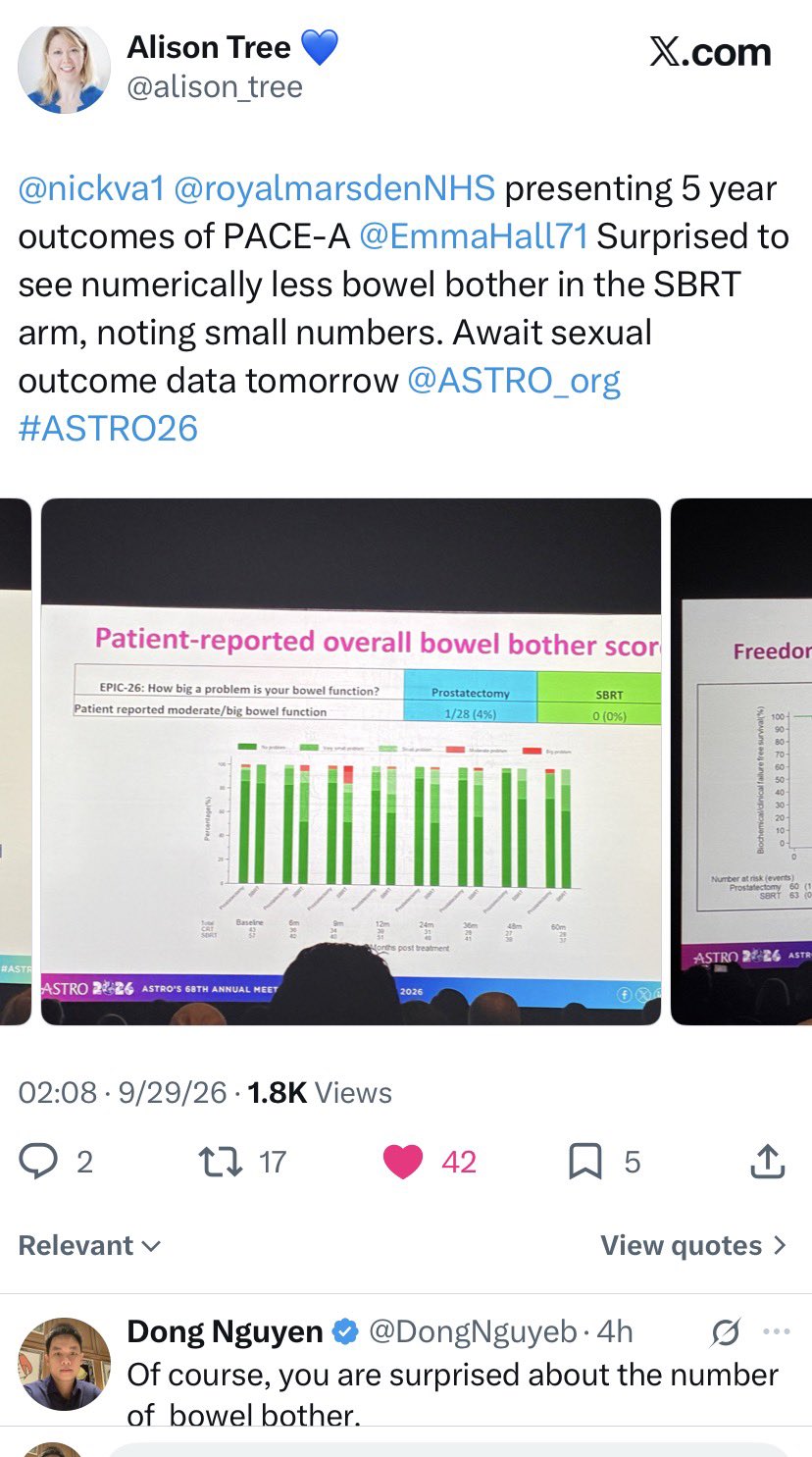
Furthermore, we object to your use of the conference #ASTRO to disseminate misleading information: replacing the co- primary endpoint of bowel function assessment by EPIC-26 bowel domain score which was unfavorable to SBRT to patient-reported moderate/big bowel function, thereby making the results appear nearly balanced between RP vs SBRT.



Hashim U. Ahmed retweeted

Not ALL rad oncs are uncivil or close minded just like not all urologists are civil and open to new ideas. That being said, the most strident and frankly hostile takes on focal seem to be coming more from rad oncs. Just an observation
Hashim U. Ahmed retweeted
Some Urologists have questioned the rate of pad use >1 after surgery, which is notably high at the 2–5 year mark (48–50%).
There may be differences between surgeons and between centers. But in essence, this is a patient-reported number, not an objective measurement.
That is why @nickva1 explains that many men after surgery are largely dry, yet still wear pads to feel safe.
That also explain why a large difference in using urinary pad does not translate into a meaningful difference in patients’s overall urinary bother between RP vs SBRT.


Hashim U. Ahmed retweeted
Regarding urinary function in EPIC-26:
5-year results: 14/29 (48%) in the RP arm vs. 3/36 (8%) in the SBRT arm.
But don't let the number fool you into overlooking the nature of how they reported it.
The authors chose a single question about the number of pads needed per day to give impression .
Other urinary questions in EPIC-26 were reported, but only as secondary endpoints.
If the results were reported in full, the picture would be different:
RP is worse for urinary incontinence, while SBRT is worse for obstructive symptoms.
But overall, the degree of urinary bother between the two arms shows no statistically significant difference.


Hashim U. Ahmed retweeted
I agree to @JackAndrewsMD
To see the full picture of the issue, we must understand how Pace A selected its primary outcome also selected results to represent at some conference.
After all, what he, @nickva1, report is only what he wants you to see.
To determine whether they are biased, we must understand their design.
Initially, the primary endpoint of PACE -A was biochemical failure.
But it was later modified because patient recruitment was too slow.
Note that the new primary endpoint was changed after the study had already been conducted, that is co-primary endpoint;
1. Pads needed per day to control urinary leakage, that’a a single question about pads.
2. Bowel: the total score of the bowel domain.
Notice the asymmetry in measurement: the urinary endpoint uses a single question, while the bowel endpoint uses a multi-question domain score.
Pace A results at 2 year.
• Pads (urinary): favors SBRT.
• Bowel domain score: favors surgery.
And in ASTRO 26, Please note that when presenting at the ASTRO conference, he swapped the criteria for evaluating bowel function to “"How big a problem is your bowel function?" That’s favor to SBRT.


Hashim U. Ahmed retweeted

Thank you @angiodynamics for providing an educational grant to support the @therapy_focal Travel Scholars to help train the next generation of clinicians that will study and move the field of #focaltherapy forward!
@Alex_Battin4 @sina_monfared @AbhinavSidana
