

The NAIP is a multidisciplinary research group working at Mayo Clinic Rochester. Tweets ≠ our employer's view/endorsement.
Joined May 2021
- Tweets173
- Following158
- Followers434
- Likes219





Neurology Artificial Intelligence Program retweeted


@DavidJonesBrain of @MayoClinicNeuro is discussing imaging approaches to distinguish forms of dementia at the morning session of the 2023 Holloway Summit.

Neurology Artificial Intelligence Program retweeted

Mayo Clinic embarks on a $5 billion project to revolutionize its flagship medical campus in #RochMN. Five new buildings will fuse traditional medical services with AI and digital tools, creating a 21st-century vision of clinical care. bit.ly/3uE2Wuk @statnews

Neurology Artificial Intelligence Program retweeted

Yes, I do.
LLMs produce their answers with a fixed amount of computation per token.
There is no way for them to devote more (potentially unlimited) time and effort to solving difficult problems. This is very much akin to the human fast and subconscious "System 1" decision process.
True reasoning and planning would allow the system to search for a solution, using a potentially unlimited unlimited time for it. This iterative inference process is more akin to the human deliberate and conscious "System 2".
This is what allows humans and many animals to find new solutions to new problems in new situations.
Some AI systems have planning abilities, namely those that play games or control robots. Game playing AI systems such as AlphaGo, AlphaZero, Libratus (poker), and Cicero (Diplomacy) have planning abilities. These systems are still fairly limited in their planning abilities, compared to animals and humans.
To have more general planning abilities, an AI system would need to possess a *world model*, i.e. a subsystem that can predict the consequences of an action sequence: given the state of the world at time t, and an imagined action I could take, what would be the set of plausible states of the world at time t+1.
With a world model, a system can plan a sequence of action so as to fulfill an objective.
How to build and train such world models is still a largely unsolved problem.
Even more complex is how to decompose a complex objective into a sequence of sub-objectives. This would enable hierarchical planning, something that humans and many animals can do effortlessly but is still completely out of reach of AI systems.
Neurology Artificial Intelligence Program retweeted

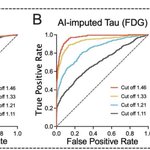
Tau PET is an attractive biomarker for Alzheimer’s disease but is not readily accessible to patients. Lee et al. present an AI model that can impute tau PET images from more widely available cross-modality imaging inputs. tinyurl.com/mr38rbmc

Neurology Artificial Intelligence Program retweeted
We specifically address the anthropocentric definition of intelligence @NaipMayo and use a more general definition found here: pubmed.ncbi.nlm.nih.gov/3513…

Neurology Artificial Intelligence Program retweeted

Intersection of Cerebrovascular and Alzheimer’s Disease
by
Jonathan Graff-Radford, MD
Professor of Neurology
Mayo Clinic @MayoClinic
Memory and Aging Center Grand Rounds
Friday, Oct 6, 2023, 9 to 10am PT
register 👉 bit.ly/46xnBhc

ALT Jonathan Graff-Radford, MD
Neurology Artificial Intelligence Program retweeted

NEW WORK!
Magnetic Susceptibility in Progressive Supranuclear Palsy Variants, Parkinson's Disease, and Corticobasal Syndrome - Satoh - Movement Disorders - Wiley Online Library movementdisorders.onlinelibr…

Neurology Artificial Intelligence Program retweeted
It is a truly amazing place for Complex Neurology and Neurosurgery! @NaipMayo hopes to digitize the expert knowledge that helps make this possible and make it widely available.

Mayo Clinic in Rochester, MN has been ranked #1 in the World's Best Specialized Hospital 2024 rankings in both Neurology and Neurosurgery! bit.ly/45dNnpT

Neurology Artificial Intelligence Program retweeted
This is the type of thing that you find yourself working on when your goal is getting things into clinical practice that you wouldn’t focus on as much for grants and research papers (@NaipMayo starts at about 11 min mark): m.youtube.com/watch?v=Zrl4da…

Neurology Artificial Intelligence Program retweeted
We have job openings :)

We're looking for a google cloud engineer to work with our interdisciplinary team at @MayoClinic. We're already well on our way to deploying an ecosystem that will virtualize the Neurological exam and give providers tools to view and explore AI analyses. tinyurl.com/ypn2py97
Our development chief will be presenting at Google NEXT! He will be speaking along with Dhananjay Dalave next week about how Mayo and Google have been successfully collaborating to create a platform for the Neurology AI Program at Mayo Clinic.
cloud.withgoogle.com/next/se…
Neurology Artificial Intelligence Program retweeted
We @NaipMayo agree. It’s definitely going to happen! I use gait information interpreted with my brain right now for clinical practice, no reason why algorithms can’t do it as well. This is true for the entire neurological exam that remains key to medical decision making.
We're looking for a google cloud engineer to work with our interdisciplinary team at @MayoClinic. We're already well on our way to deploying an ecosystem that will virtualize the Neurological exam and give providers tools to view and explore AI analyses. tinyurl.com/ypn2py97
Neurology Artificial Intelligence Program retweeted

Happy to share two new papers! Looking at diffusivity changes and altered functional connectivity in atypical Alzheimer's disease variants.
@NRGMayo
Diffusivity changes:
content.iospress.com/article…
Altered functional connectivity:
academic.oup.com/braincomms/…

Neurology Artificial Intelligence Program retweeted
We are taking @yudapearl approach @NaipMayo in bringing AI to the practice of neurology. We know a lot about our patients and we build interpretable frameworks that reflect this understanding. It allows for a framework for medical reasoning that can be applied to individuals.

There are two paths to "understanding reality". (1) LLM: Take everything written about reality and write a program that answers questions about it. (2) CI: Take a tiny chunk of reality that you understand well, and ask: What would it take for a machine to reach YOUR level of understanding. I call (2) "Understanding understanding", and I doubt whether (1) can succeed without (2). The main challenge of "understanding reality" is to take what we know about (2), which is quite a lot, and harness it to guide (1). @elonmusk, @xAI,@GaryMarcus,@lexfridman,
Neurology Artificial Intelligence Program retweeted
Representative datasets for knowledge of interest is more important than data size, architecture, or task. If you don’t have the knowledge of interest it will be hard to know if the dataset is representative. This should underscore the importance of domain expertise. @NaipMayo

1/ Excited to share a new NeuroAI preprint: “What can 1.8 billion regressions tell us about the pressures shaping high-level visual representation in brains and machines?” Led by Colin Conwell, with @_jacobprince_, @cvnlab, and @grez72. biorxiv.org/content/10.1101/…

Neurology Artificial Intelligence Program retweeted
We must understand the nature of intelligence to understand dementia. #endalz Understanding the nature of intelligence is facilitated by building intelligent systems. #AI Building intelligent systems is facilitated by understanding dementia. @NaipMayo @MayoClinicNeuro
Neurology Artificial Intelligence Program retweeted
This fits with one of our @NaipMayo maxims “use your eyeballs”! In this context show every datapoint in the plot not just central tendency measures and confidence in those measures. Get as close to the data as reasonably possible in visualizations summarizing the data!

We are visualizing our data all wrong.
Typically, academic graphs show statistical confidence intervals or standard errors. This paper shows that everyone from doctors to tenured faculty misread these graphs, assuming effects are larger. Show variability! jakehofman.com/pdfs/illusion…


Neurology Artificial Intelligence Program retweeted
That’s why @NaipMayo uses this definition “an agent’s collection, processing, and modeling of information about an environment to perform beneficial actions in that, or related, environments”