

Your unfair advantage in love & life. Master Psyche Dating, destroy dead bedrooms, dominate divorce, stack jobs, accelerate your career & future proof your life
Tokyo | SV | Kyoto | Dubai
Joined December 2008
- Tweets34.8K
- Following987
- Followers2K
- Likes16.3K








PsycheOS | Psyche Suite 🧠🧬 retweeted

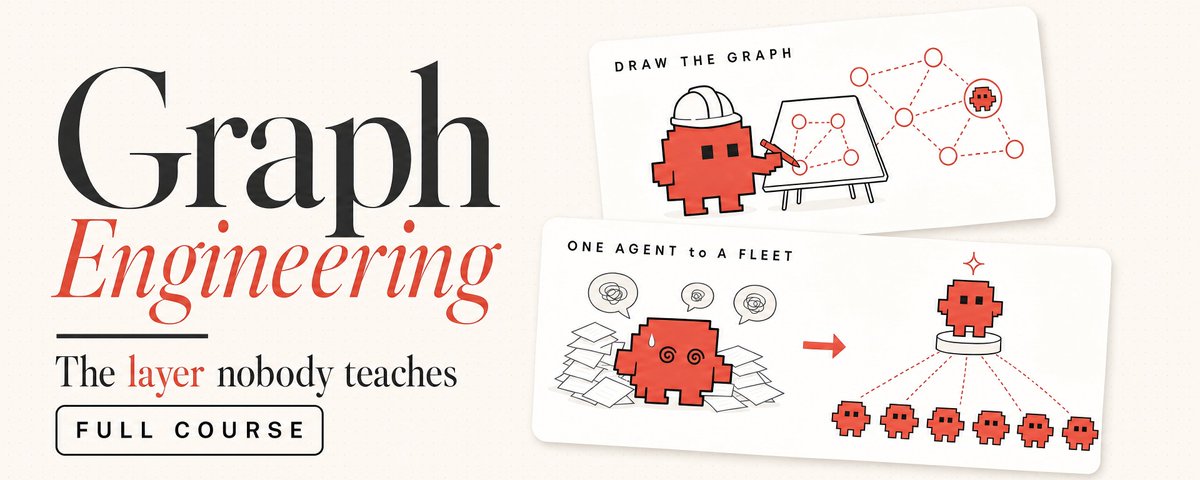
a new kind of engineer is showing up. they don't write prompts, they design how the AI works. it's called graph engineering, and the people who get it now are about to make everyone else look slow
PsycheOS | Psyche Suite 🧠🧬 retweeted

NVIDIA QUIETLY DROPPED A $249 BOX THAT REPLACES YOUR $200/MONTH OPENAI SUBSCRIPTION WITH $2 IN ELECTRICITY
it's called the jetson orin nano super. smaller than a wallet, runs at 25 watts, does 70 trillion ai operations per second. runs llama 3, mistral, gemma and deepseek locally with no api fees and no data leaving your house
a developer running automations and coding assistants pays $200 a month to openai. the same workload on this box costs $2 a month in electricity and breaks even in 10 weeks
install ollama with one command. change one line in your code. point it at localhost instead of openai. everything else works identically
7 billion parameter models handle 80% of what people use chatgpt for. summarization, drafting, coding, document q&a, automation pipelines. total monthly cost drops from $200 to $22
cloud subscriptions keep getting more expensive and rate limits keep getting tighter. the people who set this up in 2025 are going to look very smart in 2027
bookmark this and read the article below


Readers added context they thought people might want to know
Jetson Orin Nano Super ($249) can run quantized 7B models locally but its 8GB memory limits capabilities for complex coding compared to OpenAI cloud models. Designed for edge AI and robotics, not full replacement for $200/mo subscriptions. nvidia.com/en-us/autonomo… jetsonhacks.com/2024/12/17/jet… jeremymorgan.com/blog/tech/nvid…
PsycheOS | Psyche Suite 🧠🧬 retweeted

🚨BREAKING: HKUST just gave AI agents permanent memory that improves over time.
No retraining required. Lessons from one model transfer to another.
Up to 11 points better on the hardest benchmarks.
> Every AI agent you use today starts each task completely blind. No memory of what worked last time. No memory of what failed. Every mistake gets repeated forever.
> HKUST built XSKILL a dual memory system that accumulates two types of knowledge after every task: skills (what workflows to follow) and experiences (what specific mistakes to avoid).
> The model itself never changes. The memory just gets smarter.
> The part nobody expected: knowledge learned by Gemini transfers directly to GPT and o4 mini. No additional training. One model's lessons become another model's head start.
→ Up to 11.13 point improvement over the strongest baseline on hard benchmarks
→ Syntax errors cut nearly in half: from 20.3% to 11.4% after skills added
→ Cross-model transfer works: Gemini's knowledge improves GPT-5-mini and o4-mini
→ Zero parameter updates required at any point
→ Knowledge compounds: more tasks = smarter memory = better performance
The fix is simple in principle. Skills stop the agent from wasting steps on errors it already made. Experiences tell it exactly which tool to pick in which situation. Together they turn a stateless agent into one that actually learns from its past.
Every AI agent deployed today is leaving this on the table.

PsycheOS | Psyche Suite 🧠🧬 retweeted

The entire RAG industry is about to get cooked.
Researchers have built a new RAG approach that:
- does not need a vector DB.
- does not embed data.
- involves no chunking.
- performs no similarity search.
It's called PageIndex. Instead of chunking your docs and stuffing them into pinecone, it builds a tree index and lets the LLM reason through it like a human reading a book.
hit 98.7% on financebench. beats every vector RAG on the leaderboard.
no embeddings. no chunking. no vector DB.
100% open source.

PsycheOS | Psyche Suite 🧠🧬 retweeted
Tencent has killed fine-tuning and RL with a $18 budget.
Right now, if you want an AI agent to become an expert at a specific, complex real-world task, you have to use Reinforcement Learning.
You let it try, fail, and update its internal parameters over and over again.
This is the exact optimization technique (GRPO) that DeepSeek used to build their massive reasoning models.
But there is a massive problem.
Updating model weights is insanely expensive. It requires massive GPU clusters. And worst of all, when you train a model to be highly specialized at one thing, it often "overfits" and forgets how to be good at everything else.
Tencent killed this bottleneck forever.. by building Training-Free GRPO.
Instead of spending thousands of dollars to permanently alter the AI's brain, they asked a simple question: What if we just distill the experience of learning, and inject it as a memory?
Here is how it works.
They run the AI through the exact same trial-and-error process. But instead of updating the weights, they extract the "semantic advantage"—the actual logic of why one answer was better than another.
They compress this winning logic into a "token prior”, a tiny package of high-quality experiential knowledge.
Then, they just attach that knowledge directly into the API call.
The results are staggering.
Tested on DeepSeek-V3, this method required only a few dozen training samples to turn the AI into a specialized expert in complex math and web searching.
It didn't just compete with models that were actually fine-tuned. It outperformed them.
Zero parameter updates. Zero expensive training runs. Zero base-model amnesia.

PsycheOS | Psyche Suite 🧠🧬 retweeted

Heavy Technical Debt powered by Big Block Brute Force AI.
vs
Fully optimized Clean Sheet Paper process design.
In fact, Clean Sheet Paper processes powered by Microsoft Excel even beat Broken Processes powered by AI.
PsycheOS | Psyche Suite 🧠🧬 retweeted
Startup / New Venture reality:
It's a process of falsification and elimination which takes time but market timing is always pulling the strings.
But the most you can do is push on the strings.
So you need to move as fast as you can (to falsify and eliminate) BUT be resilient enough to hang on if the market isn't ready yet -- and the market, especially nascent markets are almost never ready when you or your product is.
PsycheOS | Psyche Suite 🧠🧬 retweeted

The romanticization of being a startup founder is kind of insane to me:
– You’re statistically unlikely to succeed
– You’ll have no life and be totally consumed
- Incredible lows
– You’re locking yourself in for 10+ years
This is insanely hard and NOT for everyone.
PsycheOS | Psyche Suite 🧠🧬 retweeted

Psychology solved the AI memory problem decades ago.
We just haven't been reading the right papers.
Current AI architectures are failing because they treat memory like a hard drive.
Vector databases (RAG) are just flat embedding spaces. Conversation summaries compress a life into a bio. Episodic buffers give agents a 30-second memory span.
Past 10k documents, semantic search is basically a coin flip.
But in 2005, a landmark psychology paper mapped exactly how human memory actually scales.
It’s called the Self-Memory System.
Humans don't store memories like database rows. We construct them.
Our brains organize memory hierarchically: Lifetime periods. General events. Episodic details.
When you remember something, your brain doesn't perform a vector similarity search across billions of flat tokens.
It filters the past through the "Working Self", a dynamic system that retrieves only what is directly relevant to your current active goals.
This changes everything for how we build AI agents.
Right now, we are force-feeding models massive context windows and hoping they figure it out.
We are trying to solve a cognitive problem with a database engineering solution.
If we want AI that can actually reason across a lifetime of data, we have to stop building better hard drives.
We have to build an artificial Working Self.
An AI shouldn't retrieve the most "semantically similar" document. It should retrieve the memory that is most relevant to its current objective.
The blueprint for agentic memory has been sitting in psychology journals for 20 years.
We just have to stop thinking like software engineers.
And start thinking like psychologists.

PsycheOS | Psyche Suite 🧠🧬 retweeted

Lean what our Universe actually is: A computation (a.k.a. simulation) on a holographic screen. Here's exactly how it works, and the math to prove it.
learn.floatingpragma.io?v10
PsycheOS | Psyche Suite 🧠🧬 retweeted

Dell’s 11K cut went viral two weeks ago.
Since then:
Oracle: 30,000
HSBC: 20,000
Meta: 16,000
Nokia: 14,000
We’re already tracking 100+ more companies expected to cut in the next 3 months.
Here’s the full Q1 2026 recap. Buckle up for Q2.




PsycheOS | Psyche Suite 🧠🧬 retweeted

Context graphs will be to the 2030s what databases were to the 2000s.
Within a year, every frontier lab will be building one and here's why:
At 10 people, coordination is free. Everyone knows what everyone else is doing. You never hold a meeting to "align."
At 100 people, you spend maybe 20% of your payroll on coordination. Managers, syncs, standups, planning sessions, status reports.
At 10,000 people, that number approaches 60%. The majority of your headcount exists not to produce anything but to make sure the people who produce things are producing the right things in the right order.
This is the dirty secret of large organizations: output scales linearly with headcount, but coordination cost scales exponentially. Every person you add creates new information pathways that must be maintained. The hierarchy is the protocol that manages this, and it's brutally expensive.
Hierarchy is a compression algorithm for organizational knowledge. At every layer, a manager compresses the reality of their team into a summary that fits in a 30-minute meeting with their boss. Their boss compresses eight of those summaries into one for their boss. By the time information reaches the CEO, it's been lossy-compressed through five or six layers of human interpretation.
This is why CEOs make bad decisions. The information they receive has been compressed, filtered, and distorted at every layer. The hierarchy is high-latency, low-bandwidth, and lossy.
Jack didn't fire 4,000 producers but cut 4,000 compression nodes. Block's "world model" is a replacement algorithm. Zero latency, high bandwidth, lossless. Every person at the edge gets the full picture without waiting for information to travel through human relays.
The infrastructure that makes this possible is the context graph. A living, continuously updated representation of how the organization actually works. Not just data, but decision traces: the reasoning connecting observations to actions. Not what's true now, but why it became true.
The shift from "give agents memory" to "give agents organizational judgment" will define the next platform war


PsycheOS | Psyche Suite 🧠🧬 retweeted

Google just published research that could change the economics of AI forever.
The algorithm is called TurboQuant.
Every AI system runs on a hidden piece of working memory called a KV cache and it stores everything the model needs mid conversation.
That cache is why AI costs a fortune to run and the entire chip industry bet its future on this problem never being solved.
Micron is sold out of HBM memory through the end of 2026 and SK Hynix locked in Nvidia supply years in advance.
But guess what? Google’s algorithm cuts that memory by at least 6x and delivers up to 8x faster speed with zero accuracy loss.
Every compression method before this one made a trade, shrink memory, lose quality.
Engineers accepted that deal because there was no other option and TurboQuant eliminates that trade entirely.
It compresses AI memory down to 3 bits per value, the industry standard is 32 bits.
Google tested it across three major AI models and five benchmarks, it matched or beat everything.
This is already running inside Gemini and the memory industry was forecasting 70% year-over-year HBM demand growth for 2026.
Near term the memory stocks are fine, contracts are signed, revenue locked in nothing blows up this quarter.
However, Google just proved the most expensive hardware bottleneck in AI can be dissolved with software.
The companies charging fortunes to supply memory for a problem that no longer has to exist at that scale, that story is coming.
The most dangerous disruptions never replace your hardware, they just make it matter less.


Introducing TurboQuant: Our new compression algorithm that reduces LLM key-value cache memory by at least 6x and delivers up to 8x speedup, all with zero accuracy loss, redefining AI efficiency. Read the blog to learn how it achieves these results: goo.gle/4bsq2qI
PsycheOS | Psyche Suite 🧠🧬 retweeted

Most of ai twitter pay $200/month for Claude.
In the coming months that probably won't need to.
google just open-sourced an algorithm called TurboQuant. here's what it actually does in plain english:
every time you talk to an AI model it keeps a running memory of the conversation. the longer you talk, the more memory it eats. eventually it slows down, gets dumber, and falls apart.
TurboQuant compresses that memory by 6x. makes the model run 8x faster. zero quality loss.
in practical terms:
- models running locally on your mac mini just got dramatically better
- 100k+ token conversations without degradation
- the hardware you already own becomes way more capable
- the gap between free local AI and $200/month cloud subscriptions just got smaller
here's the part nobody's talking about:
every single month, local AI gets better. open-source models get smarter. compression techniques like this keep dropping. hardware keeps getting cheaper.
12 months ago running a real AI model locally was a novelty. now it's genuinely useful. 12 months from now it might be the default.
google published the full research. no paywall. no API key. no subscription. anyone can use it.
the companies building for local-first AI right now are going to look very smart very soon.
Introducing TurboQuant: Our new compression algorithm that reduces LLM key-value cache memory by at least 6x and delivers up to 8x speedup, all with zero accuracy loss, redefining AI efficiency. Read the blog to learn how it achieves these results: goo.gle/4bsq2qI
PsycheOS | Psyche Suite 🧠🧬 retweeted

my armodafinil just kicked in so ill leave you all with a message on this saturday where most are resting:
you’re competing against people with more money, more connections, more time, and more resources.
and you’re playing fair?
use every tool. every shortcut. every hack. every legal advantage you can find. automate what you can. steal strategies from people ahead of you. move faster than anyone thinks is reasonable.
your competition isn’t sleeping. they’re not worried about “doing it the right way.” they’re worried about winning.
if you’re too scared to take risks, too proud to use shortcuts, too comfortable to go all in - you already lost.
nobody remembers who played it safe.

PsycheOS | Psyche Suite 🧠🧬 retweeted

Founders: stop trying to convince every investor you meet.
Yesterday, we dropped our Series A pitch deck, and the response was insane. But the most important part of that deck isn’t the traction or the team.
It’s the “What You Need to Believe” slide. If you aren’t including this, you’re wasting everyone’s time.
A great deck should do the work for the investor. It should clearly state the fundamental truths they must agree with to see a 100x return. If they don’t buy the premise, you won’t buy their time.
For Boardy, we make it clear. To get excited about us, you have to believe:
1. The Founder Explosion is real.
By 2030, there will be 100x more multi-million-dollar companies than there are today. The barrier to entry has collapsed. In 2016, @Shopify democratized commerce; today, AI-native tools like @cursor_ai and @Lovable mean that technical talent is no longer the primary bottleneck for innovation. We are entering an era of the “solopreneur unicorn,” where leverage is at an all-time high.
2. Boardy is the “First Call.”
Every founder will instinctively call Boardy for positioning and pitch tweaks. Not just during a frantic fundraising cycle, but as a core partner for the next decade of building. Boardy isn't a service you use once; he is the strategic infrastructure that founders plug into from day one to ensure their narrative matches their ambition.
3. Context is everything.
Once Boardy understands a company’s DNA, that context scales across the entire business lifecycle. Boardy will have institutional knowledge that will fuel high-stakes recruiting, strategic business development, synergistic partnerships, and earned media. When you own the context, you own the execution layer.
4. The No-Human Hire.
By the end of this year, a high-growth three-person startup will hire Boardy and integrate us into their core operations without ever speaking to a human. This represents the shift from “software as a tool” to “software as a teammate.” Boardy's goal is zero-friction adoption, where value is so obvious that the procurement process becomes automated.
This slide is intentionally polarizing.
If an investor looks at this and says, “I don’t get it,” that’s a win. We just saved ourselves months of pointless meetings. But for the ones who look at it and immediately say, “I get it” - those are the partners Boardy wants to build with.
We aren’t reshaping Boardy's vision to fit investor expectations. We’re using this deck as a discovery process to find the believers.


PsycheOS | Psyche Suite 🧠🧬 retweeted

There will be 2 types of companies in the future.
Those that are great at AI, and those that used to be in business
PsycheOS | Psyche Suite 🧠🧬 retweeted

LLMs are the new disk drives: commodity infrastructure you hot-swap for whoever’s cheapest + best. The fantasy that the model is a moat just expired. ☠️

