

ELVIS - Architecting Future: AI-Driven Scalable Software Paradigms. (Chief Arch. Ex-IBM) Prof. of Practical Impossibilities (PPI). I‘m here to help us, us all.
Vienna, Austria
Joined February 2021
- Tweets5.5K
- Following1
- Followers277
- Likes29.5K
Enterprise Software Architecture retweeted

SAP Confirms Cyberattack, Source Code Reportedly Compromised securityweek.com/sap-confirm…

Enterprise Software Architecture retweeted

NVIDIA just open-sourced the engine for training AI on your company's database.
Most enterprise data lives in connected tables.
Customers link to orders, orders link to products, and products link to returns.
But almost every ML pipeline starts by flattening all of that into a single table.
Someone writes joins and aggregates, and engineers features like "orders in the last 30 days." The model only ever sees that summary.
The connections between records get thrown away before training even starts.
Graph learning keeps them. Every row becomes a node and every foreign key becomes an edge, so the model learns from the actual structure of your data.
The catch has always been scale. To make one prediction, you have to pull a record's whole neighborhood: its orders, those orders' products, everyone else who bought them.
At billions of rows, that neighborhood lookup becomes the bottleneck. It also has to be time-correct, so the model never sees data from after the moment it's predicting.
Kumo Engine is built for exactly this step.
A Rust-based engine called DiskGraph indexes your data on local NVMe SSDs and retrieves time-correct neighborhoods straight from disk.
So the full index doesn't have to fit in RAM, and the GPU gets fed directly from the SSD.
NVIDIA tested it on a synthetic graph with 50 billion nodes and 175.5 billion edges, pulling neighborhoods for 1 million entities:
↳ 2 hops: 5 seconds vs 4.0 minutes for a prepared DuckDB
↳ 3 hops: 19 seconds vs 5.3 minutes
↳ 4 hops: 39 seconds vs 6.5 minutes
The index was 2.6 TiB, bigger than the machine's 1 TiB of RAM.
On training, it finished 15 epochs on a 111-million-node graph in 41 minutes vs 64 minutes for a matched PyG model, with test accuracy of 63.26% vs 63.93%.
The workflow is just Python:
→ Define your tables and how they connect
→ Write the prediction as a query, like "will this customer order in the next 30 days"
→ The engine handles ingestion, graph construction, sampling, training, and batch prediction
It reads local CSV and Parquet files, plus S3, GCS, BigQuery, Snowflake, and Databricks.
It also ships agent skills, so an AI agent can set up and run the workflows for you.
Churn, fraud, recommendations, and risk scoring are all the same problem: predicting something from connected records.
GitHub repo: github.com/NVIDIA/kumo-engin…


Enterprise Software Architecture retweeted

It appears that vibe coders on R*ddit have learned that you can edit files via notepad and make changes to the programs, without burning any tokens.
Amazing discovery.

Enterprise Software Architecture retweeted

I deleted Linux completely, baked Qwen3-0.6B into a 24 KB pure x86-64 assembly OS, and it runs up to 54% faster than native Linux llama.cpp.
The entire Multiboot OS binary (asm-llm-os.elf) is 24,252 bytes, written from scratch without Linux, Windows, C, Rust, or libc. It boots in 74 to 94 ms straight into 64-bit Long Mode, wakes every CPU core over APIC, maps the 614 MiB Q8_0 weights directly from physical RAM, and drops you into a live multi-turn KV-cache chat over VGA, PS/2 keyboard, and serial.
I ran head-to-head CPU benchmarks against llama.cpp (Q8_0, -ngl 0) on the same AMD EPYC 7642:
- 1 thread hits 23.67 tok/s vs 16.63 (+42%)
- 4 threads hit 78.89 tok/s vs 51.08 (+54%)
- 8 threads hit 118.08 tok/s vs 80.79 (+46%)
- 16 threads hit 134.94 tok/s vs 103.03 (+31%, 136.6 peak)
On a diskless 0 GB Proxmox VM (2014 12-core Intel Xeon E5-2670 v3, 2 GiB RAM), it boots straight to the prompt in under 5 seconds (95 ms kernel boot) and runs live out of RAM at 78 tok/s decode and up to 111.5 tok/s prefill, with a hybrid BIOS+UEFI ISO builder included too. Output stays bit-exact across thread counts and matches all 64 greedy tokens against PyTorch FP32 (0.99965 cosine).
The 14.7 KB Linux ELF build (FAST_Q8=1 INT8xINT8 AVX2+F16C) also beats llama.cpp by 18% to 36% from 1 to 40 threads, and booting bare metal with 2 MiB huge pages squeezes out another 10% on top.
Repo, ISO builder, and Proxmox setup guide are in the reply below.
Enterprise Software Architecture retweeted

‼️ BREAKING: 1Password was hacked. An attacker hijacked an employee's GitHub account, pushed malicious code to its backend and downloaded some customer account records.
Names, emails and some recovery tokens were taken.
1Password says vaults and their keys were not accessed.


Enterprise Software Architecture retweeted

As part of a coordinated, whole-of-government effort, NASA has rapidly mobilized specialized research aircraft, space-based observation capabilities, and scientific personnel to support ongoing efforts at the Iowa Army Ammunition Plant in Middletown, Iowa. NASA stands ready to bring its unique capabilities and world-class scientific expertise to bear whenever called upon in service of the nation and the American people.
In support of this effort, NASA has deployed a P-3 Orion and Gulfstream III from the agency's Langley Research Center in Virginia and a NASA Ames contracted B200, and is leveraging observations from its space-based Tropospheric Emissions: Monitoring of Pollution (TEMPO) instrument.
Working alongside our partners across the federal government, NASA is utilizing its advanced scientific instruments and expertise to collect environmental and atmospheric data to inform the broader federal response.
Enterprise Software Architecture retweeted

I just open-sourced /Inkworks, a skill for creating interactive 3D projects.
• completely FREE
• MIT licensed
• install: npx skills add Moh4696/inkworks-skill
🔗: github.com/Moh4696/inkworks-…

Enterprise Software Architecture retweeted

Turns out you should ask Gemini 4 Neon to write everything in C.
Enterprise Software Architecture retweeted

BREAKING: President Trump and Vice President JD Vance became convinced that Jensen Huang was a singular figure protecting US open-weight AI models and keeping closed-model companies from becoming too powerful, per Reuters.
Trump and Vance were also briefed on the national security elements of the Nvidia situation and saw no evidence that Huang did anything illegal or untoward related to US national security, according to a source.
Both personally intervened over the weekend in the board’s decision to reinstate Huang as CEO.
Enterprise Software Architecture retweeted

A toothpaste company has quietly killed the entire market research industry and nobody is talking about it.
Colgate published a paper showing you can predict real purchase intent by simply asking LLMs to roleplay customers.
And this is beyond insane.
If you ask an AI, "Rate this product from 1 to 5," it gives safe, middle-of-the-road garbage.
So researchers invented a method called Semantic Similarity Rating (SSR).
Instead of asking the AI for a number, they asked it to roleplay.
They gave the LLM a demographic profile. They showed it a product concept. And they asked it to write down its raw, unfiltered thoughts.
Then, they used a semantic model to translate those written thoughts into a numerical score.
The results are staggering.
Tested against 57 real personal care product surveys and 9,300 human responses, the synthetic consumers hit 90% of human test-retest reliability.
They perfectly mirrored how different age brackets and income levels react to price changes.
And they provided detailed, qualitative feedback that was deeper and more critical than what actual humans wrote.
This destroys the economics of traditional market research.
You don't need to wait a month to see if a product will sell.
You can simulate 1,000 hyper-targeted customer interviews overnight.
You can A/B test pricing across every demographic instantly.

Enterprise Software Architecture retweeted

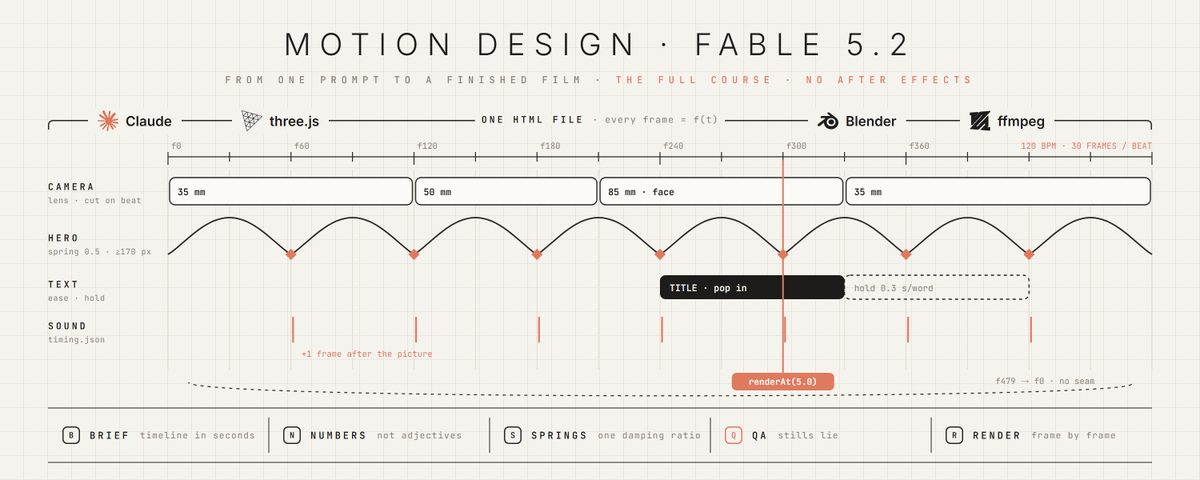
I haven't opened After Effects in months, these 18 GitHub repos replaced it
this is f*cking gold for Fable 5.2
Rebuild. Time. Paint. Glow. Sync. Caption.
reanimate → rebuild any animation you see, frame by frame
github.com/NiazMorshed2007/r…
motion-design-skill → timing and easing like a trained animator
github.com/LottieFiles/motio…
mg-styles-15 → 15 motion styles, one prompt each
github.com/Vincentwei1021/mg…
huashu-art-motion → paintings that move in 35 art styles
github.com/alchaincyf/huashu…
anidoodle → doodles and loops, all in code
github.com/alexgreensh/anido…
cinetic → launch films straight from code
github.com/Leonxlnx/cinetic
motionmaxxing → turns AI slop into designer-level motion
github.com/Tejashmakwana/mot…
Manim → turns formulas into smooth animation
github.com/ManimCommunity/ma…
blender-skills → pro Blender tricks your agent can use
github.com/EL4CTEO/blender-s…
three.quarks → particle effects that make every scene pop
github.com/Alchemist0823/thr…
react-postprocessing → the cinematic finish on every frame
github.com/pmndrs/react-post…
Tweakpane → sliders for every tiny detail
github.com/cocopon/tweakpane
EffectCraft → fast compositing, built in Rust
github.com/storytold/effectc…
Openverse → free sounds and music for every scene
api.openverse.org/v1/
librosa → finds the beat so your motion follows it
github.com/librosa/librosa
WhisperX → word-perfect captions, timed to the millisecond
github.com/m-bain/whisperX
Remotion Skills → official video skills for any coding agent
github.com/remotion-dev/skil…
FFmpeg → turns your animation into a real video file
github.com/FFmpeg/FFmpeg
See → rebuild → polish → score → export.
Bookmark this, then the guide below shows how to rebuild your first animation tonight ↓

Enterprise Software Architecture retweeted

If you open the Linux kernel source code (include/uapi/linux/reboot.h), you'll find that the low-level reboot() system call requires two magic numbers to prevent accidental reboots.
the first is 0xfee1dead.
the second, when converted to hexadecimal, is literally Linus Torvalds's birthday: 0x28121969 (28 December 1969).
and it gets better. the kernel accepts three additional values for the second magic number. they encode the birthdays of his three daughters.
these numbers are still in the Linux kernel today.

Enterprise Software Architecture retweeted

it’s over.
lossless compression has been solved.

We shrank 1 GB of Wikipedia to 105.39 MB, losslessly.
Introducing tufazip: the best entry on the Large Text Compression Benchmark using a neural network as its sole predictor. Everything above it mixes a transformer with hand-built models.
Full post 👇
tufalabs.ai/research/tufazip

Enterprise Software Architecture retweeted

🚀 A Japanese startup open-sourced a voice AI that can listen while it talks.
And you can run it locally on an NVIDIA GPU with roughly 12GB VRAM!
It hit #1 on Hugging Face’s trending models list across all categories!
This is Haru-4B from higurashi AI (@HigurashiAI).
Unlike traditional voice assistants that wait until you to stop talking before responding, Haru is designed for full-duplex conversations.
That means it can do the following ...
🎙️ Listen while speaking
🗣️ Handle interruptions
💬 Generate overlapping speech
👂 Give conversational acknowledgments
🌎 Converse across 9 primary languages
Here is the performance ...
On an Apple M1 Max MacBook, the developers report ...
⚡ 65.2ms median processing latency
🎵 One audio frame every 133ms
🚀 Custom Metal inference kernels
The architecture is based on Qwen3.5-4B, with additional audio components.
And look at the training!
🧠 40M+ hours of real speech
🗣️ 13M+ hours of full-duplex dialogue
🌍 Training speech spanning 160+ languages
Here are the local AI requirements
💻 NVIDIA GPU → ~12GB VRAM
🍎 Apple Silicon → native MLX implementation
⚙️ GPU serving → vLLM-Omni
🔓 Apache 2.0 weights AND inference code
📦 ~10.5GB BF16 checkpoint
It even supports custom characters and voices using reference audio.
Video Source: @HigurashiAI
Enterprise Software Architecture retweeted
libracoder/kiri: A small, fast container runtime for macOS, Windows and Linux with free Ngrok alternative github.com/libracoder/kiri

Enterprise Software Architecture retweeted

Hard to overstate how big of a deal this is.
tl;dr — ANY unpatched Linux server with even a single TCP port exposed to the internet (say for HTTP or SSH) and MPTCP active (default for many Go web servers) is vulnerable to complete takeover.

What a disaster atlasum.net/blog/cve-2026-98…

Enterprise Software Architecture retweeted

I found that Windows starts to collect your coding agent usage information. Windows 11 build 26200.9974 checks codex.exe, claude.exe, copilot.exe, cursor.exe, antigravity.exe, github.exe and agy.exe through MissionControlAggregator, then reports agent bitsets in ETW.


